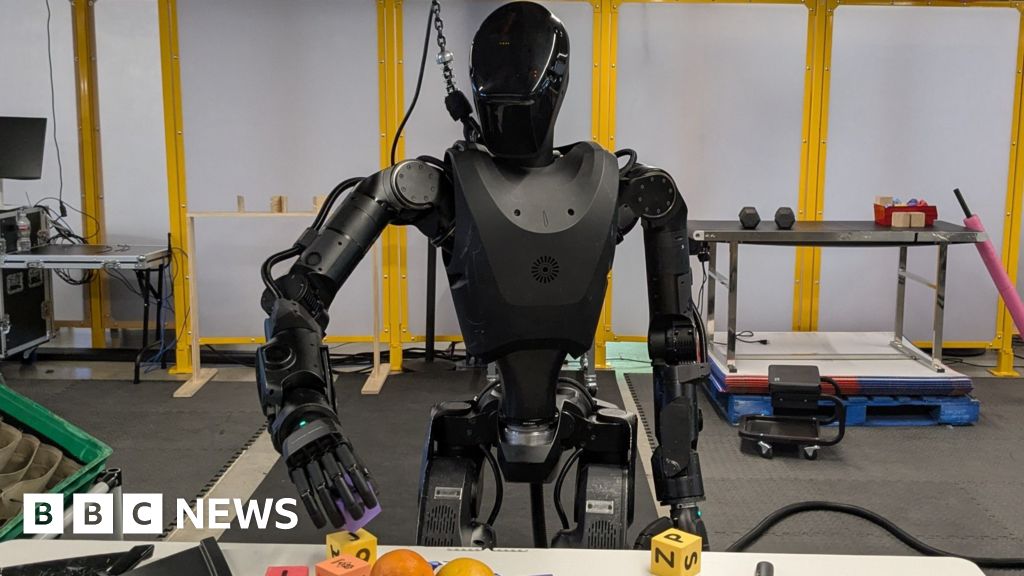
The battlefield of the future may include humanoid robots alongside soldiers, handling dangerous tasks from supply runs to direct combat. That is the vision of two-year-old startup Foundation Robotics, which is developing the Phantom humanoid robot for military and civilian use, as reported by the BBC. The company aims to reduce human casualties by deploying AI-driven robots in harm's way.
The Phantom Robot: From Blocks to Battlefield
When BBC journalist Zoe Corbyn visited Foundation's San Francisco facility, the Phantom MK-1 robot was not performing combat drills but manipulating colored kids' blocks. "We need data from it just interacting with its environment…[and] this is today's menu," explained co-founder and CEO Sankaet Pathak. The 80kg robot, covered in steel, is designed for a broad range of defense applications. According to Pathak, Foundation claims it is the only US firm developing humanoids specifically for defense.
The current MK-1 model has significant limitations: it lacks a battery, is not dust or waterproof, and cannot get back up if it falls. A second-generation model, Phantom MK-2, is under construction. Pathak says it will be element-proof, have a large battery providing about six hours of runtime, be able to recover from falls, and withstand more force. Better hands with wrists that help it fire weapons are also planned.
Use Cases: Support and Weaponization
Foundation envisions two categories of military roles: support and frontline. Support tasks include:
- Supply pickup
- Reconnaissance
- Recovery of equipment or casualties
- Hazard inspection
More controversially, the robot could be used for "frontline weaponisation" – engaging and neutralizing threats. Pathak argues that arming robots keeps human soldiers out of danger, especially in situations like building searches where "chokepoints can be lethal." He claims land-based autonomy can be more precise than autonomous airstrikes, potentially reducing collateral damage.
The company has $24m (£18m) in research contracts to pilot its technology with the US military and two units currently being tested by the Ukrainian military. The US pilot is limited to handling rather than firing weapons, though weaponisation is part of Ukraine testing, Pathak said.
Funding, Production Targets, and Competition
Foundation's goal is to produce at least 40,000 units a year by end of 2027 with long-term costs under $20,000 (£15,000) each. The military interest is clear: Dean Fankhauser at humanoid robotics advisory firm Robozaps pointed to a current US Army contest for humanoids that could eventually support soldiers across a wide range of tasks. He called it "completely inevitable" that a company would see a business opportunity in weaponising the technology. Pathak disagreed, arguing it is dangerous that more firms aren't following Foundation's lead.
Technology Comparison: MK-1 vs MK-2
| Feature | Phantom MK-1 | Phantom MK-2 (planned) |
|---|---|---|
| Battery | None | Large, ~6 hours runtime |
| Environment | Not dust/waterproof | Element-proof |
| Recovery after fall | Cannot get up | Can recover and withstand more force |
| Hand dexterity | Basic | Improved, wrists for weapon firing |
Ethical Considerations
The BBC article notes ethical questions surrounding autonomous weapons. Pathak envisions "hundreds of thousands" of AI-driven humanoid robots forming a ground force, matching the growing use of autonomous drones. A fleet like that, he says, could be "a major deterrent to conflict." However, the report does not provide independent expert criticism on ethics beyond the inherent controversy.
For enterprise technology leaders, the development signals a shift in defense procurement toward embodied AI systems that could eventually find applications in industrial logistics, disaster response, and hazardous environment inspection. Foundation's approach, combining civilian block-stacking data collection with military contracts, illustrates a dual-use path that may accelerate humanoid robot deployment in both sectors.
Sources: