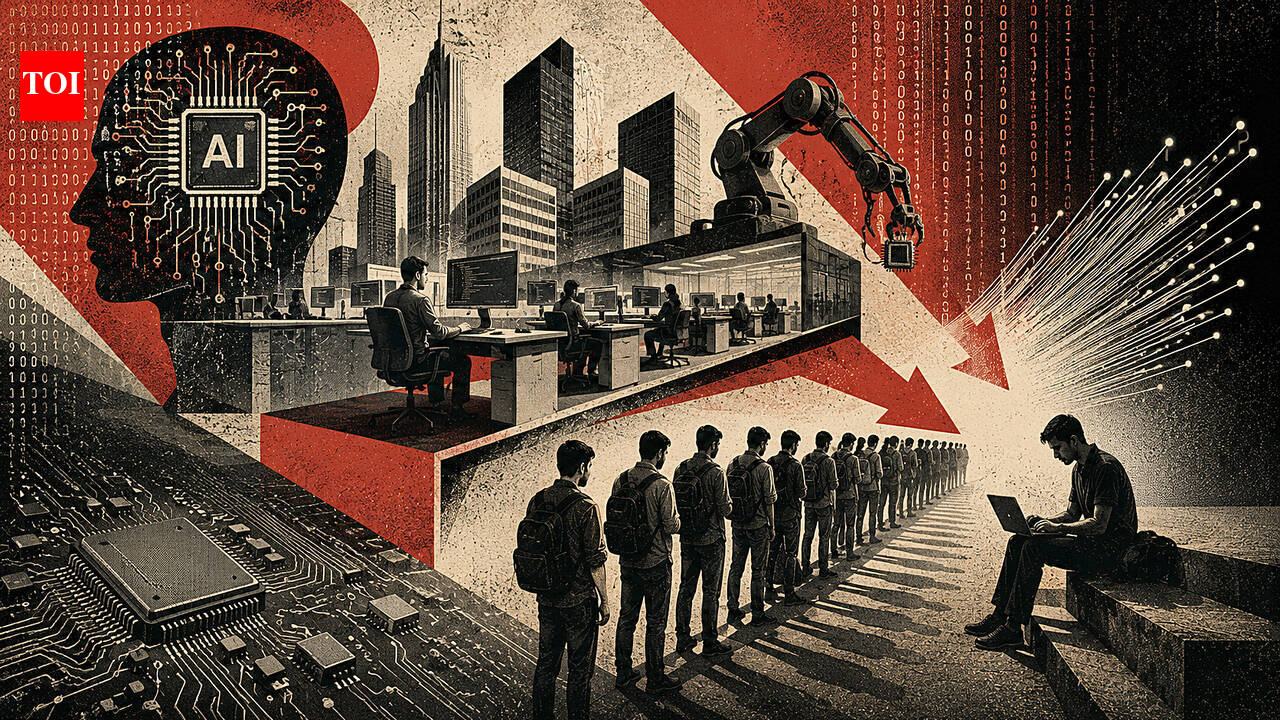
India's IT sector, a major employer of engineering graduates, is undergoing a significant hiring reset that has made the path to a first job far more uncertain. Firms including IBM, Accenture, Oracle Financial Services Software and Cognizant have informed candidates that joining timelines depend on project availability, business requirements or administrative processes, according to a report by The Times of India. This has left many engineering graduates waiting months — and sometimes more than a year — just to start work.
Fresher hiring in Indian IT: fewer jobs, delayed onboarding
The trend reflects a broader reset across the sector. India's five largest IT companies cut a net 6,981 jobs in FY26 after adding 12,718 in FY25, while Nasscom estimates the industry's workforce grew by only 1.35 lakh to 5.9 million in 2026. Some green shoots have emerged: India's six largest IT companies added a net 5,400 employees in the first quarter of FY27, reversing the 7,100 reduction seen in the previous quarter. The increase was driven largely by TCS, which hired a net 9,000 employees — its biggest quarterly addition in three years. Nevertheless, for freshers the horizon remains uncertain.
| Metric | Value |
|---|---|
| Net job cuts by top 5 IT firms (FY26) | 6,981 |
| Net addition by top 5 (FY25) | 12,718 |
| Industry workforce growth (2026) | 1.35 lakh to 5.9 million |
| Net addition by top 6 firms (Q1 FY27) | 5,400 |
| Net reduction previous quarter (Q4 FY26) | 7,100 |
| TCS net hiring (Q1 FY27) | 9,000 |
AI reshapes demand for entry-level talent
The most fundamental shift is that hiring is becoming increasingly selective and project-driven rather than volume-based. Neeti Sharma, CEO of TeamLease Digital, told The Times of India: "AI is not replacing freshers, but it is changing what companies expect from them. Employers no longer want graduates who need months of training before they become productive. They want people who can start contributing with AI tools from day one." Sharma added: "The bigger shift is that companies have moved away from hiring thousands of freshers in advance and keeping them on the bench. Today, hiring is happening when projects are confirmed. That means onboarding depends more on client demand than on campus placement calendars. So, expect more selective, skill-based hiring rather than widespread offer rollbacks."
Anil Ethanur, Co-founder of staffing firm Xpheno, noted: "As AI impact is highest at rule-based entry-level work in tech, the need for and relevance of high-volume entry-level talent has become increasingly questionable. The visible drop in fresher intakes over the last 2 cycles endorses the fact that AI is reshaping hiring plans, intake volumes and velocity."
Skills in demand: AI, cloud, cybersecurity
Freshers now account for around 15% of hiring, down from nearly 28% a few years ago, as companies focus more on AI, cloud, data and automation skills. Hiring is also moving away from simply looking at degrees to evaluating whether candidates can apply AI in real business situations. HR experts say that hiring is increasingly focused on AI, data engineering, cybersecurity and other specialised skills. The traditional volume-driven campus recruitment model is giving way to selective, demand-led hiring centred on AI-ready talent.
Experts believe that high-volume entry-level hiring is becoming a thing of the past. As Ethanur put it, "The overall state of fresher intakes over the last 2 cycles endorses the fact that AI is reshaping hiring plans, intake volumes and velocity." For enterprise technology buyers, this means the talent pool will be more specialised and AI-proficient — but also smaller and harder to access for traditional roles.
Sources: