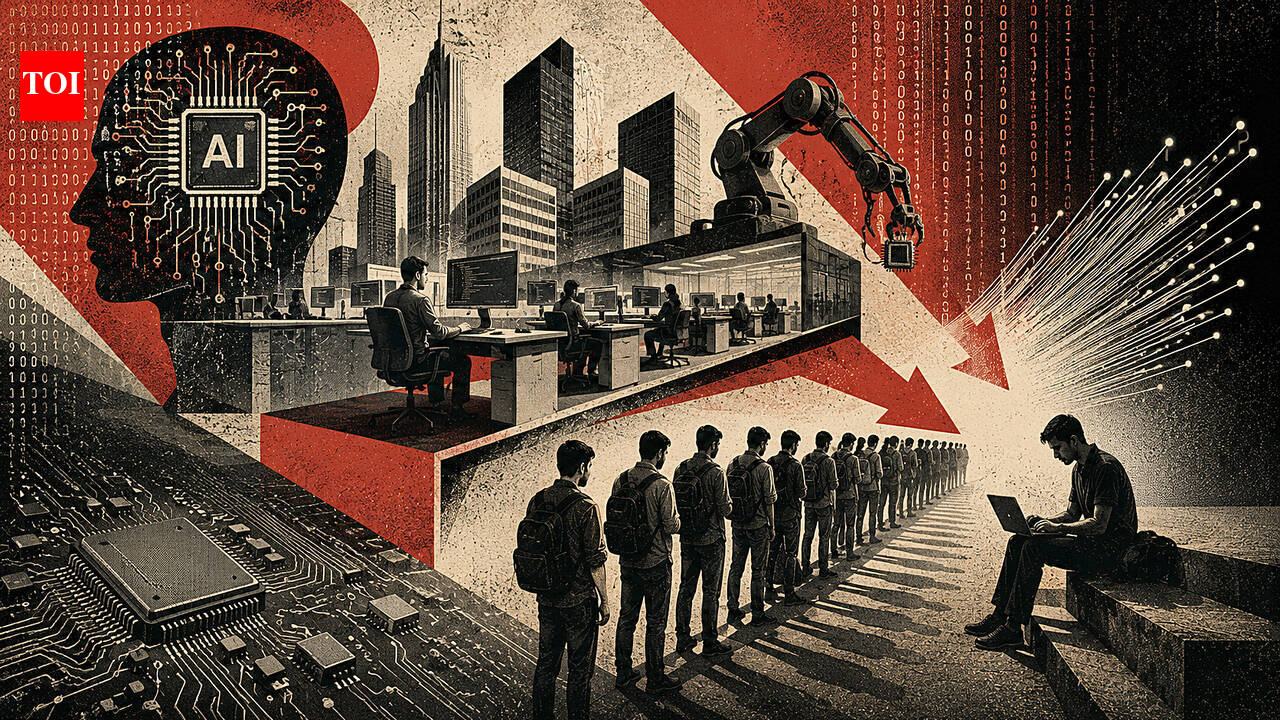
Is artificial intelligence taking away jobs or is it leading to hirings? A new report by Nomura Holdings Inc suggests that in India, AI is creating more jobs than cuts. According to the report by Nomura economists Sonal Varma and Si Ying Toh, India — long regarded as the global back office for multinational companies — is becoming an important barometer for measuring AI's impact on employment, experiencing the "largest absolute impact" of AI across layoffs, hiring freezes and recruitment, and making it "ground zero" for evaluating how the technology is reshaping work.
India's AI Job Math
The report examined 69 AI-related developments across Asia, most occurring between 2022 and August 2026. According to Bloomberg, the study found that India added 83,100 AI-related jobs during the period, compared with 31,921 positions lost through layoffs and attrition. Across Asia, AI-related recruitment reached 130,758 positions, with technology accounting for more than 90% of those hires. During the same period, 60,654 jobs were lost, of which roughly 60% were in the financial services sector.
| Indicator | India | Asia (study period) |
|---|---|---|
| AI-related jobs added | 83,100 | 130,758 |
| Jobs lost (layoffs and attrition) | 31,921 | 60,654 |
| Technology share of AI recruitment | Not stated in report | More than 90% |
| Financial services share of job losses | Not stated in report | Roughly 60% |
Most firing cases are support teams replaced by chatbots, while most hiring cases are of IT-services graduates that firms explicitly credit to AI demand. — Nomura economists Sonal Varma and Si Ying Toh, as reported by Bloomberg
A Two-Tier Labour Market
The report said the growing adoption of AI is producing a two-tier labour market in economies such as India and Korea. While demand for entry-level workers is weakening, employers are increasingly seeking experienced professionals with a stronger understanding of business operations. The economists noted that these findings "runs counter to the narrative of massive job losses due to growing AI adoption" and indicate that, in the initial phase of the AI revolution, employment creation has more than compensated for worker displacement. The trend is visible not only in major economies such as India and China, but also in the Philippines, where business process outsourcing is a significant contributor to the labour market.
However, the report cautioned that overall figures conceal an uneven impact. "Since displaced workers rarely transition to AI engineering roles, the aggregates do mask distributional pain," the Nomura economists wrote. They also noted the analysis should be viewed as an indication of broader labour market trends rather than an absolute measure of employment, since Asia's labour markets remain fragmented and the study relied on news reports.
Nilekani: India's Opportunity Is in Applied AI
Meanwhile, Infosys co-founder and chairman Nandan Nilekani said India is well positioned to capture significant gains in productivity and inclusion from AI over the coming decade, even though the country currently has limited presence in semiconductors, AI infrastructure and large language models (LLMs). Speaking at the India Policy Forum, Nilekani said India's biggest opportunity lies in applying AI at scale rather than competing in foundational technologies.
It's in the area of applied AI, that India will become a leader. We will become the AI use case capital of the world because we will actually deploy AI and make it useful, not just for a few businesses or a few people, but make it accessible and useful to a billion Indians. Applying AI to change the lives of Indians and population scale, just like we did with DPI (digital public infrastructure), is really where it's going to go. — Nandan Nilekani, at the India Policy Forum
Nilekani, who also serves as chairman of think tank NCAER, said AI is likely to have a significant impact on employment at large companies.
What Enterprise Technology Leaders Should Watch
For CTOs and digital transformation leaders, the Nomura findings offer a data point on AI's net headcount impact: in aggregate, AI-related hiring currently outpaces displacement. But the report's two-tier market warning matters for workforce planning — firms are replacing support teams with chatbots while paying a premium for experienced hires who can connect AI to business operations. The heavy concentration of job losses in financial services also signals where automation is biting first, even as technology and IT-services firms continue to hire AI-related talent. As Nomura's economists put it, the aggregate numbers mask "distributional pain," so leaders planning AI deployments should weigh both the hiring upside and the retraining burden on displaced workers.
Sources: