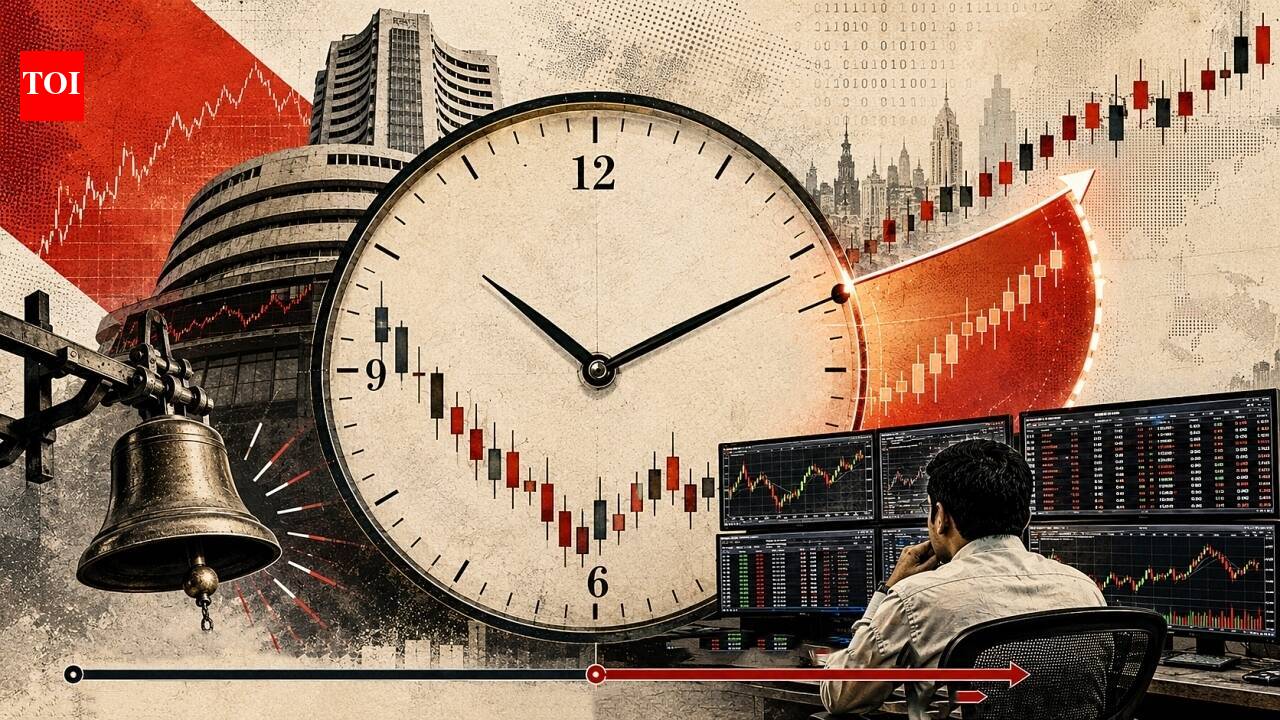
Indian stock exchanges are shifting to a new closing-time framework from today, introducing three separate end-of-day timelines for different categories of securities, according to a report by the TOI Business Desk. Continuous trading in stocks with futures and options (F&O) contracts will now conclude at 3:15 p.m., after which these stocks enter a Closing Auction Session (CAS). Stocks that are not part of the CAS framework will continue trading until 3:30 p.m., while trading in index and stock derivatives will remain open until 3:40 p.m.
What changes from today
The revised schedule creates three distinct closing times, the report said:
| Security category | Closing time | How closing price is determined |
|---|---|---|
| Stocks with listed F&O contracts | Continuous trading ends 3:15 p.m.; auction runs to 3:35 p.m. | Orders matched at a single equilibrium price in the Closing Auction Session |
| Securities outside the CAS framework | 3:30 p.m. | Existing methodology based on 30-minute volume-weighted average price (VWAP) |
| Index and stock derivatives | 3:40 p.m. | — |
Key detail: Under the revised framework, all buy and sell orders in eligible stocks are collected during the auction and matched at a single equilibrium price, according to an ET report carried by the TOI Business Desk.
Rationale behind the change
The CAS is designed to concentrate liquidity at the end of the trading day, the report said. It aims to facilitate smoother execution of large orders and generate a closing price that more accurately reflects overall market demand and supply.
The move also addresses a specific problem for passive investors. Index-tracking passive funds often execute sizable trades near the close to match benchmark closing prices. Such transactions can move prices during continuous trading and increase tracking error. By aggregating orders into a single auction, large buyers and sellers can execute trades more efficiently at one common price.
The revised framework is also designed to reduce the influence of large last-minute orders on closing prices of stocks and benchmark indices. Similar closing auction mechanisms are already in place at several major global exchanges, including the New York Stock Exchange and the London Stock Exchange, according to the report.
How the Closing Auction Session works
For F&O-linked stocks, trading does not stop completely at 3:15 p.m. — only continuous trading ends, following which a 20-minute auction takes place until 3:35 p.m. to establish the official closing price. The sequence is as follows:
- 3:00 p.m. to 3:15 p.m.: Exchanges calculate the VWAP for each eligible stock, which serves as the reference price for the CAS.
- 3:15 p.m. to 3:20 p.m.: A five-minute transition period during which no fresh orders can be entered. Most open limit orders from the continuous session will automatically carry over; stop-loss orders, iceberg orders, and orders placed outside the permitted CAS price band will lapse. The permissible price range for the auction is set at 3% above or below the reference price.
- 3:20 p.m. to 3:25 p.m.: Investors can place both market and limit orders. Exchanges publish auction information, including the indicative equilibrium price, cumulative buy and sell quantities, order imbalances, and indicative index values.
- 3:25 p.m. to 3:30 p.m.: Only limit orders can be submitted. Market orders placed earlier cannot be modified or cancelled during this stage.
- Random close: The order entry window closes at a randomly selected time between 3:28 p.m. and 3:30 p.m.
Impact on investors
The official closing price is a key market benchmark, the report said. It is used to calculate indices such as the Nifty and Sensex, determine the net asset value (NAV) of mutual funds, settle derivative contracts on expiry, value pledged securities, and compute portfolio profit and loss.
At present, a stock's closing price is calculated using the VWAP of all trades executed during the final 30 minutes of continuous trading. Under the new framework, the CAS will replace that mechanism for eligible F&O-linked stocks, with all orders matched at a single equilibrium price.
The initial phase applies only to stocks with listed derivative contracts. All other securities will continue to follow the existing closing price methodology based on the 30-minute VWAP, in line with a SEBI circular. So while the market now operates with multiple closing times, the CAS change is phased in, leaving the calculation method for most non-derivative securities unchanged for now.
Sources: