
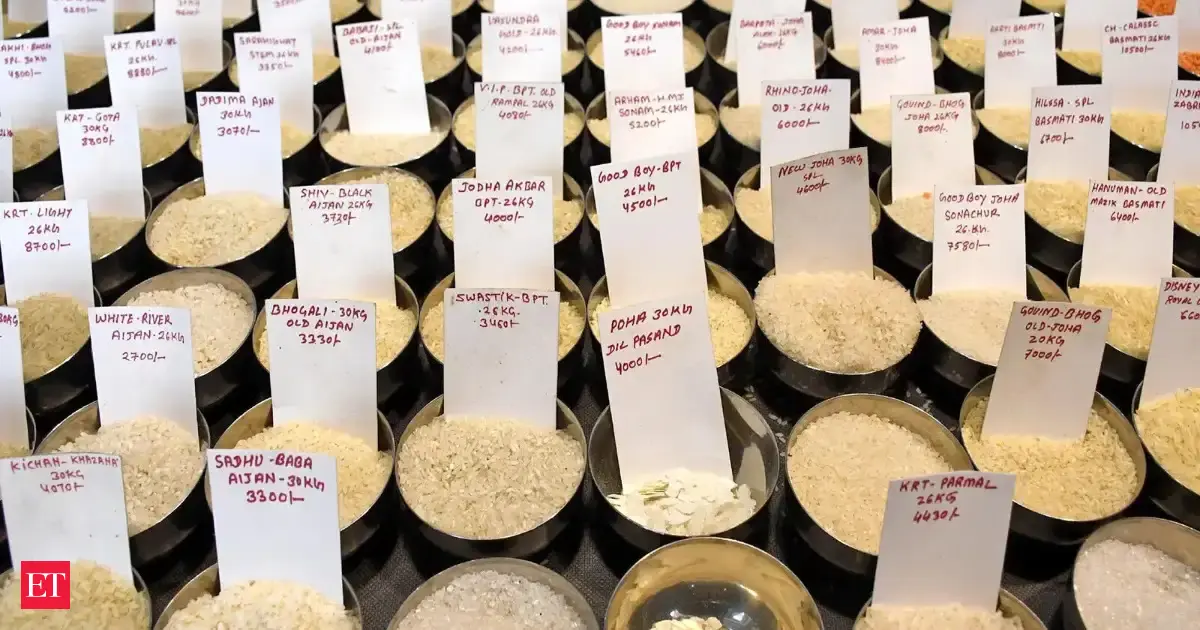
India's rice exports to a 26-market basket reached Rs 23,476 crore, with volumes touching 4.79 million tonnes during the five-month period, exceeding the average for the corresponding November-March window of the preceding three years, according to Economic Times – Foreign Trade. Eleven of the 26 target countries recorded year-on-year growth in both export value and volume, the report said.
Export performance across 26 target markets
The strongest growth was recorded in the UAE, where rice export value increased 65% year-on-year and volume rose 64%, according to the report. Belgium registered a 53.8% rise in export value and 44.5% growth in volume, while Germany recorded 33.5% and 24.6% growth, respectively.
| Market | Export value (YoY, %) | Export volume (YoY, %) |
|---|---|---|
| UAE | +65.0 | +64.0 |
| Belgium | +53.8 | +44.5 |
| Germany | +33.5 | +24.6 |
| France | +31.3 | Not reported |
| United Kingdom | +26.9 | Not reported |
| South Africa | +26.0 | Not reported |
| Kenya | +22.3 | Not reported |
| Mexico | +22.1 | Not reported |
| Netherlands | +20.5 | Not reported |
| Canada | +10.2 | Not reported |
| Senegal | +5.3 | +29.9 |
The report also cited export value growth of 27.2% and volume growth of 26.3% between November 2025 and March 2026, adding that all three markets involved recorded their highest November-March export levels in the four-year period examined.
Supply-side context: diversifying beyond conventional destinations
India is seeking to diversify its rice export markets amid substantial domestic production and the need to develop demand beyond conventional destinations, the report said. The strategy is increasingly focused on demonstrating how specific Indian rice varieties can meet the requirements of established international cuisines, rather than competing only on price or volume.
BIRC 2026: moving from volume-led to application-led growth
BIRC 2026 is being positioned as a market-development platform aimed at moving India's rice export story from volume-led growth towards application-led diversification. With a wide range of rice varieties and substantial production capacity, India is seeking to position individual grains according to the functional requirements of different cuisines and markets, according to Economic Times – Foreign Trade.
As part of the conference, ITC Hotels will curate a Global Rice Festival featuring 24 international dishes and 10 regional Indian biryanis, with Indian rice varieties selected based on characteristics such as aroma, texture, starch, grain length and absorption.
BIRC 2026 will broaden the focus beyond exporters, millers and international buyers to include chefs, food creators and consumers through programmes such as a Master Chef Contest, Influencer Cook-off, Family Day and public tastings. The objective, the report said, is to connect trade promotion with consumer acceptance and build sustained demand for Indian rice varieties.
Reading the data: growth, but no proven causal link
The Economic Times noted that the data does not establish a direct causal link between BIRC 2025 and the subsequent rise in exports, as trade flows are also influenced by prices, inventories, currency movements, import policies, freight costs and broader demand conditions. The post-BIRC performance nevertheless indicates traction in several markets where buyer engagement and culinary applications were simultaneously being promoted.
For commodity traders and procurement teams, the latest figures point to a geographically broader rice export market even as India's domestic production base remains substantial, according to the report. The same source cautions that trade flows will continue to depend on prices, inventories, currency movements, import policies, freight costs and demand conditions — factors that procurement desks need to weigh as BIRC 2026 shifts promotion towards chefs, food creators and consumers.
Sources:


