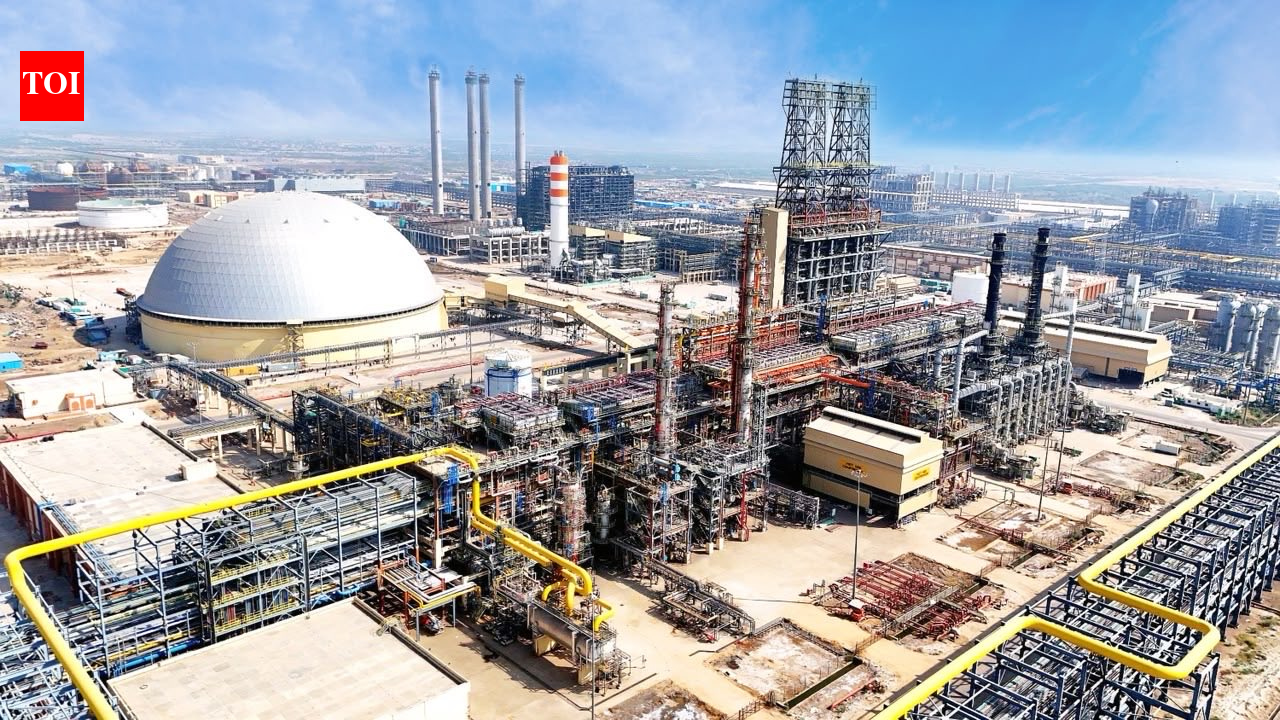
Prime Minister Narendra Modi on Saturday inaugurated the HPCL Rajasthan Refinery Limited (HRRL) project, India's first greenfield integrated refinery-cum-petrochemical complex, as part of a broader push to strengthen the country's energy security following the recent Strait of Hormuz disruption. According to the Times of India, Modi also launched and laid the foundation stone for development projects worth approximately Rs 1.06 lakh crore across petrochemicals, urban transport, railways, roads, renewable energy, and power transmission.
Strategic Significance for India's Energy Security
The inauguration comes at a time when India, which imports more than 85% of its crude oil, faces heightened supply risks. The HRRL refinery's ability to process multiple grades of crude gives India greater flexibility to source oil from Russia, the Gulf, the United States, and other suppliers, depending on prices and geopolitical developments, according to the Times of India. Calling the refinery a major milestone for Rajasthan, PM Modi said it reflected the importance of self-reliance. "Every particle of this land has taught us the importance of self-respect. Self-respect is possible only when one is self-reliant," he said, adding that the project would create employment for thousands while marking "a major step" towards making Rajasthan self-reliant.
Refining Capacity Expansion Amid Global Decline
Union Petroleum and Natural Gas Minister Hardeep Singh Puri described the refinery as far more than an infrastructure project, stating it would generate employment, bring prosperity, and enhance India's self-reliance. Puri compared India's refining expansion to global trends, noting that no greenfield refinery had been built in the United States in the last 50 years, while Europe's refining capacity continues to decline. According to Puri, India's refining capacity is set to increase from around 270 million metric tonnes per annum (MMTPA) to between 310 and 320 MMTPA by 2030. He also highlighted that Europe's capacity is declining by 220,000 barrels per day, and by 2030 it will stand at 75 million metric tons.
| Region | Current Status | Capacity Outlook |
|---|---|---|
| India | ~270 MMTPA (present) | 310-320 MMTPA by 2030 |
| United States | No new greenfield refinery in 50 years | No expansion |
| Europe | Declining by 220,000 bpd | 75 million metric tons by 2030 |
Lessons from the Strait of Hormuz Disruption
Puri said the recent disruption around the Strait of Hormuz demonstrated why expanding India's refining capabilities had become strategically important. He noted that nearly 60% of India's LPG requirement was met through imports, with 90% of those supplies passing through Hormuz before "war conditions brought that supply to a near-halt". The minister recalled the looming crisis and emphasised that India focused on leveraging its refinery capacity to navigate the disruption. PM Modi added that the Middle East conflict created one of the biggest energy crises of the 21st century, but India was able to navigate it due to timely decisions and diplomatic strength.
"You can imagine the massive crisis that was looming over our country... As soon as the crisis began, we focused on leveraging our refinery capabilities." — Hardeep Singh Puri (as reported by Times of India)
The HRRL project, located in Pachpadra, Rajasthan, represents a direct response to the vulnerabilities exposed by the Hormuz crisis. For commodity traders and energy analysts, India's expanding refining capacity (from 270 to 310+ MMTPA) signals sustained demand for diverse crude grades and a structural shift away from heavy reliance on single chokepoints. Polypropylene and other petrochemical output from the integrated complex will further support manufacturing and export markets, potentially altering trade flows in refined products across Asia.
Sources: