
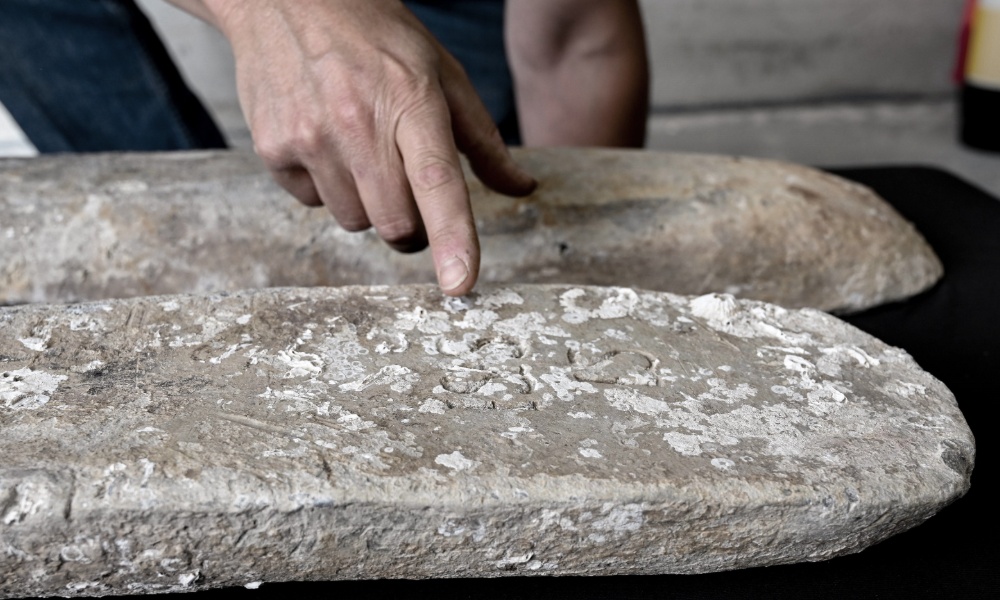
Three historic lead ingots dating to the late 17th or early 18th century were discovered during survey work on Ørsted’s Hornsea 3 offshore wind farm in the North Sea, according to Splash247. The ingots were found on the seabed alongside the remains of a wooden shipwreck, which likely transported them.
Discovery and Recovery
In cooperation with Ørsted, Historic England, and the Maritime and Coastguard Agency, MSDS Marine—a specialist marine and coastal contractor offering archaeological solutions—helped investigate, recover, and analyse the artefacts. MSDS Marine was contracted by Ørsted as archaeological advisors when the ingots were identified during investigations on potential unexploded ordnance locations, the source reported. Little structure remained of the wooden wreck, but some timbers could be seen underneath the ingots. It is common for cargo to be the only visible remains of wooden-hulled shipwrecks due to the dynamic underwater environment and shipworms, which eat away at exposed timber. The ingots were collected by a remotely operated vehicle for further investigation.
Archaeological Significance
The three ingots weigh around 70 kg each. Following recovery and recording, they will be housed at the Peak District Lead Mining Museum in Matlock, Derbyshire. This marks a return home, as the lead from which they were made may have been mined in the same area. Each ingot is stamped with a different mark, similar to those found on the wreck of the Dutch East India Company ship Kennemerland (1664), which sank off the coast of Shetland. The shape of the three ingots resembles those from other 18th-century shipwrecks, including the Zuiddorp, a Dutch East India Company vessel that sank off the coast of Western Australia in 1712, Splash247 noted.
"In creating the future with the Hornsea 3 Offshore Wind Farm, we’re also careful to acknowledge and preserve the past. There’s so much rich history attached to our onshore and offshore sites, which are a valuable part of the UK story. We want to ensure that it is protected and celebrated," said Luke Bridgman, managing director of Hornsea 3.
"It has been fascinating to see this story unfold, from the point of discovering the ingots through to seeing them being put on display at the Peak District Mining Museum. There’s so much to learn from historic shipwrecks and cargoes that are discovered during offshore development, and this shows the positive way we’ve all worked together to explore and study this shipwreck," added Christopher Pater, head of marine planning at Historic England.
Trade Route and Economic Context
The ingots provide a glimpse into historic trade routes, England’s once-thriving lead industry, and the maritime connections that shaped Europe’s economy. Lead was an important material in historic times due to its versatility, used in products from plumbing pipes to weaponry. It was formed into ingots for easier transport. The wreck found at Hornsea 3 lies directly on the route from Hull to the Netherlands. At the time, England produced vast quantities of lead, particularly from mines in Derbyshire and the Peak District, and there was a healthy trade in ingots shipped from Hull and London to Amsterdam and Rotterdam. The vessel may have been Dutch en route to the Netherlands, Splash247 reported.
Implications for the Commodity Industry
For the lead and metals commodity community, such archaeological finds offer rare insights into historical lead production and trade patterns. Ingots discovered on shipwrecks are often some of the only remaining examples of their type, as ingots were typically melted down. These artefacts can help provide important information about their production and trade at the time. The discovery highlights the enduring value of lead as a commodity across centuries, though no current market prices or supply data were mentioned in the source.
Hornsea 3 Wind Farm
When constructed, Hornsea 3 will be the world’s largest offshore wind farm, capable of generating 2.9 GW of clean energy, enough to power more than 3.3 million UK homes. The wind farm development, while focused on renewable energy, also led to this significant historical find.
| Attribute | Detail |
|---|---|
| Number of ingots | 3 |
| Weight each | ~70 kg |
| Estimated age | Late 17th / early 18th century |
| Origin of lead | Possibly Derbyshire / Peak District, England |
| Likely destination | Netherlands (Amsterdam / Rotterdam) |
| Shipwreck location | North Sea, on route from Hull to Netherlands |
| Museum destination | Peak District Lead Mining Museum, Matlock, Derbyshire |
| Wind farm capacity | 2.9 GW, enough for 3.3 million UK homes |
Sources:


