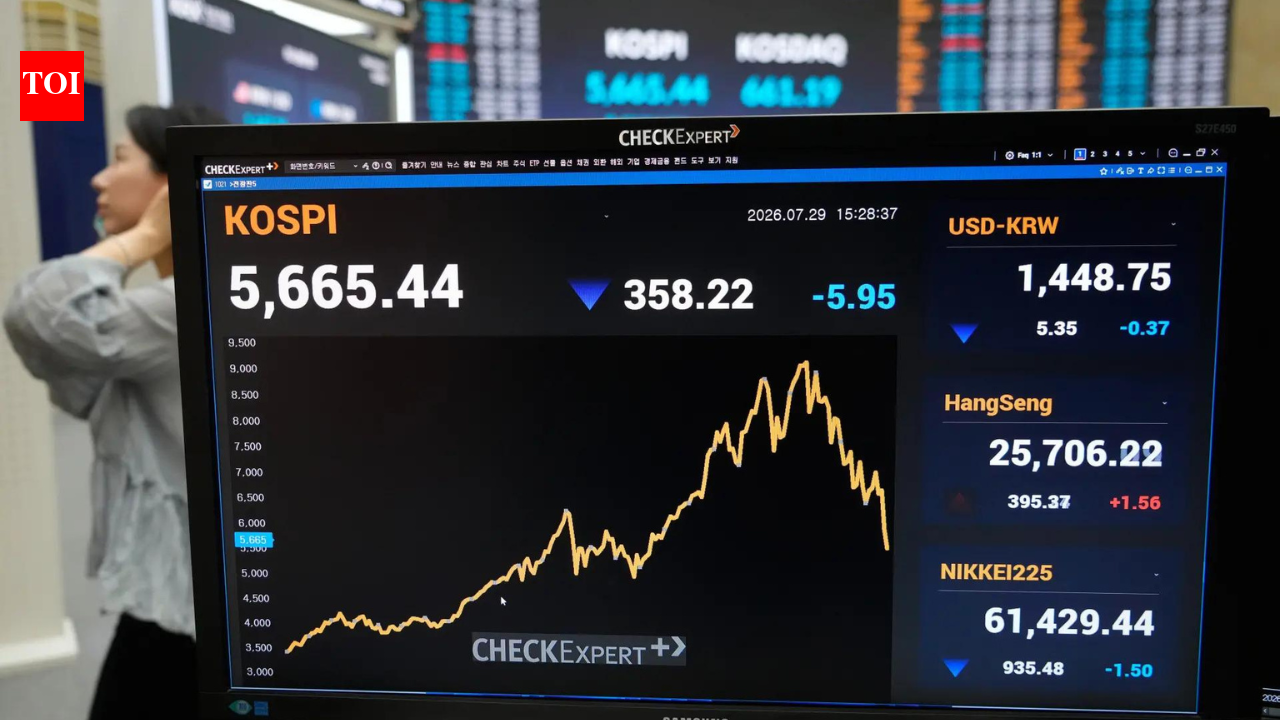
Asian equities were mixed on Thursday as investors weighed the Federal Reserve's decision to hold interest rates steady and a volatile week marked by an AI-driven sell-off. South Korea's Kospi surged 201.22 points to 5,864.46, up 3.55%, while China's Shenzhen index dropped 299.165 points to 13,359.279, falling 2.19%, according to the Business-Today report.
Mixed Asian Market Performance
Taiwan's benchmark climbed 666.47 points to 40,705.65, up 1.66%. Japan's Nikkei rose 881.37 points to 62,315.56, up 1.43%, but remained on track for a weekly decline of 3%. In Hong Kong, the Hang Seng slipped 34.84 points to 25,773.08, down 0.13%. Mainland China's Shanghai lost 12.14 points to 3,816.329, down 0.32%. Elsewhere, Australia's ASX 200 fell 0.48%, Singapore's STI eased 0.64%, Malaysia's benchmark dropped 0.15%, and New Zealand's NZX 50 fell 1.43%.
| Index | Level | Change (points) | % Change |
|---|---|---|---|
| Taiwan Weighted | 40,705.65 | +666.47 | +1.66% |
| Kospi (South Korea) | 5,864.46 | +201.22 | +3.55% |
| Nikkei 225 (Japan) | 62,315.56 | +881.37 | +1.43% |
| Hang Seng (Hong Kong) | 25,773.08 | -34.84 | -0.13% |
| Shanghai Composite | 3,816.329 | -12.14 | -0.32% |
| Shenzhen Composite | 13,359.279 | -299.165 | -2.19% |
South Korea's equity market has been at the center of investor concerns after more than $2 trillion was wiped off the country's stock market this week, the report noted. The sell-off, concentrated in chipmakers, has fueled worries over whether massive investments in artificial intelligence will generate adequate returns. The decline was severe enough for Finance Minister Koo Yun-cheol to apologize for the introduction of single-stock leveraged ETFs.
Fed Decision and Bond Market Reaction
The Federal Reserve left interest rates unchanged, but its policy decision did little to settle markets. Instead, the split within the central bank left investors debating whether further rate hikes remain on the table, according to the report. At his post-meeting press conference, Fed Chair Kevin Warsh reiterated the central bank's commitment to tackling inflation but refrained from signaling its next move. He pointed to the rise in bond yields since the previous policy meeting, saying markets had already priced in tighter financial conditions, while noting that did not necessarily require the Fed to act.
The uncertainty was reflected in the bond market, where longer-dated treasury yields climbed to their highest levels in 19 years. The 30-year treasury yield stood at 5.2039% after touching 5.2273%, its highest level since June 2007. The dollar also weakened following the policy announcement.
Investor Sentiment and Expert Views
Despite the rebound, caution persists. Gina Kim, portfolio manager for emerging market equities at Nordea Asset Management in Singapore, told Reuters: "Given that the fundamental thesis remains intact, there does appear to be an irrational, panic-like element to the current selling." She added: "I cannot comment on when the panic will stop as such but some indicators to look out for would be margin balances in both Taiwan and Korea for retail investors. Both are declining but we would ideally need to see some levelling off."
Samsung Electronics offered some support to market sentiment after reporting a record second-quarter operating profit, up 19-fold from a year earlier, according to the report.
Commodities and Geopolitical Tensions
In commodities, Brent crude slipped back below $90 a barrel after jumping more than 7% in the previous session as fighting in the Middle East intensified. Despite continued missile and drone attacks, tanker traffic out of the region has continued, according to available data, easing some immediate supply concerns.
Implications for Trade Finance and Capital Costs
For CFOs, treasury directors, and trade finance professionals, the mixed trading environment and Fed's stance have direct implications. The Fed's hold on rates and the split over future hikes create uncertainty in the cost of capital for trade finance. The dollar's weakening could reduce hedging costs for non-US importers but increase FX exposure for exporters. Meanwhile, the spike in 30-year treasury yields to 19-year highs signals higher long-term borrowing costs, affecting project finance and sovereign debt markets. The $2 trillion wipeout in South Korea, concentrated in chipmakers, highlights sector-specific risks that trade finance providers must monitor closely. The recovery in Kospi and Nikkei may be short-lived if AI investment returns remain in doubt, as indicated by the ongoing panic selling.
Sources: