Lufthansa Cargo delivered €1 billion ($1.2 billion) in second-quarter revenue, up 27% year over year, driven by AI hardware shipments and strong Asia demand, according to FreightWaves.
The cargo division of Deutsche Lufthansa AG (FRA: LHA) posted a 26% gain in adjusted operating profit in the quarter, FreightWaves reported, as strong shipping demand in Asia and from AI-driven cloud service providers boosted results despite volatile market conditions and higher fuel costs associated with the U.S.-Iran war. In recent months, Lufthansa Cargo launched a full-service, cross-border e-commerce logistics subsidiary through the merger of two in-house companies and completed the first phase of a modernization project at its main hub at Frankfurt airport, according to the report.
Financial results
FreightWaves reported the following figures for the second quarter and first half:
| Metric | Result |
|---|---|
| Q2 revenue | +27% year over year to €1B ($1.2B) |
| Q2 operating income | +26% to $1.21B |
| Q2 adjusted operating income | +58% to $133.6M |
| First-half revenue | +16% year over year |
| First-half profit margin | +2.2 points to 10.4% |
| Second-quarter demand | +3% |
| Second-quarter yields | +27% year over year |
CFO Gregor Schleussner tied the growth and new investments to the carrier’s long-term ambition. In a news release issued with Group financial results, according to FreightWaves, he said:
Companies that want to succeed in the long term must be faster, more efficient, and more adaptable than their competitors. This is why we continue to work hard to create the foundation for Lufthansa Cargo’s next phase of development through our Bold Moves strategy. Our goal is clear: by 2030, we aim to return to the ranks of the world’s top three cargo airlines.
Strategy, fleet and capacity
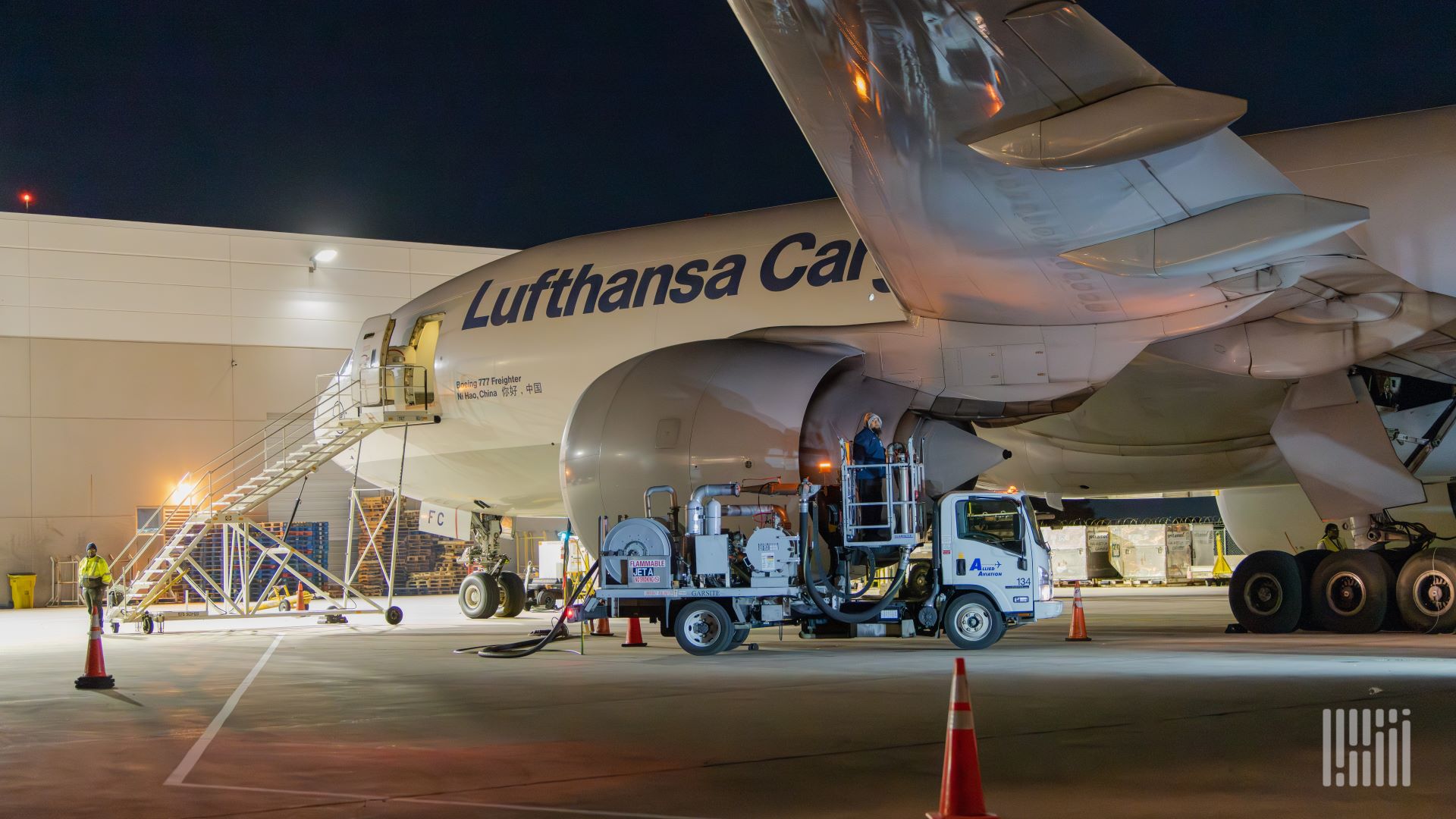
Lufthansa Cargo is currently the No. 14 carrier in the world by traffic volume, according to the International Air Transport Association (IATA). It operates 12 Boeing 777 freighter aircraft and is able to market capacity on six 777s operated by AeroLogic, a joint venture between Lufthansa and DHL Express, for a total of 18 widebody freighters under its control. It also manages the belly capacity of sister airlines Lufthansa Airlines, Austrian Airlines, Brussels Airlines, Discover Airlines and SunExpress.
FreightWaves reported on Monday that Lufthansa Cargo has quietly abandoned plans to reinstate four Airbus A321 standard-size freighters pulled from European and North Africa regional service in April. The company did not provide a reason for souring on the aircraft; analysts suspect operating and market characteristics make it difficult to fly them at a profit, according to FreightWaves.
Demand, trade lanes and yields
Second-quarter demand remained strong, up 3%, despite disruptions and economic uncertainty associated with fighting in the Middle East. According to FreightWaves, Lufthansa benefited from flight reductions at Middle Eastern competitors such as Emirates and Qatar Airways Cargo, and from a shift of some ocean freight to air as businesses sought more predictable transport. That helped produce a 27% increase in yields year over year. Fuel surcharges offset fuel expenses and brought in additional revenue, contributing to yields.
The crisis triggered a surge in demand on passenger and freighter routes to Asia. Yields to Asia and on new intra-Asia routes increased 30%, while yields to the Middle East rose even more. The company attributed profitability to an increased focus on high-margin industry sectors like pharmaceuticals, semiconductors, automotive, and artificial intelligence.
CEO Carsten Spohr said on an analyst call that moving server racks has become an industry-shaping line of business. According to FreightWaves, he said:
The increased need for transportation of server racks indeed has almost become an industry-shaping element. We are allocating and reallocating our network to serve our customers who try and who want to move server racks around the world. As you can imagine, for these high-risk and very expensive equipment, logistical costs are almost immeasurable, so this is a very profitable business. You do need freighter aircraft for this business by the sheer size of these racks.
Research from Xeneta cited by FreightWaves shows air cargo industry volumes grew 7% in June, helped by robust demand for semiconductors and AI-related hardware.
What the results mean for shippers and forwarders
The Q2 figures indicate that prioritised network reallocation and high-margin verticals, not broad-based volume growth, are driving Lufthansa Cargo’s profit. According to Spohr, capacity is being allocated and reallocated to customers moving server racks, meaning shippers of standard air freight may face tighter availability on routes where rack traffic is concentrated. Fuel surcharges, meanwhile, offset fuel expenses and added revenue, according to FreightWaves — a sign that fuel-price risk is being passed through to rates.
The shift of some ocean freight to air, as businesses sought more predictable transport, also supported double-digit yield growth. That dynamic is most visible on Asia and intra-Asia lanes, where yields rose 30%, and on Middle East lanes, where yields rose even more.
Watch list
- Fuel costs associated with the U.S.-Iran war, which Lufthansa offset with surcharges in the second quarter.
- Flight reductions at Middle East competitors such as Emirates and Qatar Airways Cargo, which pushed demand to Lufthansa.
- The pace of network reallocation toward AI server racks, a profitable but capacity-intensive cargo.
- Whether the ocean-to-air modal shift continues as shippers prioritise predictability.
- The next phases of the Bold Moves strategy and the Frankfurt airport hub modernization.
Sources: