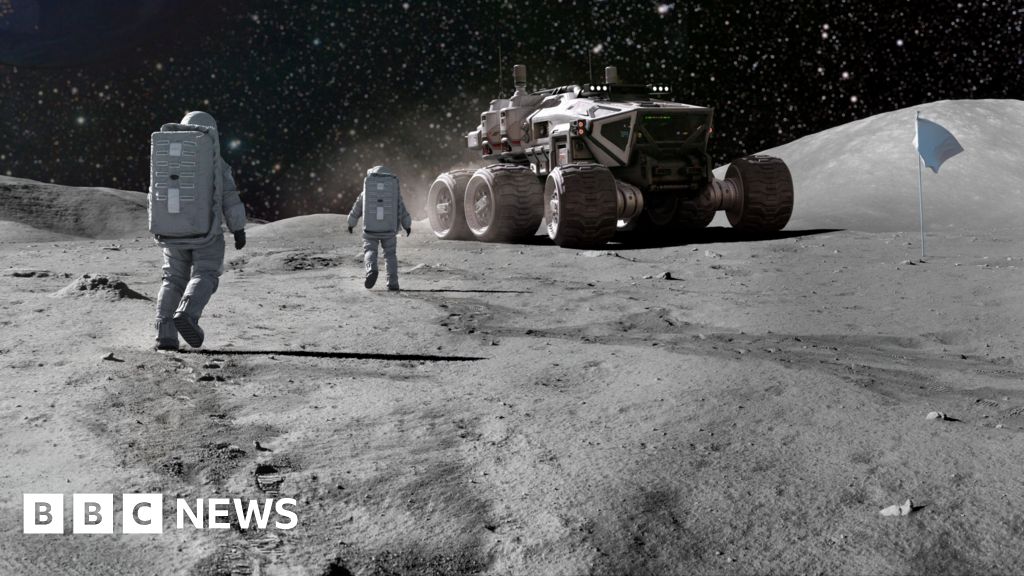
A spent SpaceX Falcon 9 upper stage is expected to crash into the Moon on August 5, and the resulting debris plume could briefly be visible from Earth with a telescope — a first for an impact on the sunlit face of the Moon, according to WIRED.
Impact Forecast: August 5, 6:34 am UTC
According to WIRED, the spent upper stage will hit the Moon's sunlit western limb near Einstein crater at more than 5,400 mph. If it unfolds as predicted, the crash could throw up a plume of debris bright enough to briefly see from Earth with the right equipment. No impact flash has ever been recorded on the sunlit face of the Moon, and that is exactly where the Falcon 9 crash is forecast to happen, kicking up plumes of dust that could stand out against the blackness of space.
The findings are based in part on two new preprint studies, WIRED reported, including one posted July 27 to arXiv and led by William Jo, a doctoral candidate at the University of Texas at Austin's Cockrell School of Engineering.
The Physics of a Hollow Metal Shell
To predict the plume, Jo ran the crash through a high-resolution physics simulation that allowed him to model what would happen when 3,900 kilograms of hollow metal hit the lunar surface, according to WIRED. That is different from solid meteorites making impact.
"It's like an empty eggshell, because it had all the fuel in it, and there is a rocket engine at one end that's denser." — David Goldstein, aerospace-engineering professor at UT Austin, who supervised the work
Rather than burrowing in like a cannonball, the shell will collapse from its edges inward, WIRED reported, throwing up a broad, low curtain of soil spreading as far as 183 kilometers wide as well as a thin, faster spike nearly straight up. All told, the crash is forecast to displace about 12,700 kilograms of debris.
Jo describes the simulation as a "best-case" model, according to WIRED. The code is two-dimensional and axisymmetric, so it can only simulate the stage coming straight down, engine-first, basically like dropping a pin on its head. But the real object — the spent stage of a Falcon 9 that carried two landers to the Moon in January 2025 — is far more likely to arrive at an angle. A glancing strike would throw up a smaller, dimmer plume, possibly without the big spike.
"I would view our study as the most optimistic in terms of generating sprays," Goldstein said.
Will the Plume Be Visible From Earth?
It's a detailed guess at the shape of the splash, but whether a plume will actually be visible from Earth is another matter, WIRED reported. Laurence Trafton, an astronomer at UT Austin, says it's possible, but hard to know until the moment of impact. Size isn't the problem: A plume reaching 50 kilometers past the limb would span about 28 arcseconds, an angle roughly one-sixteenth the apparent width of the Moon in the sky — actually, one-sixtieth, according to the source. At that size, "it can be easily resolved by a small telescope," Trafton writes in an email.
The new paper provides an estimate of where exactly to train a telescope. But contrast in the night sky could be a confounding factor. The plume will be something like 30 to 300 times fainter than the blazing Moon beside it, and scattered moonlight will only make viewing harder. Catching it will require "a very steady mount," Trafton says.
Timing will be on the observer's side. The plume should peak about 90 seconds after impact, "long enough for an observer to witness," Trafton says. Geography is not, at least depending on where you live. For anyone north of a line from Massachusetts to Texas, the Moon will hang so low that they'll be peering through more than three times the usual thickness of atmosphere, according to WIRED. That means viewers in those locations will be looking through a murky, turbulent slice of sky that could wash out any signs of the plume. The best odds of seeing any lunar fireworks — or, more accurately, debrisworks — are in the US Southeast, according to Trafton.
How the Observation Plan Came Together
Several scientists, including Bill Gray of Project Pluto who first flagged the impact, have laid out an observation plan urging professional and amateur astronomers to monitor the event, WIRED reported.
| Forecast Parameter | Value |
|---|---|
| Impact date | August 5, 6:34 am UTC |
| Impact speed | more than 5,400 mph |
| Upper stage mass | 3,900 kg |
| Predicted debris displaced | about 12,700 kg |
| Soil curtain width | up to 183 km |
| Plume height past lunar limb | 50 km |
| Plume brightness vs. Moon | 30–300 times fainter |
| Peak visibility window | about 90 seconds after impact |
Because the impact is expected on the sunlit face of the Moon, the plume must be caught at night from Earth. For observers in the US Southeast, the geometry offers the best chance, but the exact outcome will only be known at the moment of impact.
Sources: