Shipping operators deploying oxidant-based ballast water treatment systems may be unknowingly accumulating harmful chemical by-products in port waters, as existing regulations focus only on organism kill rates and chlorine discharge limits, not on the downstream chemistry of treatment by-products, according to a report by Splash247 featuring analysis by Captain Alex Byelyavtsev.
The Chemistry Behind the Problem
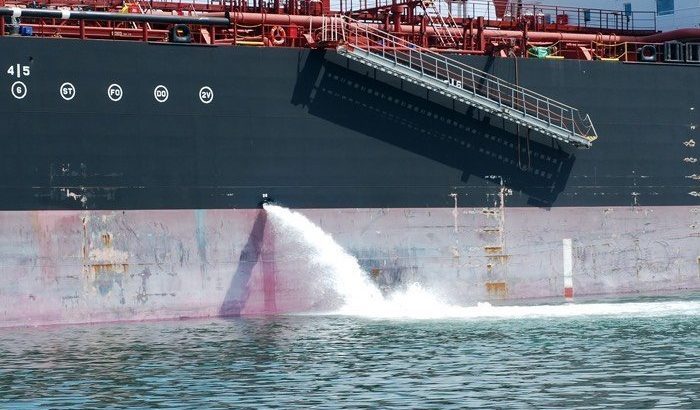
The Ballast Water Management Convention specifies that a treatment system is approved if it kills organisms in ballast water and meets concentration limits at discharge. However, Splash247 reported that ultraviolet treatment adds no chemicals, but oxidant-based systems—mainly electrochlorination—generate chlorine inside the ballast tank from seawater. That chlorine reacts with bromide and organic matter to form bromoform, bromate, chlorate, and a family of brominated acids, known as disinfection by-products.
The International Maritime Organization (IMO) and its scientific advisory group GESAMP maintain a list of these by-products. Under IMO’s Procedure (G9), manufacturers must test for them before system approval. But Splash247 noted that this risk assessment is not run against a real port; it is run against what GESAMP calls a Model Harbour, a standardised, hypothetical stand-in. Discharge limits apply only to leftover chlorine. What is not tracked is the cumulative load once systems are in commercial use.
Scale of the Blind Spot
Measuring ballast volumes is itself problematic. According to Splash247, around Singapore, cargo-based modelling has put annual ballast discharge at approximately 190 million cubic metres. IMO’s own guidance cites global transfer at 3 to 5 billion tonnes in one place and 10 billion tonnes in another, within the same document. There is no agreed method to measure ballast volumes, let alone the by-products inside them.
A 2022 review in Water Research measured disinfection by-products directly in treated ballast water. It found bromoform averaging around 247 micrograms per litre, roughly 10 times the concentration found in cooling water or desalination effluent. On that basis, the review estimated that ballast water treatment worldwide releases something like 860 tonnes of bromoform into the sea every year. Modelling for Singapore and the Pearl River Delta, published in Ocean Science and using ocean-current data from the EU’s Copernicus Marine Service, put the regional bromine input from ballast-derived bromoform at roughly 8 to 63 tonnes a year.
Regional Hotspots and Accumulation
Bromoform evaporates, and in open water much of it leaves the sea surface for the atmosphere. The Singapore modelling found that most bromoform produced there does exactly that. In slow harbours, exchange is what removes it. Splash247 pointed to the Gulf of Fos and the Persian Gulf, where the same chemistry from industrial outfalls results in bromoform concentrated near discharge points, with related compounds building up in marine tissue at concentrations many thousands of times higher than in surrounding water. Ballast water has not been added to that count in those regions, or in most of the world.
Implications for Shipping Operators
For freight forwarders, carriers, and port operators, this issue introduces potential environmental compliance and reputational risks. The current regulatory framework does not require operators to monitor by-product accumulation, but growing scientific evidence could lead to future IMO amendments or local port state controls. Operators using electrochlorination systems may face additional scrutiny or reporting obligations if ports begin monitoring bromoform levels. In contrast, ultraviolet systems produce no chemical by-products, potentially offering a compliance advantage.
| Treatment Method | By-Product Risk | Monitoring Requirement |
|---|---|---|
| Ultraviolet | None | IMO approval only |
| Electrochlorination | Bromoform, bromate, chlorate | Cumulative load not tracked |
Watch List
Factors that could alter the regulatory landscape include continued scientific research into by-product accumulation in semi-enclosed ports, such as the works cited by Splash247 in the Gulf of Fos and Persian Gulf. In 2019, Australia’s Bureau of Agricultural and Resource Economics and Sciences ran the same risk-assessment method (the source text was truncated but indicates ongoing study). Any IMO revision to the G9 procedure or the Ballast Water Management Convention to address cumulative chemical loads would directly impact fleet compliance costs and system selection. Port authorities may also begin voluntary monitoring programs, potentially affecting vessel clearance or requiring deballast reporting.
Sources: