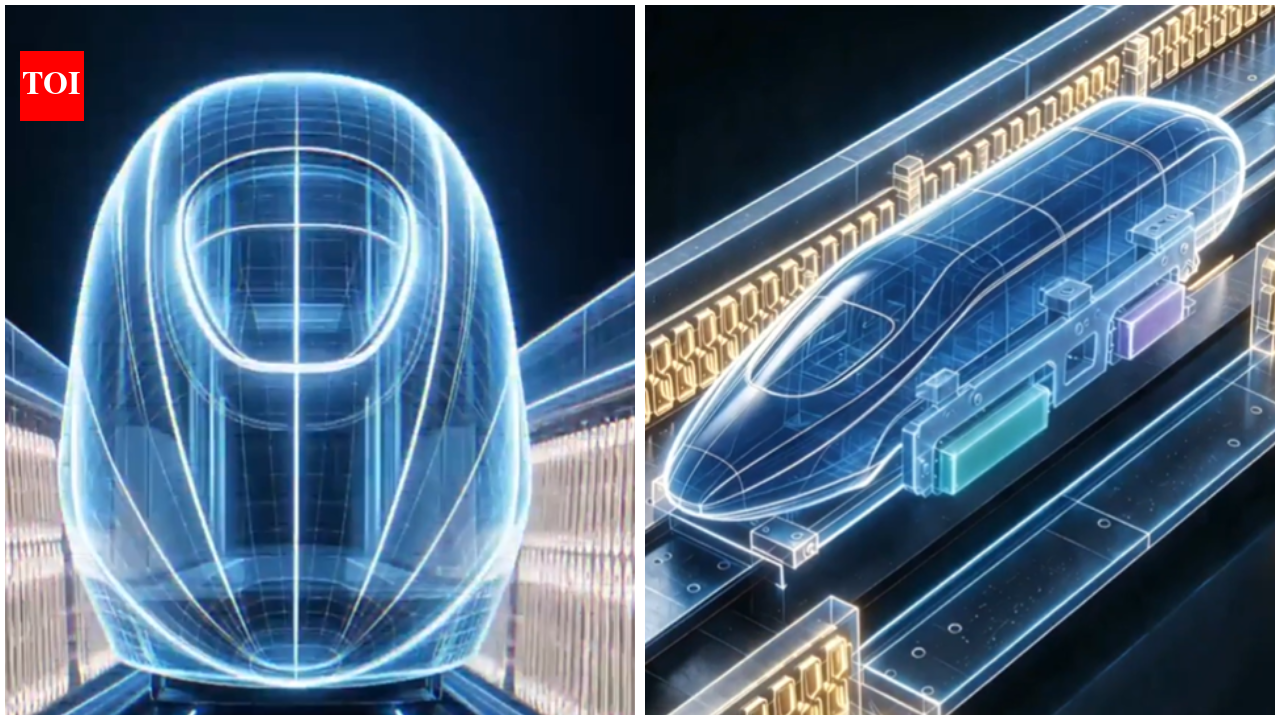
China's experimental maglev vehicle has set its third world record in six months, accelerating to 800 kmph in 5.3 seconds on a 1-km test track in Hubei, a milestone that — while not aimed at passenger travel — signals potential future applications in industrial transport and high-speed ground systems, according to Business-Today.
The 1,110-kg test vehicle, developed at Donghu Laboratory, reached the speed in its latest trial. Unlike conventional trains, maglev vehicles use magnetic forces to reduce or eliminate physical contact between the train and the track; electromagnetic systems levitate and propel the vehicle forward, Business-Today reported.
According to CGTN, the system worked like a giant slingshot: magnetic forces propel the vehicle forward while eliminating the friction associated with conventional rail travel.
Record progression
The test vehicle has broken its own short-distance acceleration record multiple times, according to Business-Today. The progression:
| Trial | Speed | Acceleration time |
|---|---|---|
| June 2025 (first public run) | ~404 mph (650 kmph) | 7.1 seconds |
| Subsequent run | ~433 mph (697 kmph) | Not specified |
| November run | ~496 mph (798 kmph) | Not specified |
| Latest trial | 800 kmph | 5.3 seconds |
For comparison, China's fastest commercial maglev service, the Fuxing system, has a top speed of about 217 mph (349 kmph). The experimental Donghu Laboratory vehicle is operating at more than twice that speed, the report said.
Engineering challenges
At 800 kmph, even tiny deviations in the track become a major engineering challenge. The experimental system reportedly requires track alignment to remain within 0.5 millimetres, according to Business-Today. Control systems must simultaneously manage the vehicle's position, levitation and electromagnetic propulsion while maintaining stability during rapid acceleration. Because the vehicle weighs around 1,110 kg, enormous amounts of energy and force are required to accelerate it to such speeds within seconds.
The trials have also helped researchers test technologies involving high-power energy delivery, levitation control, positioning, electromagnetic propulsion and emergency braking, the source reported.
Beyond passenger rail
The biggest significance of the experiment may lie beyond railways, according to Business-Today. Passenger trains travelling at such speeds would require expensive infrastructure and enormous energy inputs, while the acceleration levels involved would not be suitable for conventional commuter travel. Researchers are therefore exploring whether similar electromagnetic acceleration technology could eventually be adapted for rockets, drones and military aircraft.
A ground-based launch system capable of giving a rocket or aircraft a substantial initial boost could potentially reduce the amount of fuel it needs to carry for take-off. Similar technology could also find applications in industrial transport and specialised elevators, the report said.
Shipper and operator implications
For freight forwarders and logistics operators, the immediate effect is limited — no commercial freight line currently operates at or near these speeds. However, the source's mention of potential applications in industrial transport and specialised elevators suggests that high-speed electromagnetic propulsion could one day play a role in moving high-value, time-critical cargo over short distances, particularly in factory or port settings.
For now, the technology remains experimental, Business-Today reported. China's commercial maglev systems already demonstrate that magnetic levitation can deliver very high-speed passenger transport, but the leap from those systems to an 800-kmph experimental vehicle represents a very different engineering challenge.
Watch list
- Whether researchers at Donghu Laboratory progress from the 800-kmph test to a ground-based launch system for rockets or aircraft, as suggested by the source.
- Any future application of the electromagnetic acceleration technology to industrial transport or specialised elevators — the two logistics-adjacent uses named in the article.
- The track-alignment tolerance of 0.5 mm and the energy demands of accelerating a 1,110-kg vehicle in seconds, both of which will determine scalability.
Sources: