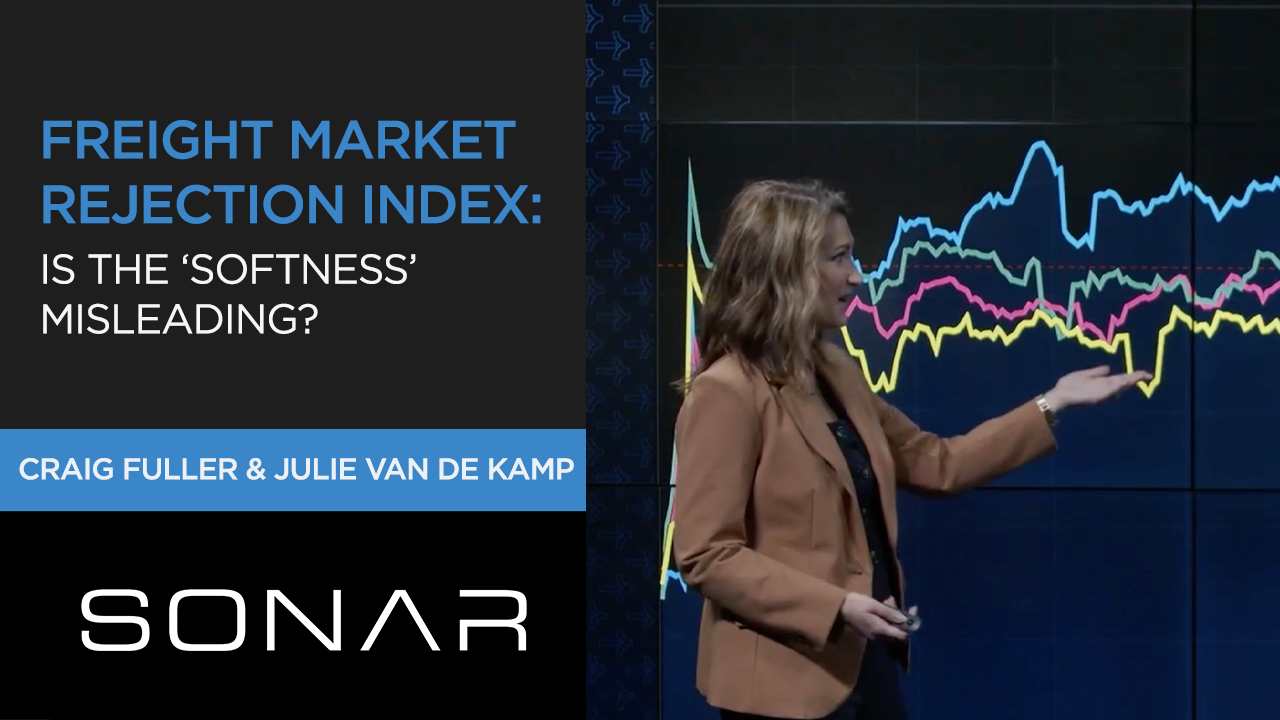
The national truckload market is tightening: tender rejections — the share of load requests carriers decline — are running at 14.36% against a six-month average of 10.9%, with flatbed rejections at 23.5% and refrigerated at 19.46%, according to FreightWaves SONAR data. The drivers are supply-side — regulatory enforcement removing noncompliant capacity, durable spot rates and a structural driver shortage — rather than any sudden demand surge. The data lines up with what major public carriers are telling analysts on Q2 earnings calls, according to the FreightWaves market update.
Five pillars explain the tightness
The FreightWaves analysis identifies five interlocking pillars: capacity is leaving the market; spot rates are strong and durable; demand is steady but not surging; shippers are pivoting toward asset-based and dedicated capacity; and driver recruiting is becoming materially harder. Each pillar surfaced in Q2 earnings calls from Knight-Swift, Werner and J.B. Hunt, lending independent corroboration to the SONAR data.
Knight-Swift management attributed rapid tightening to supply-driven dynamics, with spot rates exceeding normal seasonality and tender rejections reaching levels the carrier had not seen since 2021. Both Knight-Swift and Werner specifically called out Federal Motor Carrier Safety Administration (FMCSA) and DOT efforts to revoke invalid commercial driver's licenses (CDLs) and shut down noncompliant driving schools as forces removing low-cost, noncompliant capacity from the market. Werner also flagged electronic logging device (ELD) providers exiting alongside the school and driver removals.
Tender rejections and rate durability
| Segment | Rejection index | Six-month average |
|---|---|---|
| National Truckload | 14.36% | 10.9% |
| Flatbed | 23.5% | — |
| Refrigerated | 19.46% | — |
The sustained nature of those levels, rather than any single week's reading, is the clearest sign that capacity is not self-correcting quickly, the update reported. FreightWaves' National Truckload Index showed a modest dip in mid-June before resuming its climb. Stripping out fuel costs — the key durability test — spot rates continue to move higher independent of diesel prices, indicating that willingness to pay and lack of capacity, not fuel, are the primary drivers.
Rates can rise even when diesel is falling, and we see that in the data.
Knight-Swift's CEO characterized the current cycle as supply-driven rather than demand-driven, a view consistent with volume indexes in SONAR remaining relatively flat to modest rather than surging.
Mode shift: intermodal and dedicated gain ground
Where volume is rising is in intermodal. J.B. Hunt reported higher intermodal volume attributed to rising fuel costs and constrained truck supply pushing freight toward rail — a mode shift, not a broad demand increase. On the dedicated side, J.B. Hunt said its dedicated pipeline was at record levels, citing a tight driver market, regulatory pressures, and customer demand for reliable capacity.
Werner CEO Derek Leathers noted on his company's earnings call that organic dedicated business is growing as a whole, not solely from fleet acquisitions.
Driver recruiting and wage pressures
The driver recruiting picture is worsening across the board. J.B. Hunt flagged increased sign-on bonuses and targeted wage increases as a potential margin pressure point going forward. With the eligible driver pool shrinking under regulatory enforcement and a healthier freight market giving drivers more options to chase higher pay, carriers are absorbing recruiting costs that are unlikely to recede quickly, according to FreightWaves.
What this means for shippers and operators
The convergence of all five signals, each confirmed by both SONAR data and the largest carriers' own reporting, suggests the current tightness reflects structural shifts rather than a temporary seasonal pattern. For freight forwarders and 3PLs, the elevated rejection index means spot coverage is harder to source and more expensive; for shippers, the pivot to dedicated and asset-based capacity is already visible in J.B. Hunt's record pipeline, and carriers' rising sign-on bonuses and targeted wage increases are likely to feed into rates. Operators should expect regulatory removals — invalid CDLs and noncompliant driving schools — to keep shrinking the eligible driver pool, while intermodal becomes a more attractive option as truck capacity stays constrained.
Watch list
- FMCSA and DOT enforcement actions on invalid CDLs and noncompliant driving schools continue to remove capacity.
- ELD providers exiting the market alongside school and driver removals (flagged by Werner).
- Diesel prices and their interaction with spot rates — the data shows rate strength independent of fuel.
- Carrier Q2 commentary on sign-on bonuses and targeted wage increases as margin pressure points.
- SONAR volume indexes remaining flat to modest rather than surging, consistent with a supply-driven cycle.
Sources: