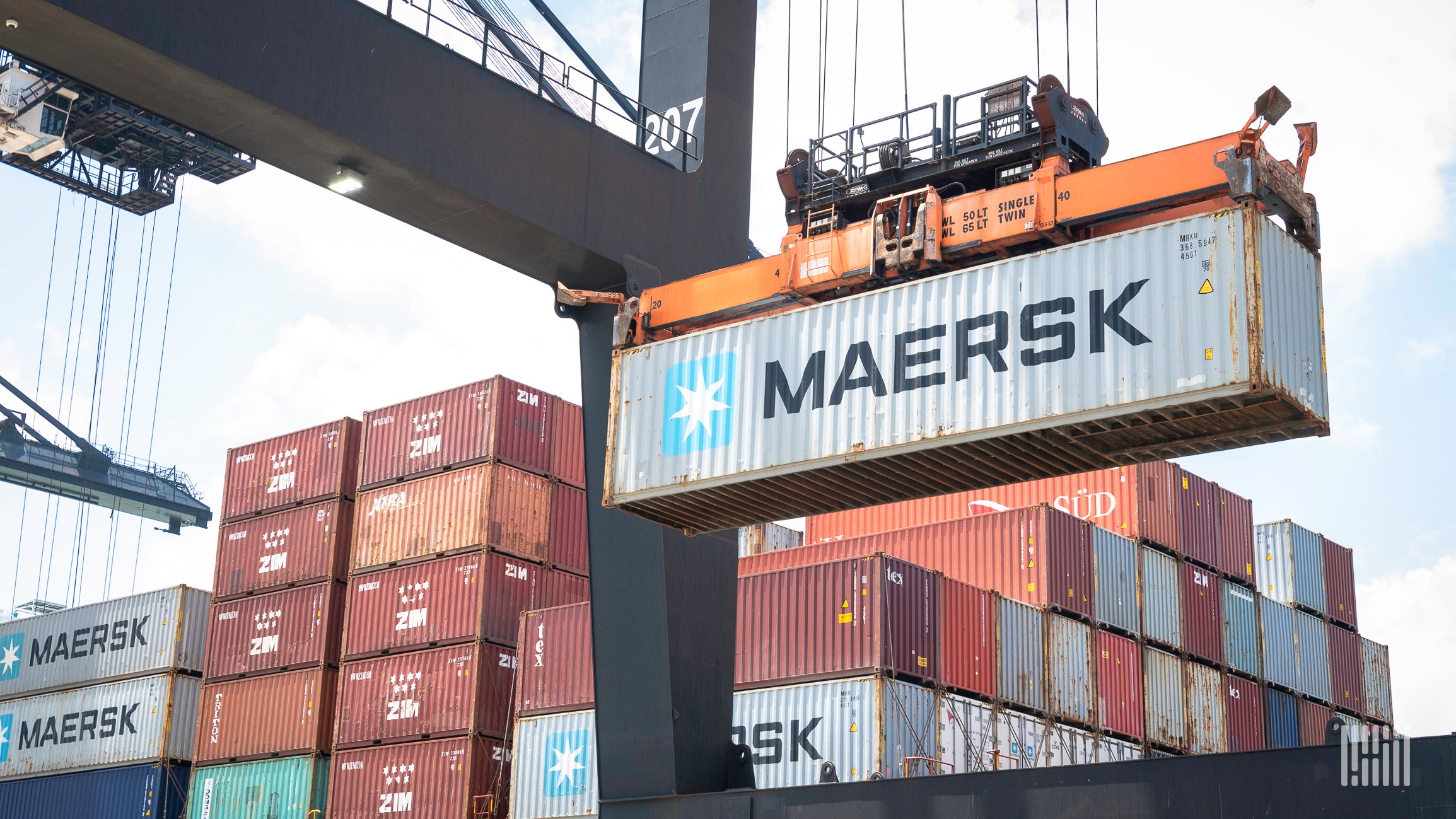
Maersk sharply lifted its full-year 2026 guidance, citing continued strong demand in the container market and rising spot rates fueled by wartime disruptions in the Middle East, according to FreightWaves.
Guidance Revision Details
The Copenhagen-based carrier, the world's second-largest container line, now expects underlying EBITDA in a range of $8-$10 billion, up from previous estimates of $4.5-$7 billion. Underlying EBIT is forecast at $2-$4 billion, compared to a prior loss range of $1.5-$1 billion. Negative free cash flow is now expected at $1.5 billion, improved from $3 billion.
Maersk also raised its volume growth outlook for the global container market to about 4% from the earlier 2%-4% forecast.
| Metric | Previous Guidance | New Guidance |
|---|---|---|
| EBITDA | $4.5-$7 billion | $8-$10 billion |
| EBIT | Loss $1.5-$1 billion | $2-$4 billion |
| Free cash flow | -$3 billion | -$1.5 billion |
| Volume growth | 2%-4% | ~4% |
'Continued strong demand in the container market, particularly in the Far East, and a recent sustained increase in spot market rates means that A.P. Moller–Maersk upgrades its guidance for full year 2026,' the company said Monday.
War's Impact on Ocean Freight
Ocean carriers received an unexpected boost from the U.S. war with Iran that began Feb. 28, according to FreightWaves. The closing of the Strait of Hormuz and Iranian attacks on refining choked global supplies, sending crude oil and fuel prices soaring. Thousands of ships were trapped in the Gulf region, which helped push up freight rates and led carriers to implement emergency surcharges.
Rates were also buoyed by frontloading by shippers anxious to avoid tariff chaos and expected price hikes by Asian manufacturers, the report added.
Maersk petitioned the Federal Maritime Commission to waive the 30-day waiting period for implementing emergency fuel surcharges, but the U.S. regulator rejected the requests three times.
Shipper Implications and Forward View
For freight forwarders and logistics managers, the sharp guidance upgrade signals sustained rate pressure on the Far East outbound lanes. The combination of war-related capacity constraints, fuel cost increases, and preemptive shipper demand is likely to keep spot rates elevated through peak season. Maersk's revised volume growth outlook of 4% indicates container availability may tighten further.
Operators should monitor the Middle East situation closely — any escalation or de-escalation will directly affect fuel surcharges and route availability. The Strait of Hormuz closure has already trapped vessels and disrupted schedules, contributing to port congestion in the region.
Maersk will release second-quarter earnings on August 13, providing further clarity on demand trends. The company's ability to pass on fuel costs remains constrained by the FMC's rejection of its surcharge waiver, which may pressure margins despite higher revenue.
Sources: