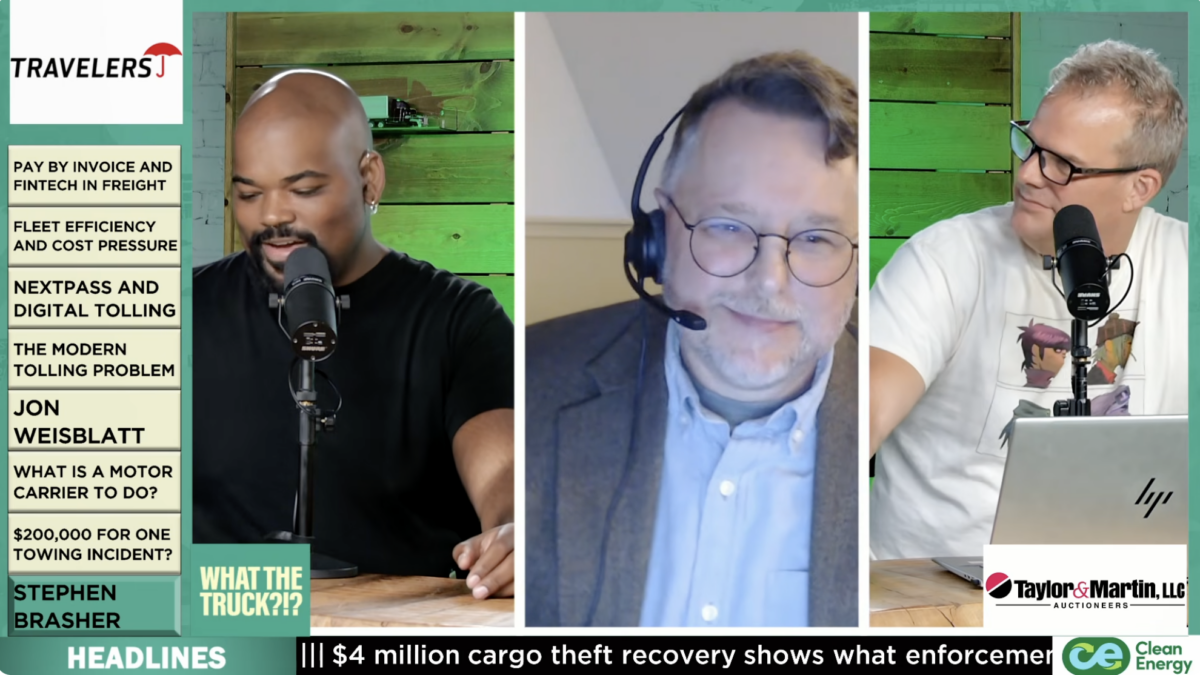
Truck accidents are now financial minefields, with predatory towing practices routinely inflating recovery costs to six figures and exposing motor carriers to devastating uncovered expenses. Stephen Brasher, Travelers Inland Marine Claim Unit Manager, told FreightWaves' "What the Truck?!" that tow operators hold nearly all the leverage, invoices are routinely inflated, and carriers who do not respond immediately watch storage fees consume any remaining margin.
How the Billing Clock Starts
Brasher explained that when a rollover accident occurs, the County Sheriff dispatches a tow company to clear the roadway—and the motor carrier has no say in which company responds. "Motor carriers need to understand, you do not get to choose that tow company," Brasher said. Once the tow operator hooks up, the billing clock starts and the truck, trailer, and salvageable cargo are taken to the operator's storage facility. From that point, fees compound daily across multiple line items.
Storage Fees Add Up Fast
According to Brasher, storage fees average $120 per day per component: $120 for the truck, $120 for the trailer, and $120 for the cargo. "They will not release any of it until their invoice is paid in full," he said. This structure gives tow companies an asymmetric advantage because the motor carrier needs its equipment back to generate revenue, and the cargo may be time-sensitive or perishable. "Towing operators know how desperate the situation is and use it to their advantage," Brasher added. "Possession is nine-tenths of the law; in this case, the tow company has all the leverage."
Average and Extreme Invoices
Brasher cited industry data showing the average tow-and-recovery invoice is nearly $12,000, a figure that can balloon dramatically. He noted "a documented case in Virginia where a single truck crash recovery resulted in a $200,000 invoice." The following table summarizes the cost structure:
| Fee Component | Cost per Day | Typical Total |
|---|---|---|
| Average invoice | — | $12,000 |
| Storage (truck) | $120 | Variable |
| Storage (trailer) | $120 | Variable |
| Storage (cargo) | $120 | Variable |
| Extreme case (Virginia) | — | $200,000 |
Insurance Coverage Gaps
Beyond sticker shock, the financial exposure is magnified by insurance coverage structure. Brasher described a "triangle of coverage" involving the motor carrier, shipper, and broker, each with different policies. "An auto policy covers the truck and trailer, while cargo insurance covers the cargo," he explained. The problem arises when towing costs exceed policy sub-limits. "If that tow recovery bill comes in at $60,000 or $100,000, and I can assure you it does, the motor carrier is responsible for the difference," Brasher said. Those sub-limits may have been set before predatory billing pushed invoices into six-figure territory, leaving carriers with excess exposure that can be a devastating financial hit.
Implications for Carriers and Shippers
For logistics managers and freight forwarders, the risk is clear: an accident can trigger a cascade of fees that far exceed standard insurance coverage. Motor carriers must act quickly after a crash—Brasher suggested that carriers should immediately engage legal counsel and notify their insurance provider to negotiate with the tow operator. Shippers and brokers should verify that carriers have adequate towing and recovery coverage, as their cargo may be held hostage until the bill is paid. The lack of regulatory oversight means the burden falls on the industry to push back against inflated invoices.
Watch List
- Regulatory scrutiny: As predatory towing gains attention, state legislatures may consider caps on storage fees or requirements for transparency in billing.
- Insurance market response: Carriers may see premium adjustments or new sub-limit structures as insurers react to rising exposure.
- Industry best practices: Trade groups may develop guidelines for post-accident procedures to limit tow operator leverage.
Sources: