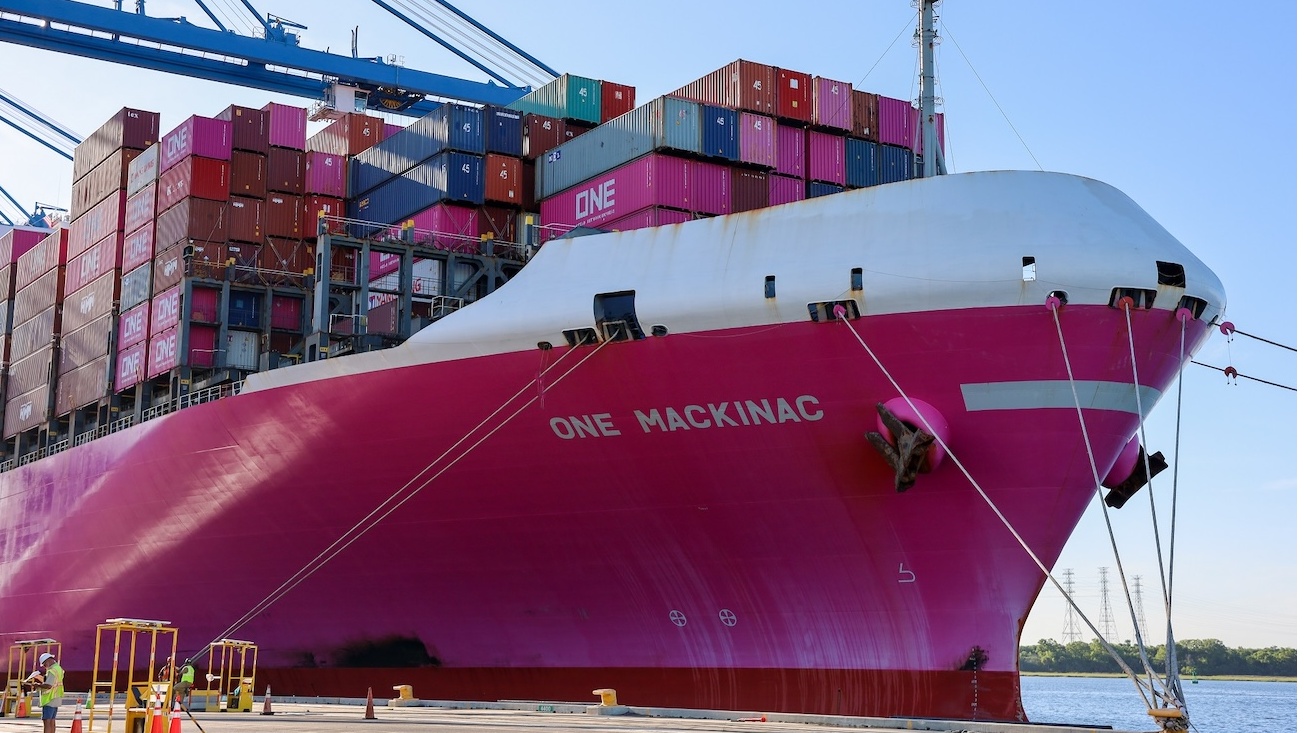
Ocean Network Express (ONE) lifted its full-year profit outlook by 200% to $900 million from a prior $300 million guidance, driven by higher freight rates and stronger volumes despite sharply higher bunker fuel costs, according to FreightWaves.
Quarterly performance: revenue up, profit down on fuel costs
For the April–June quarter (Q1 FY2026), the Singapore-based joint venture of Japan's three major container carriers reported revenue of $4.54 billion, up from $4.05 billion in the year-ago fiscal quarter. Net profit, however, tumbled to $31 million from $86 million, undercut by higher fuel costs linked to the effects of the Iran war, FreightWaves reported.
Earnings before interest, taxes, depreciation and amortization (EBITDA) rose to $707 million from $616 million in Q1 FY2025, with EBITDA margin improving to 15.6% from 15.2%. That trails competitor margins of 22.7% for CMA CGM of France and 16.8% for Maersk (OTC: AMKBY). Earnings before interest and taxes (EBIT) doubled to $76 million from $38 million; EBIT margin improved to 1.7% from 0.9%.
| Metric | Q1 FY2026 | Q1 FY2025 | Change |
|---|---|---|---|
| Revenue | $4.539B | $4.05B | +12.1% |
| Net profit | $31M | $86M | -64% |
| EBITDA | $707M | $616M | +14.8% |
| EBITDA margin | 15.6% | 15.2% | +0.4 pts |
| EBIT | $76M | $38M | +100% |
| Container volumes | 3.257M TEU | 3.165M TEU | +2.9% |
| Average freight rate | $1,300/TEU | $1,199/TEU | +8.4% |
| Average bunker price | $666/ton | $535/ton | +24.5% |
Freight rates and volumes climb
Container volumes grew to 3.257 million TEUs from 3.165 million TEUs in Q1 FY2025. The average freight rate came in higher at $1,300 per TEU compared to $1,199 per TEU a year earlier, and up from $1,154 per TEU in Q4 FY2025, according to FreightWaves.
At the same time, average bunker fuel prices reached $666 per ton, up from $535 per ton a year ago and $440 per ton in Q4 FY2025 — a 24.5% year-over-year jump. ONE said higher bunker fuel costs weighed heavily on profitability, even as demand recovered through May–June.
Executive view and forward outlook
The ONE consortium comprises Nippon Yusen Kaisha (NYK), Mitsui O.S.K. Lines (MOL), and Kawasaki Kisen Kaisha ("K" Line). Chief Executive Till Ole Barrelet highlighted improved yields, strong utilization, and operational agility as central to performance, while noting continued geopolitical uncertainty, FreightWaves reported.
ONE improved yields and maintained high vessel utilization as demand recovered through May–June, despite higher fuel and operating costs from Middle East disruptions.
Shipper and forwarder implications
For freight forwarders, 3PL operators and shippers, the figures show a carrier pricing environment in which fuel inflation is being pushed into freight rates. The average freight rate rose 8.4% year-over-year while bunker costs rose 24.5% year-over-year, meaning fuel cost growth outpaced rate growth in the quarter. ONE reported that demand recovered through May–June and that vessel utilization remained high, per FreightWaves. Shippers negotiating contracts for the remainder of the fiscal year should expect the $1,300/TEU average and the $666/ton bunker cost to be reference points in carrier pricing discussions.
Watch list
- Continued geopolitical uncertainty in the Middle East and the ongoing effects of the Iran war on fuel costs, as noted by CEO Till Ole Barrelet.
- Bunker price trajectory: average bunker price already up from $440/ton in Q4 FY2025 to $666/ton in Q1 FY2026.
- Demand recovery momentum through May–June, which supported volumes and utilization.
- Margin comparison: ONE's 15.6% EBITDA margin versus CMA CGM's 22.7% and Maersk's 16.8%, as reported by FreightWaves.
Sources: