Home EV charging still requires drivers to wrestle with heavy, often dirty cables – a friction point that companies have tried to automate for years. Xiaomi has now brought a robotic solution to production, while Tesla’s decade-old promise remains unfulfilled.
Xiaomi’s production-ready charging arm
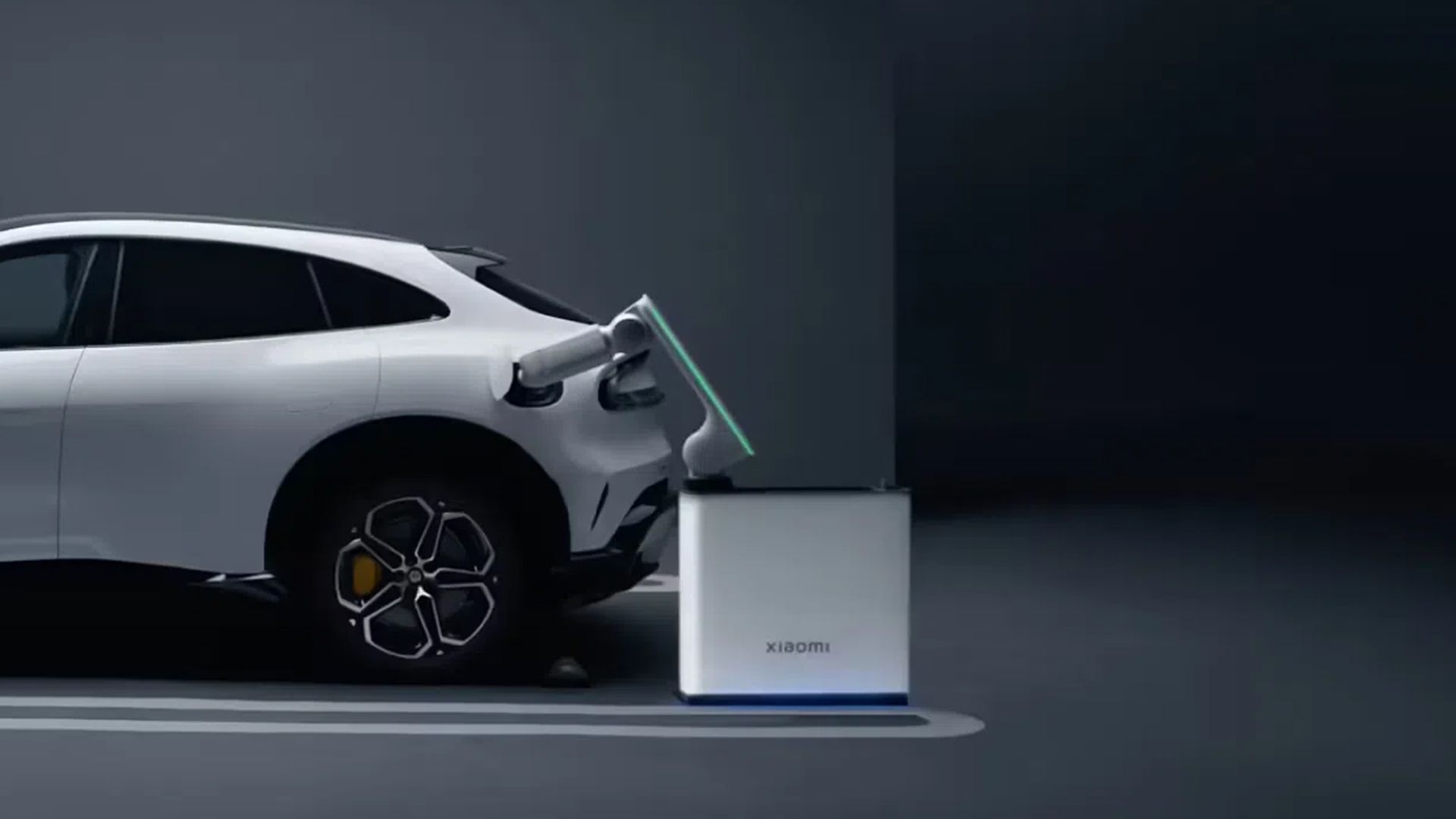
According to TechRadar, Xiaomi Auto has unveiled a compact robotic charging arm designed for residential garages. The system, compatible only with Xiaomi’s electric vehicles (the SU7 and YU7 models in China), automatically initiates charging as soon as the owner parks and walks away – no commands or manual operations required, as reported by Car News China. Once charging is complete, the robot unplugs the connector and stows it neatly in its storage unit. Owners can also start a charge remotely via a smartphone, provided the vehicle is within reach of the telescopic arm.
There is no official price yet, but the company’s promotional video shows what appears to be a production-ready product in a real-world setting, suggesting it could go on sale in China within months.
Tesla’s abandoned ‘metal snake’
Back in 2014, Elon Musk tweeted that Tesla was working on a robotic charging solution that “automatically moves out from the wall & connects like a solid metal snake.” A year later, the company demonstrated a functional prototype, but the project never reached production. TechRadar notes that the snake-like design likely proved too complicated, too expensive, and too “out there” to commercialise. Tesla also scrapped its plans for a wireless home charging solution.
Competitive landscape
Xiaomi is not alone. Aito showcased its Aito M8 pure-electric version using a robotic charging arm last year, and Li Auto stated it was working on robotic arms for its public charging network. Porsche recently announced a wireless charging pad for the Cayenne electric that lets owners simply drive over it and charge without touching cables.
| Company | Product | Status | Key Feature |
|---|---|---|---|
| Xiaomi | Robotic home charging arm | Production-ready, launching in China | Automatic plug/unplug, smartphone control |
| Tesla | ‘Metal snake’ charger | Abandoned after 2015 prototype | Wall-mounted robotic arm (never shipped) |
| Aito | M8 robotic arm charging | Showcased 2025 | Robotic arm for pure-electric SUV |
| Li Auto | Robotic charging arm | Under development | Aimed at public charging network |
| Porsche | Wireless charging pad | Announced for Cayenne electric | Drive-over wireless charging |
Why this matters for CTOs
Modern electric vehicles are already equipped with sensors and communication protocols that can interface with robotic arms, making such systems a logical evolution for seamless charging. For enterprise technology leaders, the automation of a manual, outdoor task like plugging in an EV cable demonstrates how robotics and IoT can eliminate friction in everyday operations – a principle applicable beyond automotive to logistics and industrial charging fleets. The complexity and cost remain hurdles, but with Xiaomi bringing the technology to market, the path toward cable-free charging is accelerating.
Sources: