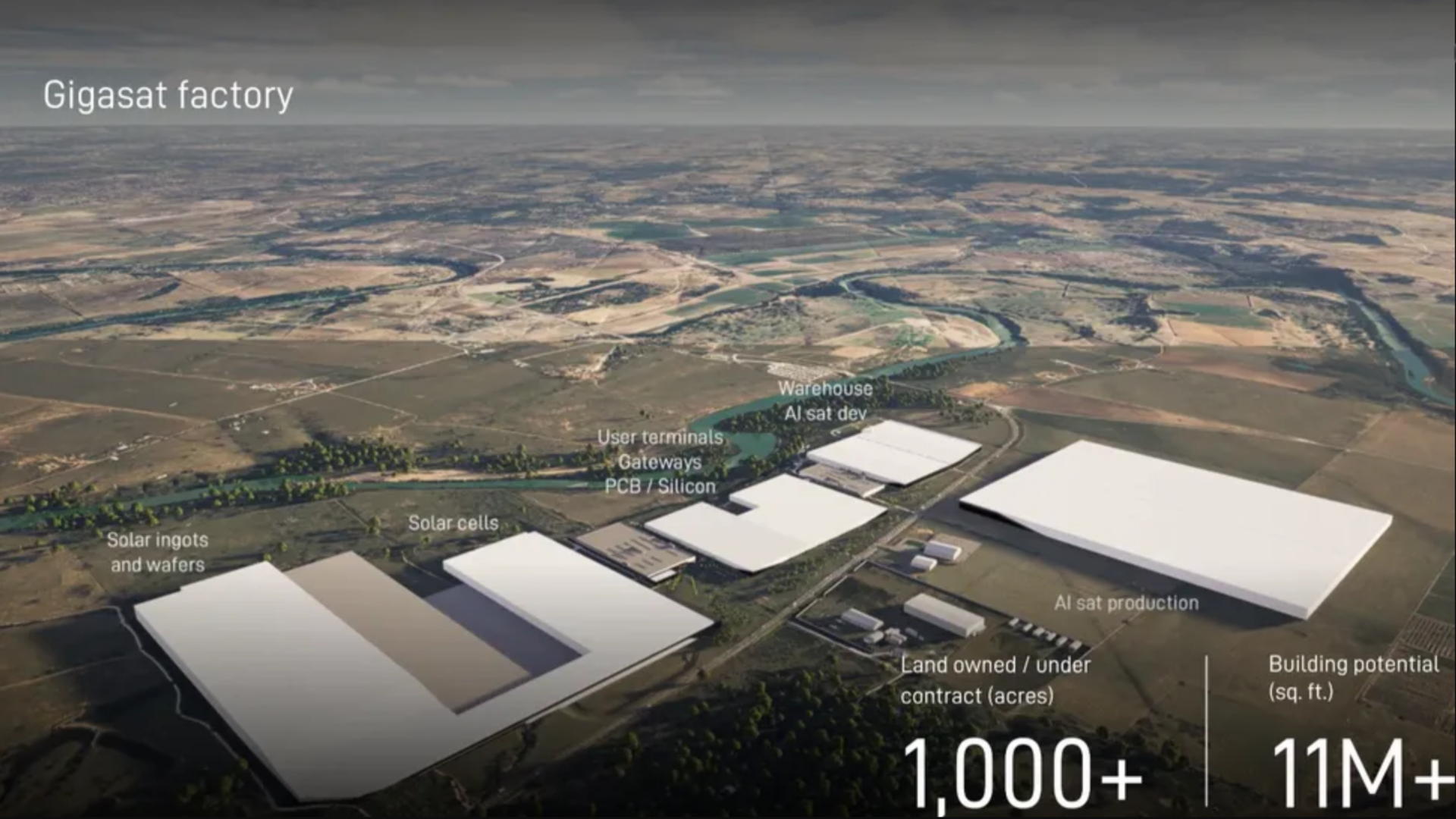
SpaceX's planned manufacturing complex in Bastrop, Texas, could reshape how enterprises think about AI computing infrastructure. The company has unveiled the Gigasat facility — a roughly 11 million square foot factory dedicated to producing satellites designed to function as orbiting data centers. According to TechRadar, SpaceX CEO Elon Musk claims the Bastrop facility will manufacture much of the hardware required for a new generation of AI satellites.
The AI1 Spacecraft and Orbital Compute Capacity
At the center of the project is a new spacecraft called AI1, which the company intends to produce in large numbers as a space-based computing platform. Musk said each satellite would carry a compute payload delivering approximately 150kW of processing capability while relying on extensive solar arrays for power generation. The satellite is expected to span roughly 70 meters in length, with solar arrays generating power at a density of about 250 watts per square meter. Its design also incorporates large radiator structures to manage the significant heat generated by onboard computing systems.
SpaceX plans for the Gigasat site to include production lines for solar components, printed circuit boards, electronic systems, communications equipment, and the satellites themselves. The facility will also feature testing areas, logistics infrastructure, warehousing capacity, and dedicated development zones. The company expects solar manufacturing activities to begin first, followed by construction of the primary satellite production building.
Timeline and Scale Targets
SpaceX believes the factory could begin producing substantial numbers of AI satellites before the end of 2027. Achieving the stated goal of 1GW of annual orbital AI compute capacity would require deploying thousands of satellites operating collectively in orbit. Musk stated, "This is what we are going to try to do and think we probably can do, which is to get to roughly an annualized rate of a gigawatt per year by the end of next year." The long-term vision extends beyond the initial 1GW objective, with aspirations to reach tens of gigawatts in subsequent years, with the possibility of even larger scales if future technologies support such expansion.
Comparison with Terrestrial AI Infrastructure
Those ambitions emerge as major technology companies continue investing heavily in conventional AI facilities. Two notable examples cited by TechRadar:
| Facility | Company | Expected Power | GPU Count (approx.) |
|---|---|---|---|
| Hyperion (Louisiana) | Meta | 5GW | 2 million GPUs |
| Colossus 2 (Memphis) | xAI | 2GW | 555,000 GPUs |
Some of the largest announced projects require enormous electrical capacity and investments ranging from tens of billions to more than $100 billion. Against that backdrop, orbital data centers are increasingly attracting attention as a possible alternative approach for supporting future computational demand.
SpaceX's Advantages from Starlink
SpaceX may hold certain advantages because many technologies required for large-scale satellite production already exist within its broader operations, according to TechRadar. Much of that experience comes from the company's extensive work designing, manufacturing, and deploying Starlink spacecraft over several years. Producing solar arrays, satellite structures, communications hardware, and related systems relies largely on established aerospace manufacturing processes. The Gigasat facility builds on that foundation to target a new, AI-focused production line.
For CTOs and technology procurement leaders, the development signals a growing option for offloading compute to orbit — albeit one that requires significant hardware deployment and time. The company's goal of 1GW by late 2027 implies a rapid ramp, but the comparisons with Meta's and xAI's terrestrial builds show that orbital computing will need to scale aggressively to compete with Earth-bound data centers on capacity and cost.
Sources: