
Topic
copper
 Commodities
 Copper futures hover near ₹1,365 support as sideways trend persists
Copper futures hover at ₹1,370/kg near key support at ₹1,365, according to The Hindu BusinessLine. The August contract has ranged between ₹1,365 and ₹1,400 since August 5. Analysts see a likely rally to ₹1,430 if support holds, with downside targets at ₹1,350 and ₹1,325 on a breach.
 Logistics
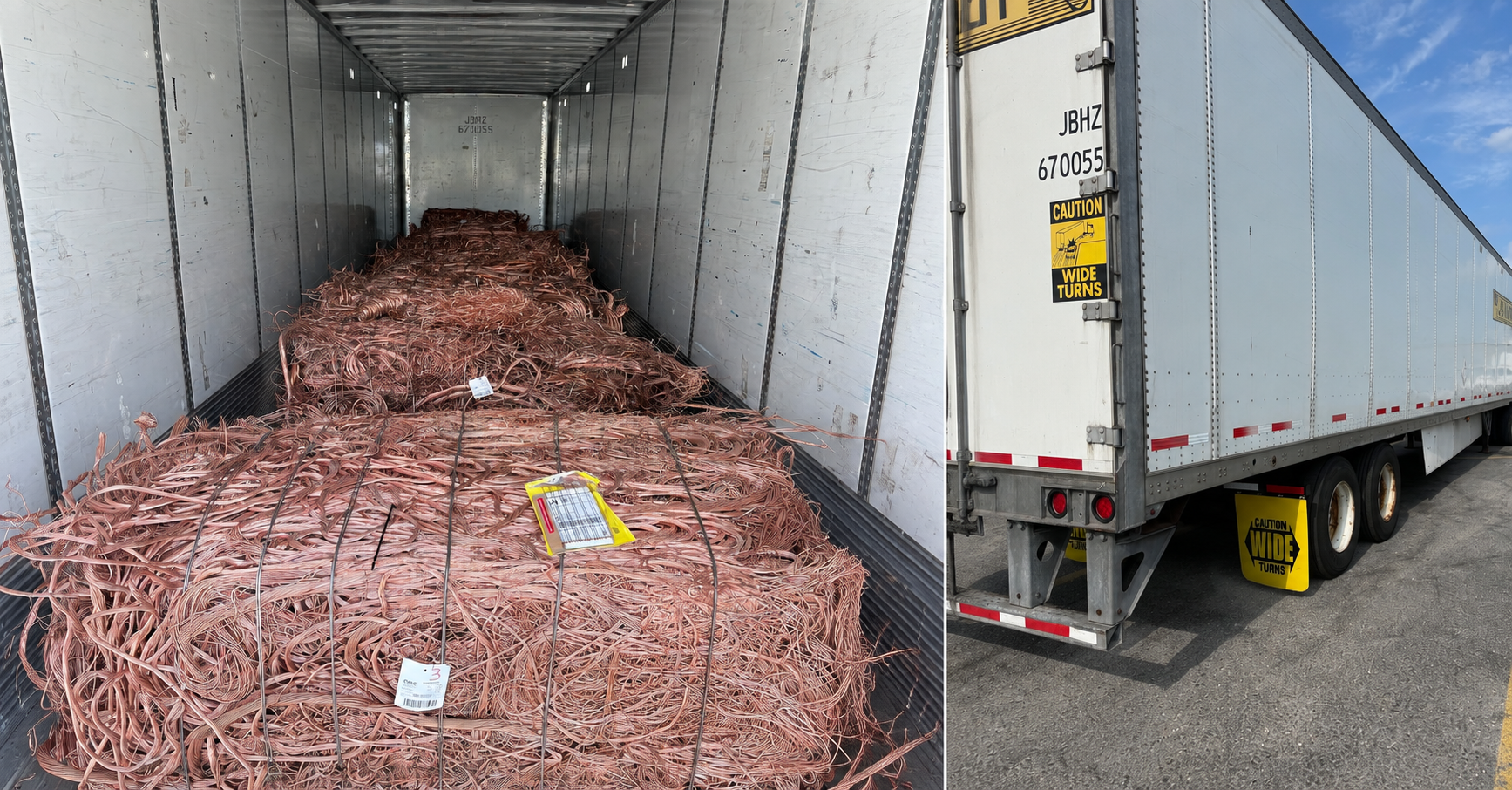
 Police Recover $258K Copper Load From Stolen J.B. Hunt Trailer in North Carolina
Kenly, North Carolina police recovered approximately $258,000 in copper wire from a stolen 53-foot J.B. Hunt trailer and arrested 41-year-old Florida man Jarrel Lamont Nightingale. The investigation spanned multiple jurisdictions, and Nightingale faces felony charges including possession of stolen goods, stolen motor vehicle, and carrying a concealed gun. Copper has led all metals in cargo theft for two consecutive years, according to FreightWaves.
 Commodities
 Copper Market Faces Volatility on West Asia Developments, US-Iran Tensions
Copper prices are expected to remain volatile in the coming months due to the US-Iran conflict and ongoing tariff uncertainty, according to analysts. The metal hit a 6-week high on supply tightness, with LME three-month contracts around $13,800/tonne. BMI raised its forecast to $12,700/tonne, citing supply-side pressures and AI-fuelled optimism.
 Commodities
 India needs 500,000 tonnes refined copper capacity every 5 years to meet demand: ICA
India will require roughly 500,000 tonnes of additional refined copper capacity every five years to keep pace with rising demand, according to International Copper Association India (ICA India) Managing Director Mayur Karmarkar. Copper demand grew 9.3% to 1,878 kilo tonnes in FY25, driven by strong growth in building construction (11% yoy) and infrastructure (17% yoy). Despite planned capacity additions from Hindustan Copper, Hindalco, and Kutch Copper, domestic production remains insufficient to meet long-term demand.
 Commodities
 Downside Limited for Aluminium and Copper Declines Fundamentally, Analysts Say
Aluminium and copper prices have fallen 17.5% and 6% respectively in the past month, but analysts from BMI, ING Think, and Sunsirs see limited downside due to supply deficits, Middle Eastern supply disruptions, and resilient demand. Aluminium is at $3,100/t (up 3% YTD) and copper at $13,300/t (up 7.5% YTD) on the LME.
 Commodities
 Copper Futures Decline Amid Market Correction
Copper futures have declined to ₹1,315/kg, breaking below key support levels. The market shows signs of a corrective decline, with potential further drops to ₹1,265.
Commodities Gujarat's Role in India's Copper Self-Reliance
Gujarat is emerging as a crucial player in India's quest for copper self-reliance. With Hindalco's massive smelter at Dahej and strategic infrastructure, the state is poised to reduce India's import dependency.
 Trade
Trade Trump Alters Tariffs to Boost US Metal Industry
President Trump has revised tariffs on copper, aluminum, and iron imports to stimulate the US manufacturing sector. The changes, effective until December 31, 2027, aim to encourage investment in the nation's industrial base.