iGEN
Visit IGEN World Explore IGEN Expo
EXPLORE UPGRADE PLANS
BREAKING
New Senate bill targets 'chameleon carriers' that reopen to escape penalties Werner Enterprises Posts Highest Revenue Per Truck Growth in One-Way Segment in a Decade CMA CGM and Stonepeak Launch United Ports LLC in $2.4 Billion Terminal Joint Venture UPS shift away from Amazon shows bigger payoff Lanesurf: 62% of Loads Get Vetted Carrier Offers Before Brokers Arrive India-China Border Trade Via Lipulekh Resumes Aug 1; China Permits 20 Traders Geopolitics Drives CMA CGM Q2 Profit Surge of 42% as Volumes and Rates Climb Benchmark Diesel Price Rises Third Week as Futures Plunge; Spread Hits Record Indian Government Limits Sugar Dealers to 400 Tonnes Stock Until November to Curb Hoarding Tenants signing longer leases for larger warehouses as 3PLs lock in capacity New Senate bill targets 'chameleon carriers' that reopen to escape penalties Werner Enterprises Posts Highest Revenue Per Truck Growth in One-Way Segment in a Decade CMA CGM and Stonepeak Launch United Ports LLC in $2.4 Billion Terminal Joint Venture UPS shift away from Amazon shows bigger payoff Lanesurf: 62% of Loads Get Vetted Carrier Offers Before Brokers Arrive India-China Border Trade Via Lipulekh Resumes Aug 1; China Permits 20 Traders Geopolitics Drives CMA CGM Q2 Profit Surge of 42% as Volumes and Rates Climb Benchmark Diesel Price Rises Third Week as Futures Plunge; Spread Hits Record Indian Government Limits Sugar Dealers to 400 Tonnes Stock Until November to Curb Hoarding Tenants signing longer leases for larger warehouses as 3PLs lock in capacity
Home ›› Commodities ›› Commodities Energy ›› Russia, Strait of Hormuz Combine to Drive Diesel Higher After Nine-Week Decline

Russia, Strait of Hormuz Combine to Drive Diesel Higher After Nine-Week Decline

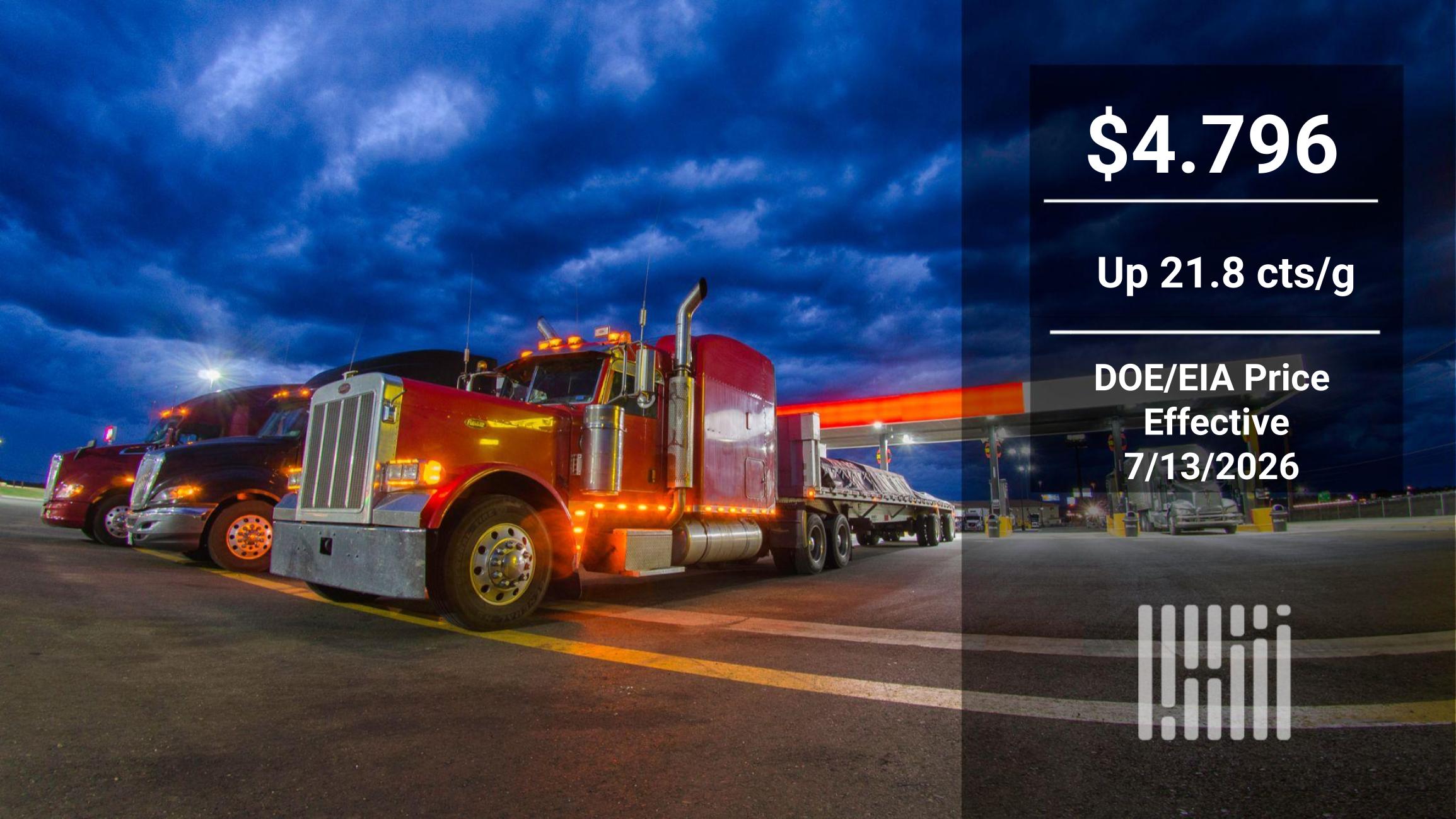
The benchmark diesel price rose 21.8 cents to $4.796/gallon amid escalating geopolitical risks. ULSD futures soared over 20% from a July 2 low as Russian refining capacity hit 21-year lows and Strait of Hormuz traffic slowed drastically. The spread between Brent crude and diesel widened to $1.84/gallon, one of the highest since the war began.

iG
iGEN Editorial
July 14, 2026
Russia, Strait of Hormuz Combine to Drive Diesel Higher After Nine-Week Decline

The benchmark price used for most fuel surcharges moved higher after nine consecutive increases with the prospect of even higher prices increasingly likely, according to FreightWaves.

The Department of Energy/Energy Information Administration average weekly retail diesel price rose 21.8 cents/gallon to $4.796/g, effective Monday and published Tuesday. The increase retraces only a relatively small part of the nine-week decline; it is still less than where the price was just four weeks ago. It is also 84.3 cents/g less than where it was in the final week before the consecutive declines.

Futures Market Surge

In the futures market, the price of ultra low sulfur diesel (ULSD) has soared in recent days. After a recent cyclical low settlement of $3.1822/g on July 2, the deteriorating situation in the Gulf and the fact that Strait of Hormuz traffic has slowed drastically has seen ULSD climb to a settlement Monday of $3.8236/g, an increase of just over 20% in six trading days. The Monday settlement is closer to the post-war high settlement of $4.6084/g set on March 20 than it is to the final settlement of $2.596/g before the war started over the weekend of February 28-March 1.

The increase in prices continued Tuesday. At approximately 11:15 a.m. EDT, ULSD was up 9.54 cents/g to $3.9190/g, an increase of 2.5%. But that marked a pullback from the intraday high which crossed the $4 mark, reaching as much as $4.0242/g.

Russia’s Refining Crisis

While the oil market focus is inevitably on what is going on in the Persian Gulf and the Strait of Hormuz, the impact from Ukrainian attacks on Russian infrastructure is a growing threat to the supplies of oil products, diesel in particular.

According to press reports, the analytics firm Kpler reported Tuesday that Russia’s volumes coming out of its refining sector had fallen to 21-year lows. Russia already had a ban on exports in place, but losing capacity means the country might need to import supplies and is even further away from lifting that ban.

Metric Value
Russian refinery runs ~3.8 million b/d
Capacity offline due to Ukrainian attacks ~4.3 million b/d
Refineries targeted by drone strikes At least 25

Kpler reported that at least 25 Russian refineries had been the targets of drone strikes.

In an interview last week with CNBC, Amrita Sen of Energy Aspects said Russian diesel exports historically had been in excess of 1 million b/d. “Last week it was only 270,000 barrels per day and now it is going to go down to a negligible level,” she said.

Rising Spread Between Crude and Diesel

Diesel is moving higher at a faster pace than crude. A comparison of the front month settlements between Brent crude, the world benchmark, and ULSD on CME produced a spread of about $1.84/g Monday. That is one of the highest levels since the war began.

On the last day of trading before the war commenced, that spread was about 87 cents/g.

The widening spread reflects the acute shortage of diesel relative to crude, driven by both the Russian refining outages and the Strait of Hormuz disruption. For commodity traders and procurement teams, this signals that diesel premiums are likely to remain elevated as long as these supply-side shocks persist. The combination of geopolitical risk and infrastructure damage means that any near-term relief in diesel prices is unlikely without a de-escalation in both the Persian Gulf and the conflict in Ukraine.


Sources: FreightWaves

Keep Reading

Recommended Stories

Crude Oil Down 2% as Strait of Hormuz Resumes Shipments Despite Vessel Strike Near Oman Commodities

Crude Oil Down 2% as Strait of Hormuz Resumes Shipments Despite Vessel Strike Near Oman

Crude oil prices fell 2% on Friday, headed for an 8% weekly loss, as more tankers exited the Strait of Hormuz following a ceasefire deal. Saudi Aramco resumed loading at Ras Tanura after a four-month halt. Despite a vessel hit near Oman and earthquakes in Venezuela, supply concerns eased with increased flows, while demand from China remained weak.

June 26, 2026
Strait of Hormuz Closure: Fitch Says High Oil Prices a Temporary Shock as Supply to Return to Surplus Commodities

Strait of Hormuz Closure: Fitch Says High Oil Prices a Temporary Shock as Supply to Return to Surplus

Fitch Ratings expects the Strait of Hormuz to reopen by end of July, bringing oil prices back to an average of $87 per barrel in 2026. The agency says the recent surge is a temporary logistical bottleneck, not a permanent supply loss, and markets will return to surplus from September.

June 14, 2026
Strait of Hormuz Closure Hits 100 Days as Dark Tanker Trade Masks True Oil Flow Logistics

Strait of Hormuz Closure Hits 100 Days as Dark Tanker Trade Masks True Oil Flow

The Strait of Hormuz has been effectively closed for more than 100 days, causing a 95% reduction in crude shipments from Arabian Gulf ports and a 99% drop in LNG carriers, according to WTO data. The 'dark trade' of vessels running without AIS transponders makes actual oil flows difficult to quantify, but analysts estimate 100 million barrels may have moved through since May 1. Despite the disruption, Brent crude sits at $87.55 per barrel due to buffers from China, the US, Brazil, and Canada. Recovery may take years, with IEA warning of up to two years for energy facility repairs.

June 14, 2026
Ukraine's Tanker and Refinery Campaign Deepens Russia's Fuel Crisis Logistics

Ukraine's Tanker and Refinery Campaign Deepens Russia's Fuel Crisis

Ukraine escalated its campaign against Russian maritime and refinery infrastructure, hitting over 20 shadow fleet tankers in the Kerch Strait and disabling major refineries including Omsk, deepening a fuel crisis that now affects more than 50 Russian regions. The campaign has also sparked diplomatic tensions with Greece after a Ukrainian sea drone was found near Lefkada.

July 9, 2026