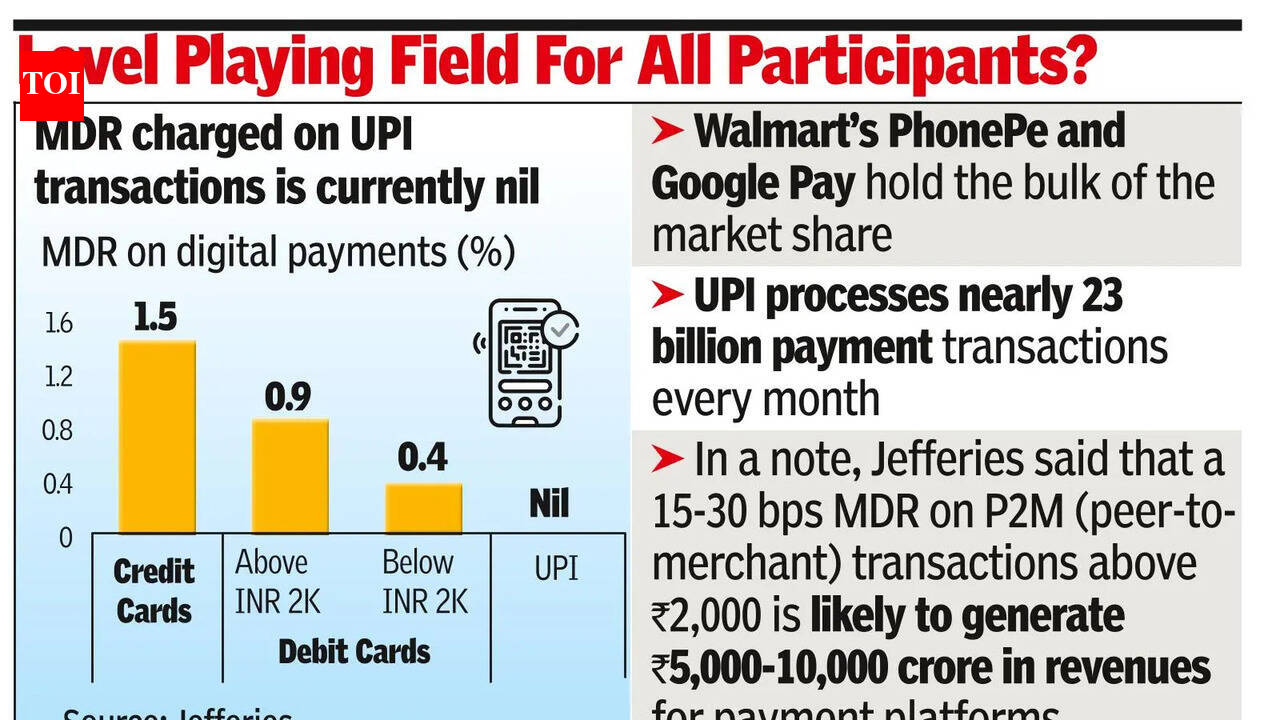
India is moving to let payment platforms charge a merchant discount rate (MDR) on large-value UPI transactions, a shift that Business-Today reports will help fintechs recover transaction costs, make business models sustainable, and strengthen the IPO prospects of several payment companies.
The MDR plan and its revenue potential
According to Business-Today, the government will introduce MDR only on large-value transactions, rather than across all UPI payments. In a note cited by the report, Jefferies estimated that a 15-30 basis points MDR on peer-to-merchant transactions above Rs 2,000 can generate Rs 5,000-10,000 crore in revenues for payment platforms each year. The broker also calculated that while such transactions made up only 4% of UPI volumes in FY26, they accounted for 67% in value terms.
| Metric | Source | Value |
|---|---|---|
| MDR rate range on P2M transactions above Rs 2,000 | Jefferies | 15-30 basis points |
| Annual revenue potential for payment platforms | Jefferies | Rs 5,000-10,000 crore |
| Share of UPI volumes, FY26 | Jefferies | 4% |
| Share of UPI value, FY26 | Jefferies | 67% |
| Monthly UPI transaction volumes | Business-Today | Nearly 23 billion |
| Annual industry cost to power UPI | Fintech executive | Rs 10,000-12,000 crore |
| Government incentive on UPI | Fintech executive | About Rs 2,000 crore |
At present, UPI transactions are free for merchants, according to the report.
Why fintechs are pushing for cost recovery
The fintech ecosystem has long called for monetisation of UPI payments to enable sustainable growth of the industry, Business-Today reported. Without MDR, the report said, there is a thinking that the market is heading toward an oligopolistic situation, with Google and Walmart dominating. The report said Walmart's PhonePe and Google Pay currently hold the bulk of UPI market share.
One fintech executive, speaking anonymously, put the cost gap in numbers.
"The ecosystem (fintech and banks) spends anywhere around Rs 10,000-12,000 crore every year to power UPI transactions. Of this, the govt gives only about Rs 2000 crore (by way of incentives). The rest gets lost."
Pine Labs CEO Amrish Rau told the report that the costs to fund expansion of UPI through continued investments in tech, IT, innovation and cyber-security have increased by almost 300% over the last 12-24 months. While there should be some recovery of these investments, Rau said, charges to consumers should continue to remain zero.
IPO pipeline and competition impact
The introduction of MDR will boost the prospects of companies awaiting IPOs such as PhonePe, Razorpay, PayU, PayNearby, and Innoviti, according to Business-Today. India's payment industry has long called for higher subsidies or a controlled introduction of MDR to recover transaction costs. The decision to allow MDR or higher value business payments will help turn many business models sustainable and thereby increase competition in an industry that is currently a near duopoly of PhonePe and Google Pay.
What sellers need to do
For cross-border e-commerce sellers, marketplace operators, and B2B platform managers processing payments in India, the potential introduction of MDR creates a new cost variable. Since UPI has been free for merchants, a 15-30 bps fee on peer-to-merchant transactions above Rs 2,000 would be a new margin item on high-value digital payments.
- Review merchant acquiring agreements for any clauses tied to interchange or MDR changes.
- Model the impact of a 15-30 bps fee on UPI peer-to-merchant payments above Rs 2,000, using the Jefferies estimates reported by Business-Today.
- Monitor Indian government announcements on the MDR implementation timeline, threshold, and scope.
- Account for the possibility that merchant acquirers may retain a larger share of the incremental cost, as Jefferies analysts noted.
Jefferies analysts were cited as saying: "As the larger part of the incremental cost is incurred by merchant acquirers, they may retain a larger share." That means the final pricing merchants face could vary by acquirer, and sellers should assess how their payment processors pass through any new charges.
Sources: