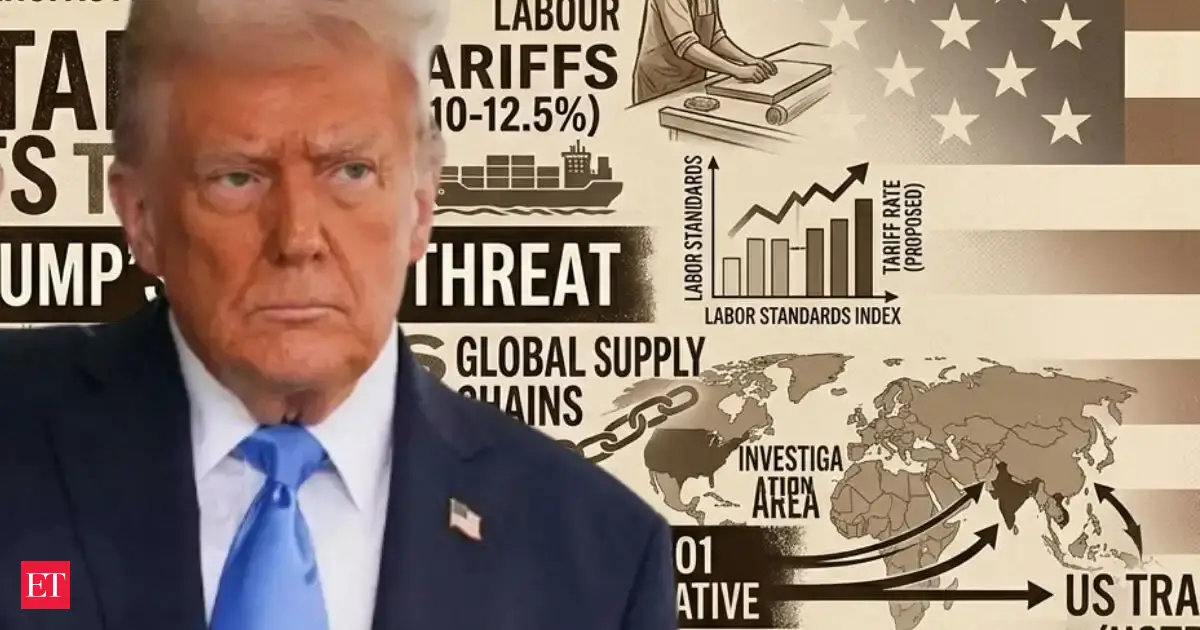
The US Trade Representative (USTR) has imposed a permanent 10% additional tariff on India and 16 other countries under Section 301 of the Trade Act of 1974, citing the import of goods produced using forced labour, according to a report by Business Today. The levy, which takes effect from Friday, replaces a temporary 10% import duty and is unlikely to have a major impact, the report said.
Tariff Details and Affected Countries
The 10% tariff is lower than the proposed 12.5% for India. Besides India, the countries facing the 10% levy include Bangladesh, Pakistan, Sri Lanka, the UK, Cambodia, Canada, Indonesia, Malaysia, and Mexico – a total of 17 nations. Around 40 other countries will face a 12.5% tariff. The USTR said the European Union (EU), Taiwan, Japan, South Korea, and Switzerland will be subject to tariffs of either 10% or 12.5%, after adjusting for the most-favoured-nation (MFN) rate. Product-specific exemptions apply, according to the report.
Trade research body GTRI (Global Trade Research Initiative) noted that about 70% of India's exports to the US will now pay MFN tariffs plus the 10% Section 301 duty, while Section 232 products (auto parts and some metal products) continue to face 25%-50% tariffs, as reported by Business Today.
India's Response and GTRI Analysis
The Indian government has not commented on the decision, but officials were expecting the outcome. GTRI founder Ajay Srivastava stated in a note: "The 10% US tariff on Indian exports under the forced-labour investigation lacks a credible factual basis. The US has not produced evidence that India imports goods made with forced labour." He added that India had already amended its Foreign Trade Policy to ban the import of goods produced using forced or compulsory labour, and Indian law prohibits forced labour in domestic production through constitutional guarantees and labour statutes. The tariff, he said, appears to serve primarily as a mechanism to preserve the Trump administration's tariff wall after the expiry of the probe, according to the report.
India had earlier questioned the probe, arguing that the unilateral move was unjustified and that India has regulations to check forced labour. During the probe, the Directorate General of Foreign Trade (DGFT) revised rules adopting the ILO definition and providing for a probe under the Foreign Trade Policy, which the USTR factored in while deciding the tariff.
Additional Threat: Structural Overcapacity Probe
Exports from India face an additional threat due to a second USTR probe against over a dozen nations for structural overcapacity, the report noted.
Oil Price Spike
In a separate development, the Indian basket of crude oil jumped 11% in a day to $103.33 per barrel on Thursday, the highest in two months, amid disruptions caused by the closure of the Strait of Hormuz and Houthi militia targeting shipping vessels in the Red Sea. Global benchmark Brent crude crossed the $100-per-barrel mark on Thursday and eased marginally to $97.08 (at 8:30 pm) Friday, according to Business Today.
International free-on-board (FOB) prices of petrol and diesel have also surged. The international FOB price of diesel averaged $129.8 per barrel in July, up from $120 in June; the corresponding price for petrol averaged $103.3 in July, lower than $107.8 in June. India imports nearly 90% of its crude oil requirements, and retail petrol and diesel prices are linked to international product prices, the report stated. Oil marketing companies (OMCs) were making an under-recovery of over Rs 1,000 crore per day in May, when the Indian basket averaged more than $110 per barrel. The government subsequently increased petrol and diesel prices by nearly Rs 7.5 per litre over a few days in May, which partly reduced the under-recoveries.
Separately, citing a notice on the US Treasury Department's website, Reuters reported that the US will allow certain transactions involving Lukoil International GmbH to continue until August 22.
Implications for Trade Professionals
For importers and exporters, the 10% Section 301 tariff adds to the cost of Indian goods entering the US, though the impact is expected to be limited due to the lower rate and product exemptions. Customs brokers must navigate the parallel Section 232 duties on auto parts and metals, which remain at 25%-50%. The ongoing structural overcapacity probe could lead to additional trade measures. Meanwhile, the oil price spike may raise input costs for industries reliant on crude derivatives, affecting trade margins.
Sources: