Amazon has started making drone deliveries outside the United States for the first time, activating Prime Air around its fulfillment center in Darlington, England, according to FreightWaves.
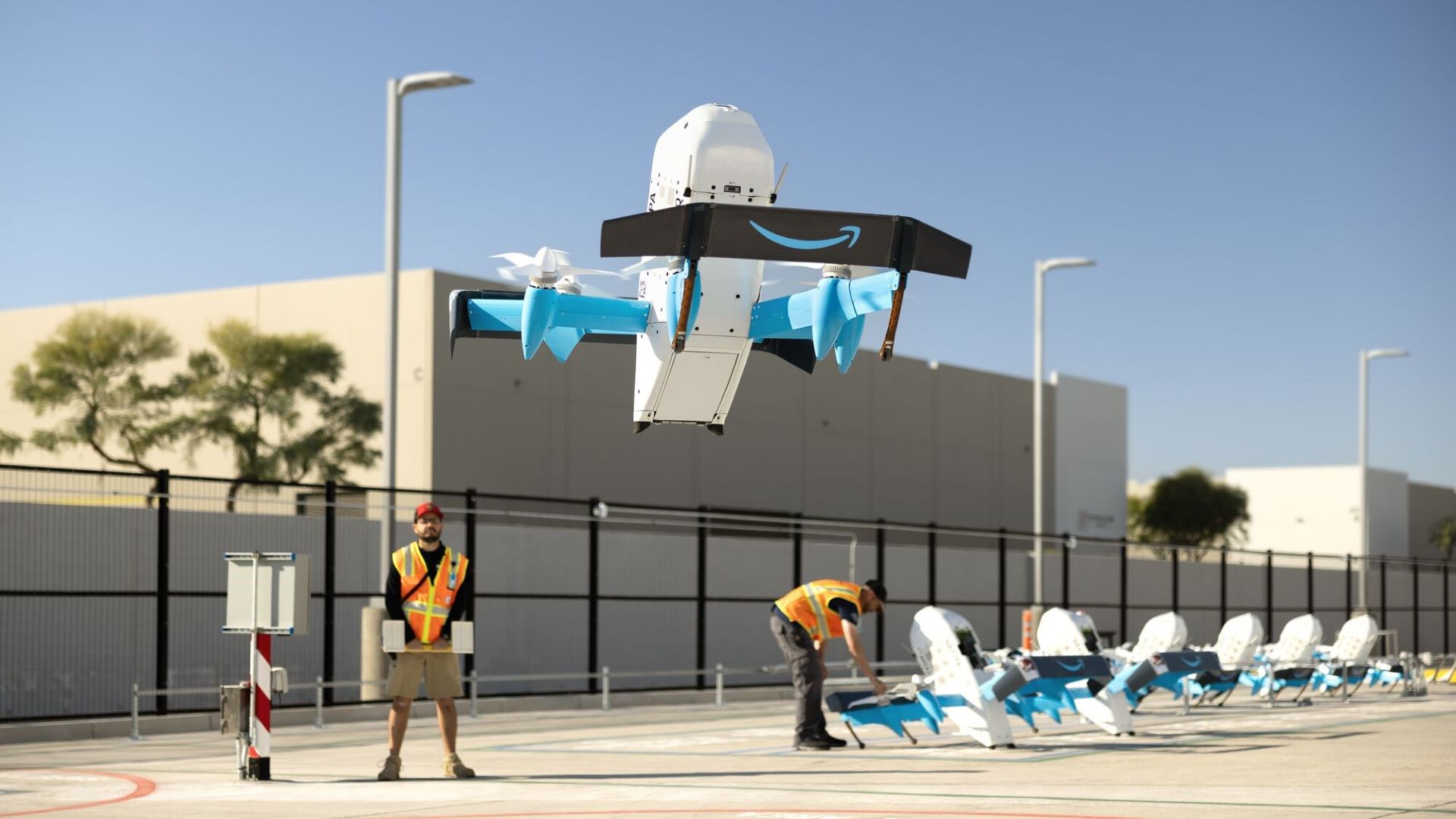
FreightWaves reported that Amazon has been delivering packages by drone since February from the large Darlington fulfillment center, the first location outside the U.S. where Amazon expanded Prime Air. Drones are another way for Amazon (NASDAQ: AMZN) to increase delivery speed and convenience, and the retail giant is deploying drones at scale this year. Like in the U.S., deliveries in the U.K. are made within 60 minutes or less of a customer placing an order using the MK30 drone.
Prime Air expands to the U.K.
Prime Air in the U.K. is currently available to customers with a garden, yard, or driveway in a 7.5-mile radius of the advanced Darlington fulfillment center, Amazon said in a website article on Saturday. When an item weighs 5 lbs (2.2 kg) or less and fits into a large shoebox, the customer can select the drone delivery option during checkout; millions of items are currently eligible. Prime Air allows Amazon to deliver a much larger range of products than Amazon Now, a new ultra-fast delivery service supported by microfulfillment centers in urban centers.
During checkout, customers see a satellite map of their property showing options for "delivery zones," pre-identified using Amazon's digital mapping and AI systems. The customer can select a drop-off zone and will be reminded to keep the area clear, according to Amazon.
| Service parameter | Detail (per FreightWaves) |
|---|---|
| First international Prime Air market | United Kingdom |
| Launch location | Fulfillment center in Darlington, England |
| Reported start of deliveries | Since February |
| Service radius | 7.5 miles from the Darlington fulfillment center |
| Delivery window | 60 minutes or less |
| Maximum item weight | 5 lbs (2.2 kg) |
| Package size limit | Fits in a large shoebox |
| Drone model | MK30, six-rotor aircraft |
| Top speed | 70 mph |
| Flight test program | More than 5,100 flights totaling over 900 hours |
| U.K. regulatory approval | U.K. Civil Aviation Authority |
MK30 aircraft and safety systems
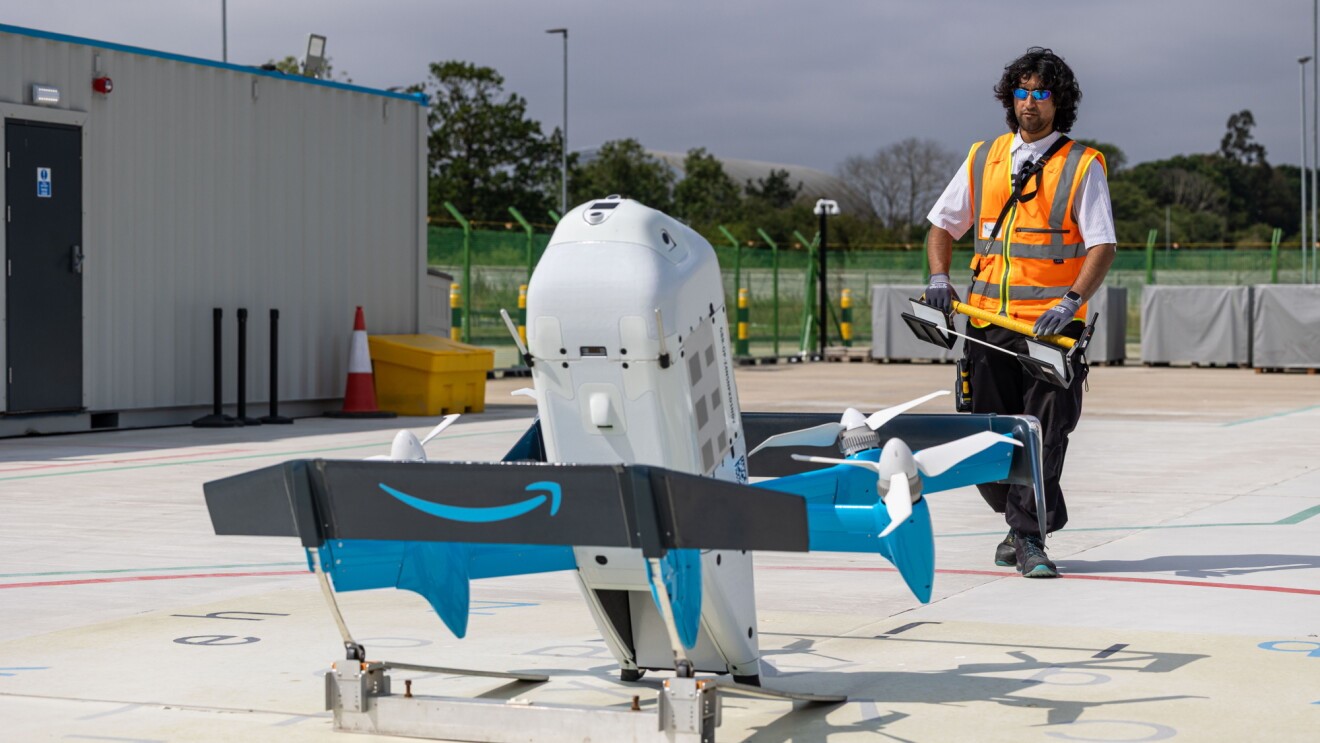
Amazon engineers spent two years building the six-rotor MK30 and conducted more than 5,100 flight tests totaling more than 900 hours in the air to account for high winds and unexpected obstacles, according to FreightWaves. The MK30 can reach speeds of 70 mph.
At the Darlington fulfillment center, a mobile robot called Hercules delivers the customer's order in a pod to an associate who packs it in Prime Air packaging. Amazon said safety is assured with its detect-and-avoid technology and pre-flight inspections, which include a visual check of key components and installing a charged battery before the package gets loaded into the underside of the autonomous aircraft.
Once the drone arrives at a customer's property, it descends while identifying and steering clear of obstacles. Cameras monitor the surrounding airspace and can navigate around unexpected aircraft. The drone then drops the parcel from a safe height. Prime Air boxes have customized cushioning technology at the bottom to protect the item during delivery.
Amazon said in the article:
The result is a machine built around one principle: no single point of failure should ever cause it to lose control. Every flight-critical system has a backup, and the drone's onboard perception system — a network of cameras and sensors — can detect and avoid obstacles that may not have been captured in satellite imagery.
The MK30 can fly safely in light rain and a range of temperatures and wind speeds, but if conditions make flight unsafe, Prime Air is grounded. Real-time weather signals are integrated into the checkout process, meaning that if conditions are unsuitable — heavy rain, high winds, or poor visibility — drone delivery won't appear as a shipping option, and the customer can choose another delivery method instead.
Implications for logistics operators
FreightWaves noted that drones are another way for Amazon to increase delivery speed and convenience. For freight forwarders, 3PL operators, and supply chain directors, the Darlington service shows how a major e-commerce carrier is using aerial assets to compress last-mile transit times inside a defined radius. The current operation applies only to lightweight parcels and is included as part of an Amazon Prime membership; Amazon said it will evaluate delivery fees consistent with other premium speed services as it extends the service to broader areas.
Amazon also plans to invest billions of dollars to expand robot deployment in warehouses across Europe, according to FreightWaves. Operators running parcel consolidation and final-mile networks should watch how Prime Air's service radius and fee structure evolve, because Amazon has stated it will evaluate delivery fees as it extends the service. The U.K.'s Civil Aviation Authority approved Amazon to conduct drone operations.
Watch list
- U.K. Civil Aviation Authority approval and additional permissions as Amazon extends Prime Air beyond the current 7.5-mile service radius.
- Delivery fees: Amazon said it will evaluate fees consistent with other premium speed services as service areas grow.
- European warehouse robotics: Amazon plans to invest billions of dollars to expand robot deployment across European warehouses.
- Weather grounding: Real-time weather signals already suppress drone delivery at checkout during heavy rain, high winds, or poor visibility, so service availability remains weather-dependent.
Sources: