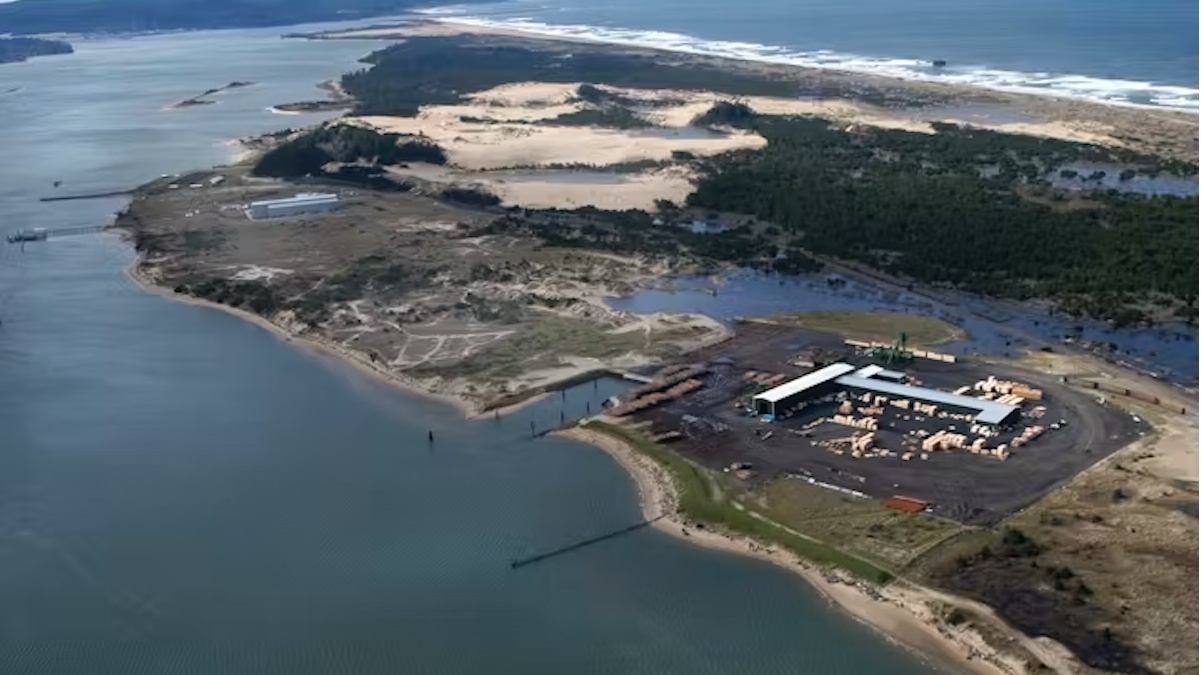
A new West Coast intermodal terminal with a projected capacity of 2 million twenty-foot equivalent units (TEUs) has taken a step forward, as the port commission of the Oregon International Port of Coos Bay approved a $25 million federal grant agreement. According to FreightWaves, the funding will allow planning and pre-construction activities for what is planned as the first fully ship-to-rail intermodal terminal on the West Coast.
The grant comes from the federal Infrastructure for Rebuilding America (INFRA) program and will be matched by $25 million from NorthPoint Development, the port’s partner in the public-private partnership. FreightWaves reports that the matching funds will advance environmental review, permitting, and preliminary engineering activities.
Project Scope and Capacity
The Pacific Coast Intermodal Port will create a new West Coast option for container traffic, moving boxes between the port and a connection via the port’s Coos Bay Rail Line with Union Pacific (NYSE: UNP) and the national rail network in Eugene, Oregon. The terminal is designed with a projected capacity of 2 million TEUs, according to FreightWaves.
Funding Sources
FreightWaves notes that the INFRA grant is just one of several recent funding awards for the estimated $2.3 billion project. The Oregon Legislature has provided $100 million; other federal money includes a $29.75 million Consolidated Rail Infrastructure and Safety Improvements (CRISI) grant, and $11.25 million from the U.S. Maritime Administration’s Port Infrastructure Development Program.
| Funding Source | Amount |
|---|---|
| INFRA Grant | $25 million |
| NorthPoint Development Match | $25 million |
| Oregon Legislature | $100 million |
| CRISI Grant | $29.75 million |
| MARAD Port Infrastructure Development Program | $11.25 million |
Market Context
“The market need for additional freight capacity and supply chain resilience hasn’t changed. If anything, it’s become more apparent,” Chad Meyer, president of NorthPoint Development, said in a release, according to FreightWaves. This statement underscores the rationale behind the project.
Operational Implications for Freight Forwarders and Shippers
The development of the Pacific Coast Intermodal Port offers a new gateway for containerized cargo on the West Coast, potentially easing congestion at existing major ports like Los Angeles and Long Beach. With a direct rail connection via Union Pacific to the national network, shippers may gain an alternative route for trans-Pacific imports and exports. The 2 million TEU capacity provides significant new throughput potential. However, as the project is still in planning and pre-construction phase, immediate operational impact is limited. Freight forwarders and logistics managers should monitor the environmental review and permitting progress, as these will determine the timeline for terminal construction and eventual opening.
Watch List
- Progress on environmental review, permitting, and preliminary engineering funded by the INFRA grant.
- Additional funding rounds or private investment announcements.
- Construction start date and projected completion timeline.
- Integration of Union Pacific rail services and potential service agreements.
- Development of supporting infrastructure at the Port of Coos Bay and along the Coos Bay Rail Line.
Sources: