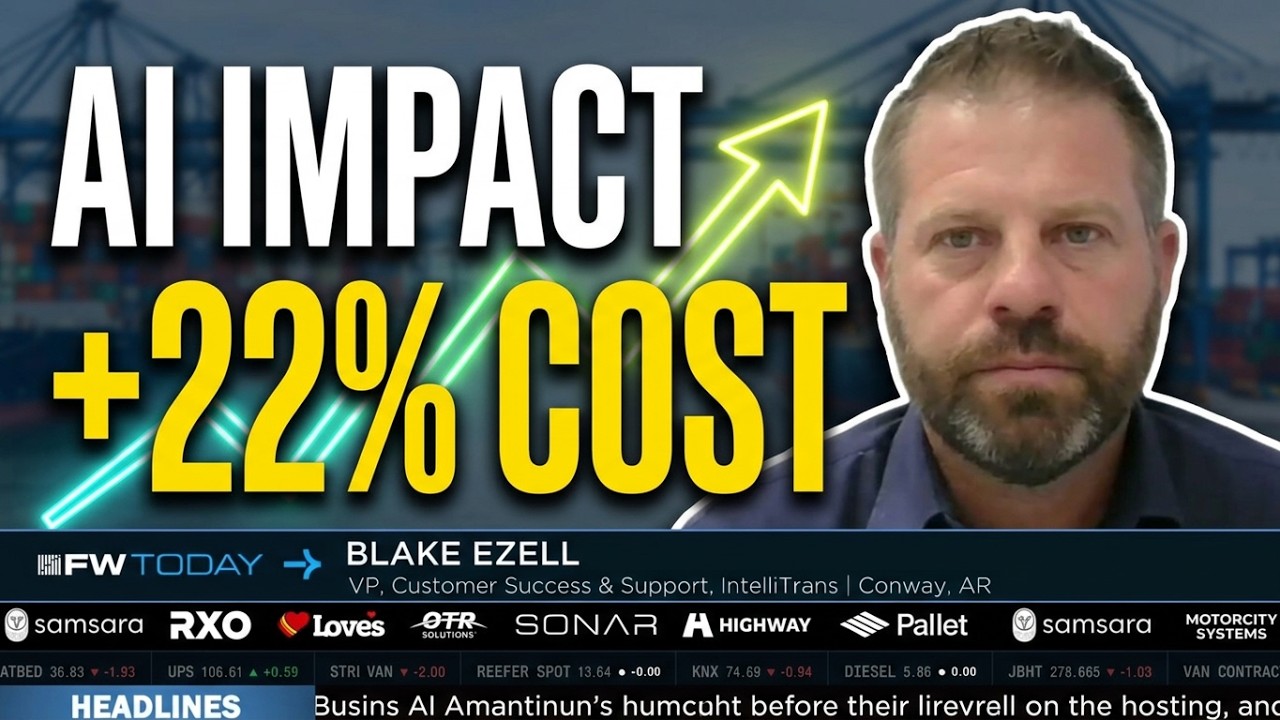
Commodity shippers hauling chemicals, plastics, building materials and metals are paying premium freight rates into a soft-volume market, and AI data center construction is a primary culprit, according to Blake Azell, Vice President of Customer Success and Support at IntelliTrans. Azell calls the phenomenon a "capacity tax": rates are elevated not because demand is broadly strong, but because flatbed and specialized capacity is being absorbed by hyperscaler construction projects at margins traditional shippers cannot match, as reported by FreightWaves.
The Scale of Data Center Investment
Hyperscalers are spending the equivalent of what the interstate highway system cost annually — roughly $20 billion a year over 35 years — every two weeks, totaling approximately $700 billion in projected outlays, according to Azell. A single 500-megawatt data center requires an estimated 30,000 truckloads of concrete, steel, copper, fiber optics and generators. A recently announced 10-gigawatt facility in Utah — 20 times that size — would multiply those freight needs accordingly. Only 8% of announced and contracted data center projects are currently under any level of construction, pointing to years of sustained flatbed demand ahead, FreightWaves reported.
Freight Market Imbalance
Against that backdrop, overall freight volumes have weakened. Azell cited roughly 4% volume erosion since 2023, with chemicals, forest products, non-metallic minerals and motor vehicles either flat or declining on the rail side. Yet the flatbed load-to-truck ratio has reached 73-to-1, and tender rejections are running at 16%, a combination Azell described as a structural mismatch rather than a cyclical recovery, according to FreightWaves.
"Our commodity shippers are now almost getting into a bidding war with the tech giants — and that's really where the concern is," Azell said.
Driver Shortage Compounds Squeeze
Driver supply has compounded the squeeze. Azell estimated the industry has lost roughly 250,000 drivers since 2020 through retirement and regulatory attrition, while fuel surcharge economics continue to pressure small independent carriers that dominate the flatbed and specialized segments, FreightWaves reported. Because hyperscalers are largely price-insensitive to freight cost increases — their capital spending is backstopped by strong cash flows and rising equity valuations — they can outbid traditional commodity shippers for available capacity without meaningful financial pain.
Four Steps for Shippers
Azell outlined four actions shippers should take to navigate the environment, according to FreightWaves:
- Abandon national rate averages — benchmark by specific lane and freight type instead.
- Renegotiate contract rates — validate that rates signed a year ago still support carrier capacity commitments, since small carriers are "bleeding OpEx" and are becoming selective about which loads they accept.
- Pursue modal arbitrage — rail capacity utilization is sitting near 70% and rail rates are up only about 2%, making transload moves a cost-advantaged alternative where lane geography allows.
- Invest in data strategy — before chasing AI tools, the competitive edge lies in clean, accessible underlying data rather than in the algorithms built on top of it.
Key Metrics at a Glance
| Metric | Value |
|---|---|
| Flatbed load-to-truck ratio | 73:1 |
| Tender rejection rate | 16% |
| Volume erosion since 2023 | ~4% |
| Drivers lost since 2020 | ~250,000 |
| Data center market size (current) | ~$83 billion |
| Projected data center market (5 years) | ~$150 billion |
| Rail capacity utilization | ~70% |
| Rail rate increase | ~2% |
Long-Term Structural Shift
The data center market itself is projected to grow from roughly $83 billion currently to approximately $150 billion over the next five years, according to figures Azell cited. With the Department of Defense, Middle Eastern sovereign funds and international competitors all accelerating data center investment, Azell said shippers should treat the capacity pressure as a permanent structural feature of the freight market rather than a temporary disruption, as reported by FreightWaves. For the foreseeable future, the competition for flatbed capacity between hyperscalers and commodity shippers will continue to tighten, making strategic adjustments essential for those moving bulk goods.
Sources: