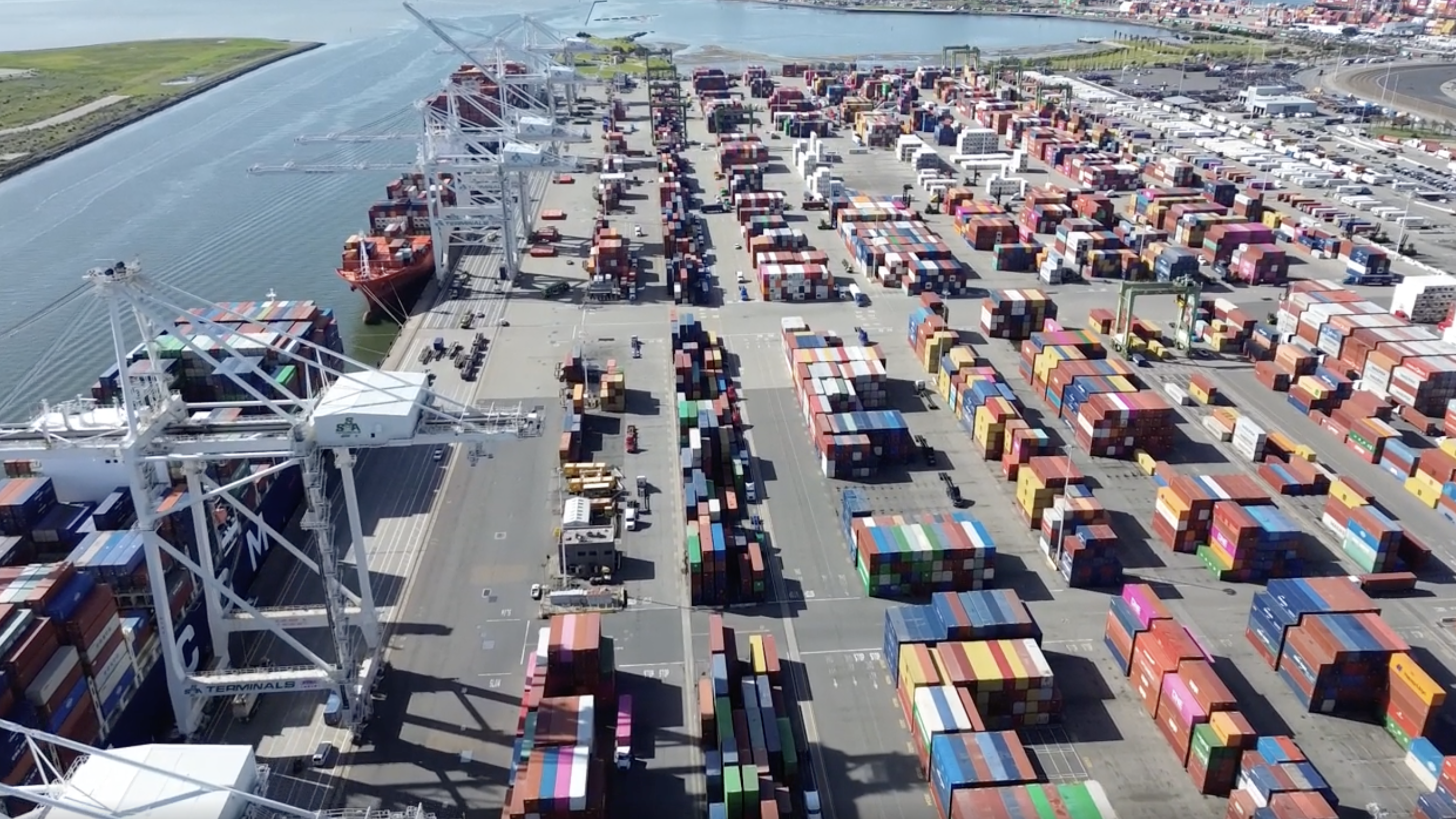
Lead: The Port of Oakland kept loaded container volumes essentially flat through the first seven months of 2026, even as July totals fell 11.4% from the same month last year, according to FreightWaves.
FreightWaves, citing port data, reported that the northern California gateway handled 179,999 TEUs (twenty-foot equivalent units) in July, virtually unchanged from June. Compared with July 2025, total container volume declined 11.4%, with full imports down 14% and full exports down 8.5%.
July container volumes at a glance
FreightWaves detailed the July results as follows:
| Metric | July 2026 | Change vs. July 2025 | Change vs. June 2026 |
|---|---|---|---|
| Total container volume | 179,999 TEU | -11.4% | Virtually unchanged |
| Full imports | 79,426 TEU | -14% | +1.7% |
| Full exports | 60,005 TEU | -8.5% | -7.9% |
| Combined laden cargo | 139,431 TEU | -11.7% | — |
| Empty containers | 40,568 TEU | -10.2% | — |
Month over month, full imports increased 1.7% from June while full exports declined 7.9%, FreightWaves reported. Empty container volume totaled 40,568 TEUs, down 10.2% from July 2025.
Year-to-date stability
Through July, Oakland handled 1,294,664 total TEUs, a 3.8% decline from the same period in 2025, according to FreightWaves. The decrease was driven primarily by lower empty-container activity, which fell 11.4%; laden cargo volume declined by 1.5% over the same period.
Full exports were slightly ahead of last year through July, increasing 0.4%, while full imports declined 3.1%, the report said. These results leave the port's core loaded cargo activity broadly stable, even as overall container movements remain under pressure.
"July was a challenging month compared to last year, but our laden volumes remain essentially flat year to date and exports are slightly ahead of 2025," said Jason Garben, the port's acting maritime director, in a release. "Despite uncertainty in the market, we are hearing a positive outlook from our ocean carrier partners for the remainder of the year."
This week, per FreightWaves, Hapag-Lloyd resumed scheduled services with the arrival of the Missouri Express, the first vessel to call Oakland as part of the WC5 U.S.-flag service.
Carrier calls and services
The gateway recorded 81 vessel calls in July, compared with 95 calls during the same month a year ago, FreightWaves reported. The decline accompanied the year-over-year reduction in total and laden container volume.
Implications for shippers and operators
FreightWaves reported that Oakland's full exports rose 0.4% year-to-date through July while full imports fell 3.1%, leaving loaded cargo activity broadly stable. In July, full imports dropped 14% year-over-year and full exports fell 8.5%. Vessel calls declined from 95 in July 2025 to 81 in July 2026, so shippers using Oakland should confirm berthing schedules and vessel cutoffs with their freight forwarders. The resumed Hapag-Lloyd WC5 service, which brought the Missouri Express to Oakland this week, adds a scheduled U.S.-flag call for the gateway; shippers can contact Hapag-Lloyd for service details.
Sources: