iGEN
Visit IGEN World Explore IGEN Expo
EXPLORE UPGRADE PLANS
BREAKING
India Seeks Sunflower Oil Alternatives as Black Sea Disruptions Delay Shipments and Raise Prices GenAI to Reshape Indian Workforce, Global Capability Centres to Cushion Job Impact: Goldman Sachs Mahindra Arm and SML Merge to Become India's 4th Largest Commercial Vehicle Player Exporters Flag Concerns Over West Asia War Impact on Trade and Logistics Asian stocks trade mixed after Fed holds rates; Kospi rallies 4%, Shenzhen slips 300 points RateSafe App Wins DASH Hackathon, Empowers Truck Drivers with Data-Driven Load Decisions Broker Liability: $604M Judgment Signals New Era of Risk in Trucking $600 Million Nuclear Verdict Against C.H. Robinson Reshapes Broker Liability Landscape Housing Market Crash Slams Last-Mile Delivery: Growth Halved, Consolidation Looms Unpacking Rail Earnings: How Volume Growth Fuels Merger Talks India Seeks Sunflower Oil Alternatives as Black Sea Disruptions Delay Shipments and Raise Prices GenAI to Reshape Indian Workforce, Global Capability Centres to Cushion Job Impact: Goldman Sachs Mahindra Arm and SML Merge to Become India's 4th Largest Commercial Vehicle Player Exporters Flag Concerns Over West Asia War Impact on Trade and Logistics Asian stocks trade mixed after Fed holds rates; Kospi rallies 4%, Shenzhen slips 300 points RateSafe App Wins DASH Hackathon, Empowers Truck Drivers with Data-Driven Load Decisions Broker Liability: $604M Judgment Signals New Era of Risk in Trucking $600 Million Nuclear Verdict Against C.H. Robinson Reshapes Broker Liability Landscape Housing Market Crash Slams Last-Mile Delivery: Growth Halved, Consolidation Looms Unpacking Rail Earnings: How Volume Growth Fuels Merger Talks
Home ›› Logistics ›› Shipping Freight ›› Shipping Lines ›› Trucking Capacity Tightness Persists as Regulatory Pressures and Driver Shortages Squeeze Supply

Trucking Capacity Tightness Persists as Regulatory Pressures and Driver Shortages Squeeze Supply

Trucking capacity remains tight as regulatory pressures and driver shortages push tender rejections well above historical norms. Spot rates are holding steady even as diesel prices fall, signaling that capacity constraints—not fuel costs—are driving rates. Carrier earnings from Knight-Swift, Werner, and J.B. Hunt show gains from supply-side tightness rather than demand recovery, with capacity expected to remain constrained through fall and into 2025.

iG
iGEN Editorial
July 30, 2026
Trucking Capacity Tightness Persists as Regulatory Pressures and Driver Shortages Squeeze Supply

Trucking capacity is tightening due to regulatory pressures and driver challenges, not just demand, according to FreightWaves. The divergence between spot rates and diesel prices supports the thesis that tight capacity—not fuel costs—is sustaining elevated freight rates. The Sonar NTI sat at $3.51 per mile as of the latest reading, climbing back from a mid-to-late June low near $4.90, while the diesel price at truck stops registered $3.48 per gallon, down from a July high near $3.80.

Tender Rejections Remain Elevated Across All Modes

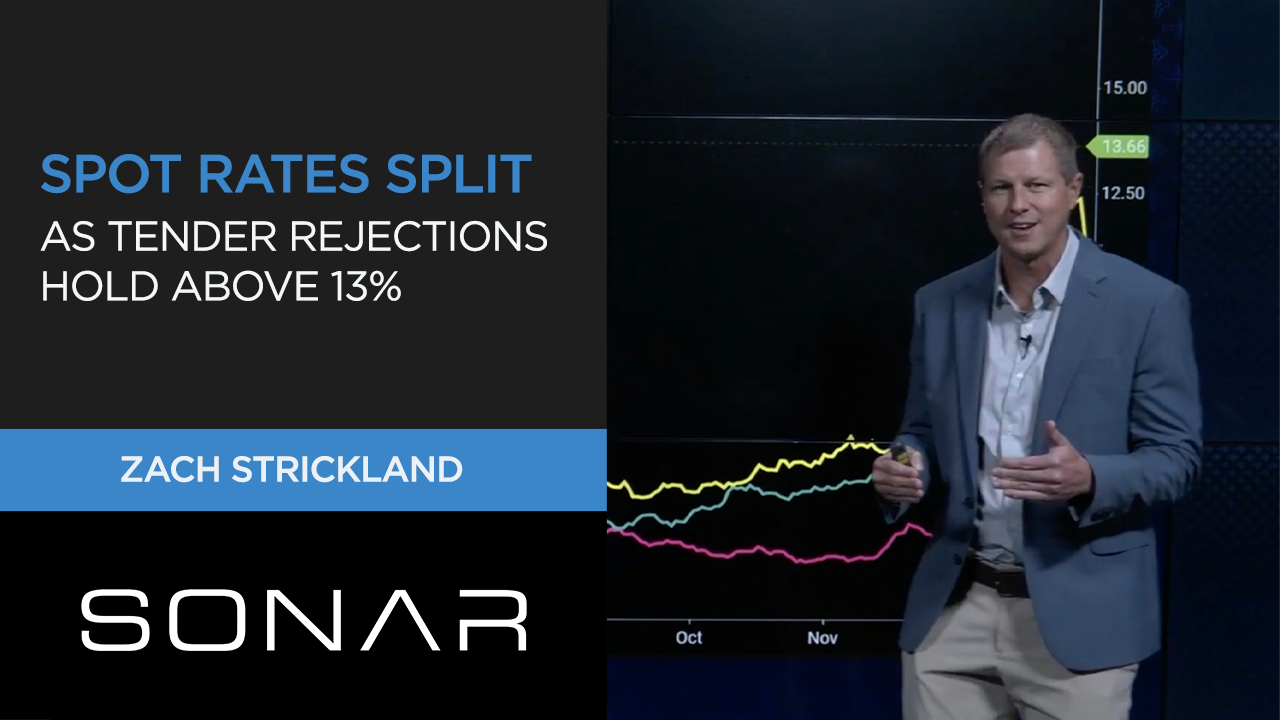
Tender rejections remain well above historical norms across all modes, according to Sonar data. The Sonar Truckload Rejection Index (STRI) stands at 14.36%, above the six-month average of roughly 10.9%. Flatbed is the tightest mode at 23% rejections—down sharply from the 40% range seen in June and early July but still historically elevated. Reefer rejections sit at 19.46%, or nearly one in five loads, while van rejections are running nearly 50% above year-ago levels.

Mode Rejection Rate Historical Context
STRI (overall) 14.36% Above 6-month avg ~10.9%
Flatbed 23% Down from 40% range in June/July
Reefer 19.46% Nearly 1 in 5 loads rejected
Van ~50% above year-ago Not specified

Carrier Earnings Reinforce the Capacity-Constraint Narrative

Recent carrier earnings reinforce the capacity-constraint narrative. Knight-Swift reported that its truckload segment operating income rose 69% year over year, with the carrier noting that strategic pricing recovery accelerated in June as recent bids took effect. The company described rapid tightening in supply-driven dynamics and tender rejections reaching levels not seen since 2021.

Werner CEO Derek Leathers said the company’s organic dedicated business is growing, and revenue in both Werner’s and J.B. Hunt’s dedicated and truckload segments improved. The gains are coming from mode shift and share shift rather than a broad demand recovery, with J.B. Hunt reporting significant intermodal growth and strong intermodal results appearing across carrier earnings broadly.

Regulatory and Driver Challenges Intensify Squeeze

Regulatory pressures are removing shadow capacity as ELD (Electronic Logging Device) providers exit the market alongside ongoing driver and CDL (Commercial Driver's License) school removals—so impacting capacity and the quality of driver availability, according to FreightWaves' reporting on Werner's commentary. Driver recruiting headwinds are intensifying the capacity squeeze. A tight market gives drivers more options, and regulatory enforcement is raising barriers to entry and complicating retention efforts.

Nuclear Verdicts Reshape Shipper Behavior

Rising nuclear verdict exposure is also reshaping shipper behavior. Shippers are increasingly moving freight to well-established asset-based carriers to limit liability, fraud, and cargo risk—a dynamic expected to benefit carriers with large dedicated fleets through the remainder of 2024 and into 2025.

Watch List: Capacity Outlook Through Fall and Beyond

With capacity continuing to exit the market and no significant fleet additions visible in large-carrier earnings, the market is expected to remain tight through fall and into the next year. Key factors to monitor include further regulatory enforcement actions, driver recruiting and retention trends, and any shifts in demand that could alter the supply-demand balance.


Sources: FreightWaves
Keep Reading

Recommended Stories

Is This Trucking Market Different? Why Capacity Won't Flood Back In Logistics

Is This Trucking Market Different? Why Capacity Won't Flood Back In

Triumph Financial CEO Aaron Graft argues that the current trucking upcycle is more structural than cyclical, with litigation risk, regulatory pressure, and a tight driver market preventing a surge of new capacity. Despite broker margin compression, load sizes are growing, and Triump's factoring data shows a 26% quarter-over-quarter rise in average invoice size, indicating supply tightening rather than demand surge.

July 28, 2026
TFI International Q2: LTL Steady but Truckload Soars on Supply Constraints, CEO Says Logistics

TFI International Q2: LTL Steady but Truckload Soars on Supply Constraints, CEO Says

TFI International reported strong Q2 earnings with EPS up 41% to $1.65. However, the performance diverged sharply between LTL (18% EBITDA margin) and Truckload (24.1%). CEO Alain Bedard attributed truckload gains to supply constraints, not demand, and said this market dynamic is unprecedented in 30 years. LTL volume surged 7.5% but revenue per shipment fell 2%, leading to cost and service challenges.

July 28, 2026
Trucking Capacity Won't Flood Back In: Why This Market Is Structurally Different Logistics

Trucking Capacity Won't Flood Back In: Why This Market Is Structurally Different

Increased litigation, regulation, and legislation are acting as barriers to entry in the trucking market, preventing the surge of new capacity seen in previous upturns. According to Aaron Graft, CEO of Triumph Financial, this structural shift suggests tight market conditions may persist longer than anticipated, impacting profitability and driver availability.

July 24, 2026
Muted Truck Transportation Job Growth Signals Persistent Capacity Constraints for Shippers Logistics

Muted Truck Transportation Job Growth Signals Persistent Capacity Constraints for Shippers

U.S. truck transportation employment in June 2026 totaled 1,466,600 jobs, just 1,000 higher than January, with monthly declines in four of the last five months. Analysts cite regulatory pressure, high operating costs, and a fragile consumer economy as factors, warning that continued rate increases may be needed to attract drivers. Meanwhile, warehouse jobs grew by 18,100 over three months but remain below year-ago levels, and rail employment continues to lag.

July 2, 2026