Russian-linked merchant shipping is changing how it moves through the Black Sea and Sea of Azov — adding anti-drone cages to hulls, hugging the Turkish coast, switching export ports and considering armed military detachments aboard cargo ships — as Ukraine's expanding maritime drone campaign turns commercial vessels into targets, according to Splash247.
Ukraine's Unmanned Systems Forces claims to have hit more than 200 vessels across the Black Sea and Sea of Azov since launching its latest campaign in early July, Splash247 reported, though the figure has not been independently verified. The campaign has already forced Russia to sharply restrict Sea of Azov shipping in July and to ban night-time vessel movements at Novorossiysk during the height of the attacks.
Where the disruption is concentrated
The fallout is concentrated on two export corridors. Grain previously moving through Sea of Azov ports has been redirected by road and rail towards deepsea Black Sea terminals, while Russia is examining greater use of Baltic ports as a safer export alternative, according to Splash247. Russian state shipping company FESCO and Turkish operator Kalyon have temporarily suspended Black Sea services after a string of strikes, and some Russia-linked tankers now sail close to the Turkish coastline rather than taking direct open-water routes.
Cages, netting and the Caruzo sighting
The most visible example of the new protective measures, according to Splash247, is the 28-year-old suezmax Caruzo, a tanker sanctioned by the UK, EU and a number of other jurisdictions. TankerTrackers.com photographed the vessel passing Istanbul carrying what it said was around 1 million barrels of Russian crude, with netting covering the accommodation block and unusual cage-like structures suspended over the aft section of the hull.
TankerTrackers.com believes the netting is intended to protect the superstructure from aerial drones, while the hanging structures appear designed to provide stand-off protection around the engine-room area against uncrewed surface vessels.
Splash247 described the Caruzo as the most visible example yet of increasingly improvised measures, pairing low-tech barriers, armour and sandbags with more fundamental changes to routing and sailing behaviour.
The adaptation playbook
| Measure | What's happening (per Splash247) |
|---|---|
| Coastal routing | Russian-flagged tanker Strateg tracked hugging the Turkish coastline; TankerTrackers.com suggested the vessel sought protection from proximity to NATO member Turkey; other tankers have adopted similar routings |
| Anti-drone structures | Netting over accommodation blocks; cage-like structures over aft hulls, as seen on Caruzo |
| AIS gaps | Some Russia-linked vessels disappear from public AIS tracking for parts of voyages, though gaps have long been linked to sanctions evasion |
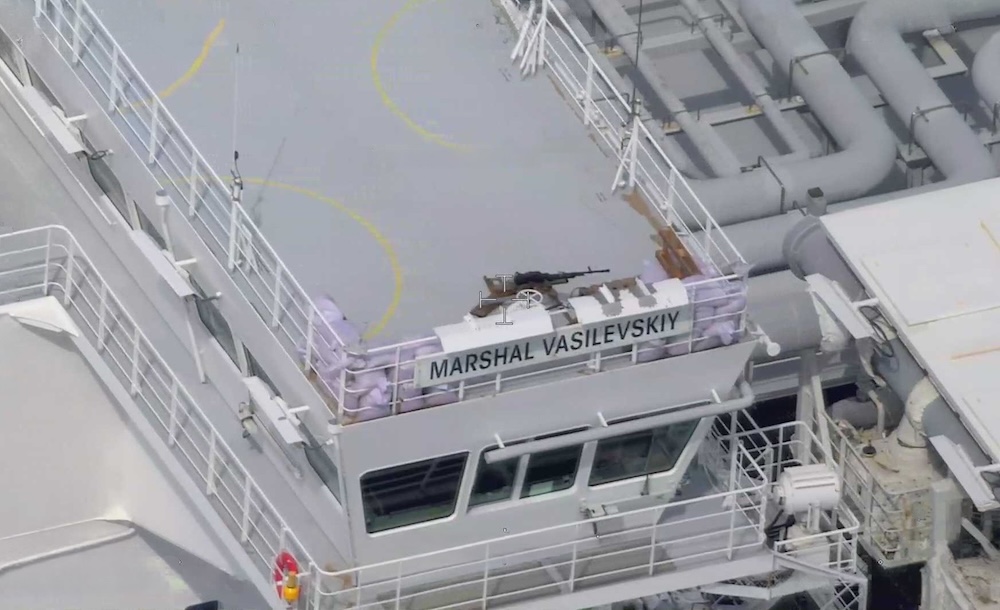
| Armed guards (proposed) | Moscow discussing military personnel, heavy machine guns, armour plating, sandbags and anti-drone mesh for vessels from the Sea of Azov |
| Convoy / escort | Patrol-boat escorts and convoying considered for commercial traffic |
| Port restrictions | Sea of Azov shipping restricted in July; night movements banned at Novorossiysk during peak attacks |
Armed guards and convoy plans
Russian military and transport authorities have been discussing plans with grain traders and shipowners to put military personnel aboard merchant vessels operating from the Sea of Azov, according to Splash247. Proposals include armed detachments, heavy machine guns and other anti-drone equipment, alongside armour plating, sandbags and anti-drone mesh.
The concept would build on an existing Russian security presence aboard parts of the shadow fleet operating principally through the Baltic, Splash247 reported. But putting weapons and troops aboard civilian vessels raises legal, insurance and flag-state questions and potentially further blurs the distinction between merchant shipping and military logistics.
What shippers and operators should expect
- Routing volatility: Expect more coastal routings, port switches and cargo diversions from Sea of Azov ports to deepsea Black Sea terminals and potentially Baltic ports.
- AIS uncertainty: Some Russia-linked voyages will show tracking gaps; Splash247 noted these gaps have long been associated with sanctions evasion and cannot automatically be attributed to drone avoidance.
- Service suspensions: FESCO and Kalyon have already temporarily suspended Black Sea services.
- Legal and insurance friction: Any move to put armed detachments aboard civilian vessels could trigger flag-state, insurance and liability complications.
Watch list
The Financial Times reported today, citing Ukrainian officials, that Ukraine has paused drone strikes on tankers using Russia's Black Sea port of Novorossiysk following a request from US vice-president JD Vance. The request came amid Washington's concern that attacks were disrupting oil markets, according to the FT report cited by Splash247.
Operators should track whether that pause holds, whether Moscow proceeds with armed-guard and convoy arrangements, and whether Sea of Azov grain continues shifting by road and rail towards deepsea Black Sea terminals and Baltic ports.
Sources: