
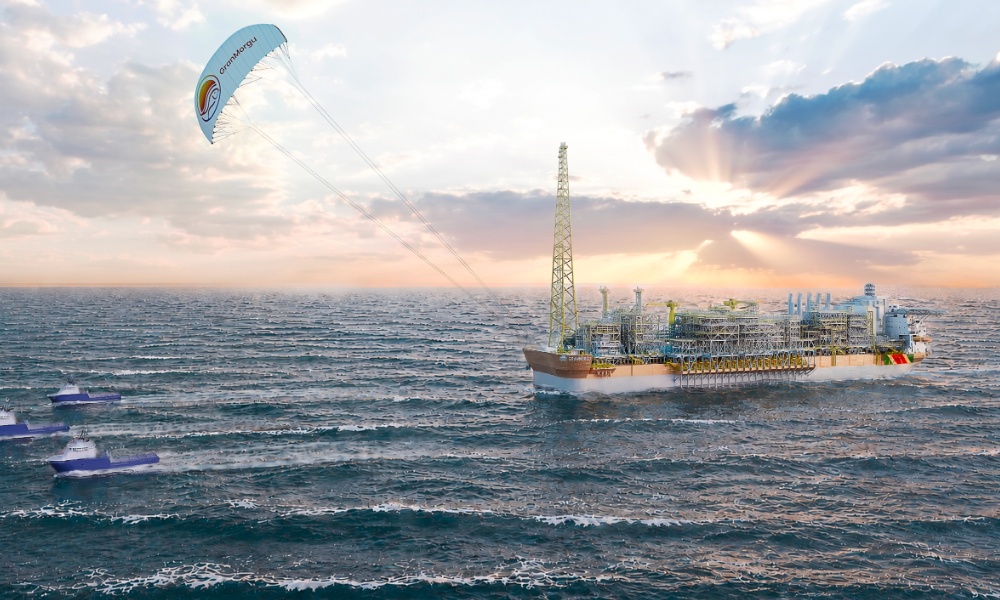
A kite-traction system will be tested on an FPSO for the first time, potentially cutting fuel burn and transit time for the GranMorgu floater's journey from its Chinese construction yard to offshore Suriname. The trial, announced by the STS joint venture — comprising SBM Offshore, Technip Energies and TotalEnergies — in partnership with French firm Beyond the Sea, could reshape how ultra-large vessels are towed across oceans.
Why a Kite for an FPSO?
Conventional FPSO towing relies on tugboats burning marine diesel throughout a voyage that can last weeks. According to the source, the project's main objective is to reduce towing duration and fuel consumption by implementing a kite traction system during the tow from the construction site in China to the destination in Suriname. The technology is described as a scalable alternative to traditional propulsion for all types of vessels. Beyond the Sea's SeaKite 2400 system will provide automated traction depending on wind conditions.
The Partners and Technology
The STS joint venture brings together three specialized players: SBM Offshore as a floater expert, Technip Energies as an engineering and technology company, and TotalEnergies as a major energy company. Beyond the Sea contributes its kite-traction know-how. The project will be delivered through a phased R&D approach covering technology development and qualification, cost and operational readiness, and an intensive onshore test program before integration on the FPSO in China. Additional objectives include validating the kite's wing-launching and recovery system and collecting data for system sizing optimisation using digital modelling.
GranMorgu FPSO Project
The GranMorgu FPSO is the first development within Block 58, located approximately 150 km offshore Suriname. It will be the first large deepwater project in Suriname, with expected production capacity of up to 220,000 barrels of oil per day and associated gas treatment capacity of up to 500 million cubic feet per day. First oil is targeted for 2028.
| Parameter | Value |
|---|---|
| FPSO | GranMorgu |
| Block | Block 58 |
| Distance offshore | ~150 km |
| Oil production capacity | 220,000 bbl/day |
| Gas treatment capacity | 500 MMsf/day |
| Expected first oil | 2028 |
Quote from SBM Offshore
Laurent Le Touze, SBM Offshore's technology and product development director, stated about the collaboration: "Decarbonization is one of our strategic priorities, and we are very much looking forward to assessing new future opportunities in this field." This underscores the dual drivers of cost and emissions reduction behind the initiative.
What This Means for Logistics Operators
For freight forwarders and ocean carriers, the successful deployment of kite-assisted towing on a 220,000-bpd FPSO could demonstrate a viable pathway to reduce fuel costs on long-haul towing operations — often a significant expense in deploying floating production units. While the trial is specific to the GranMorgu FPSO, the technology's scalability means it could later be applied to other large vessels, including tankers and LNG carriers, affecting shipping economics on major routes. The project also serves as a use case to validate kite traction for large-scale vessels, potentially influencing future towage contracts and vessel-design decisions. The timeline to first oil in 2028 gives the industry a window to observe results from the phased R&D program.
Sources:


