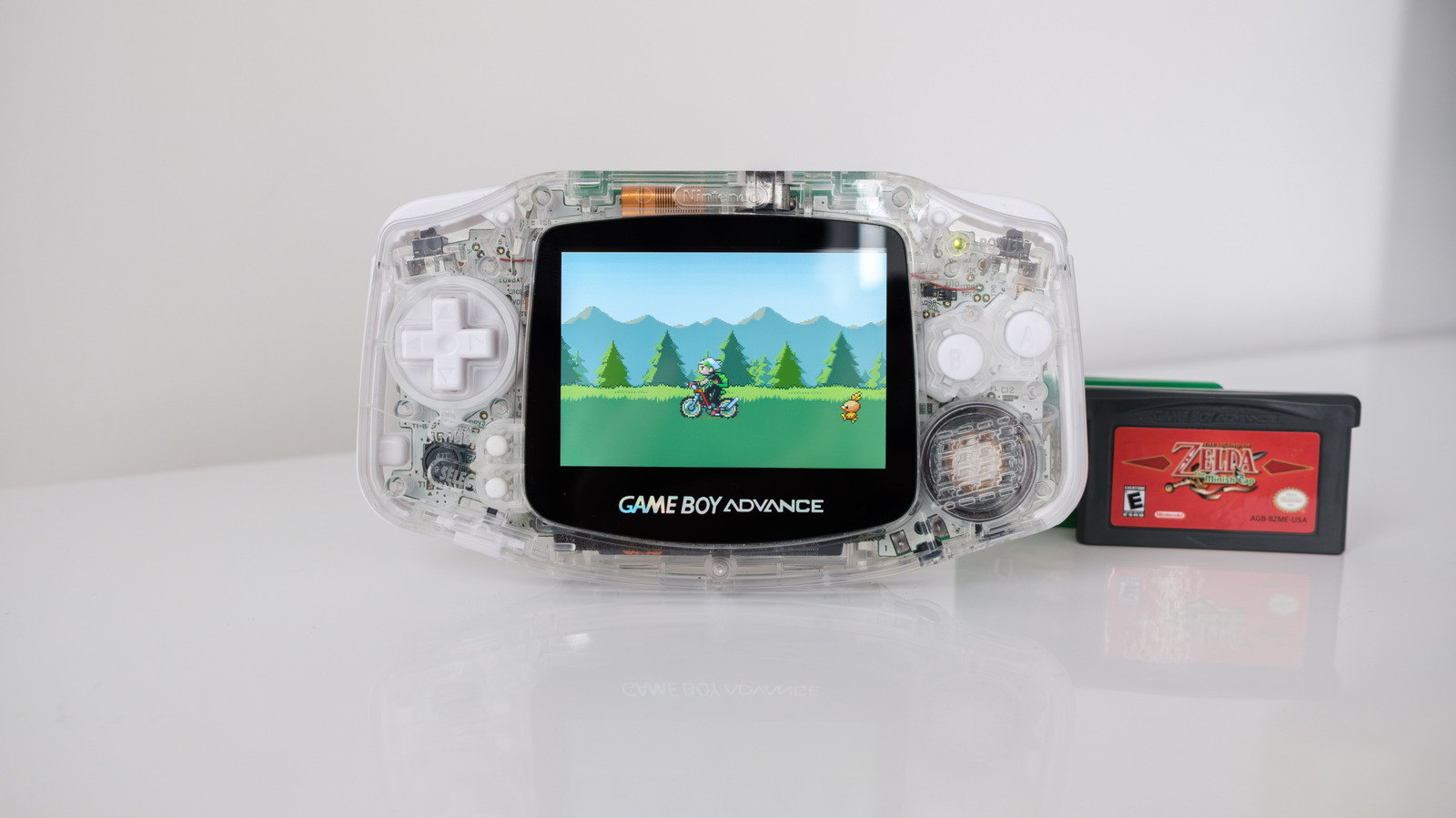
Today marks the 25th anniversary of the Game Boy Advance's (GBA) US release, and Engadget has published a retrospective celebrating the platform's most memorable titles. According to Engadget, the GBA originally went on sale in Japan in March, but US consumers had to wait until June 11, 2001, for the handheld to arrive.
A Look Back at the Hardware
Engadget described the original GBA as packing a custom system-on-a-chip with two processors running at 16.7MHz and 8.3MHz (the latter used for backwards compatibility) and 288 kilobytes of combined RAM. This represented a massive performance leap over previous Nintendo handhelds, allowing SNES-level graphics while supporting a catalog of games dating back to 1989. The device featured a 240 x 160 TFT display with rich colors, a shift from portrait to horizontal layout, and the addition of shoulder buttons alongside the classic D-pad and A/B buttons. Launch colors included solid indigo, orange (Japan-exclusive), translucent glacier blue, and fuchsia.
In 2003, Nintendo released the GBA SP (SP stands for special), which added a clamshell design and a dedicated backlight, improving portability and playability in any lighting condition. The GBA Micro followed in 2005, shrinking the system to Lilliputian proportions and becoming the last official Game Boy release. Engadget called the GBA "arguably Nintendo's most diverse and interesting pure handheld platform of all time," despite later systems like the DS and 3DS.
The Games That Defined the GBA
Engadget highlighted Advance Wars as a standout title, noting it was the first turn-based strategy game for many players. Developed by Intelligent Systems, the game introduced cute infantry icons and tank units on grid-based skirmishes, with simple rules that gradually increased in complexity. "It's easy to pick up and play, and forgiving enough for beginners to make their first tentative steps into the hugely satisfying tactics genre," according to Engadget.
The article also mentioned Golden Sun as a legendary title, though it did not provide further details about the game. Engadget described the GBA's library as "one of the greatest of any system," emphasizing the platform's strength in 2D sprite-based graphics at a time when home consoles like the N64 and PlayStation had moved to polygons.
Evolution of the Platform
| Model | Release Year | Key Features |
|---|---|---|
| Original GBA | 2001 (Japan March, US June) | Horizontal layout, 240x160 TFT display, 16.7MHz/8.3MHz processors, 288KB RAM, four initial colors |
| GBA SP | 2003 | Clamshell design, built-in backlight, improved portability |
| GBA Micro | 2005 | Ultra-compact size, last official Game Boy release |
Engadget noted that the GBA launched at $100 (equivalent to about $190 today), making it relatively affordable. The console's sturdy build and compact design contributed to its long-lasting appeal, and Engadget described it as representing "the peak of classic 2D sprite-based graphics."
Legacy and Impact
The article serves as a nostalgic trip down memory lane on the 25th anniversary, with Engadget staff sharing personal favorites. The GBA's ability to play original Game Boy and Game Boy Color titles via backwards compatibility expanded its library further. Engadget concluded that while the handheld was not the most powerful of its generation, it had an exceptional game library that cemented its place in gaming history.
Sources: