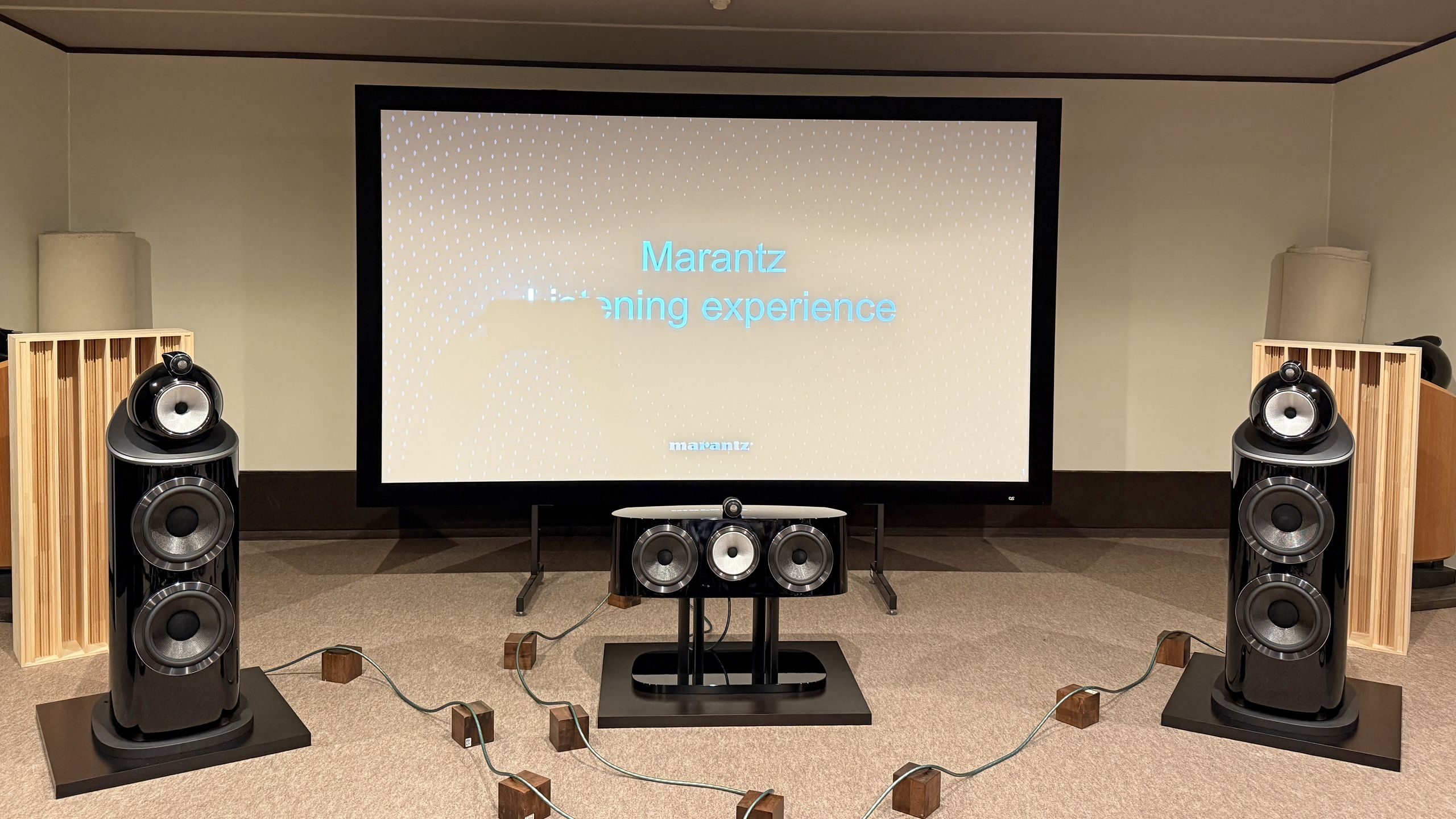
When tuning a high-end AV receiver, the listening environment is as critical as the electronics. At Denon and Marantz's combined factory in Shirakawa, Japan, the companies operate a custom reference home theater that has been in continuous use since 1983 to develop and validate their products, according to TechRadar.
The room is equipped with a 9.4.6-channel Dolby Atmos system: eight Bowers & Wilkins 801 D4 speakers, an HTM81 D4 center channel, four ASW Series subwoofers, and six ceiling-mounted speakers — roughly $250,000 of loudspeakers, TechRadar reported. Visuals are handled by a Sony VPL-VW535 4K projector and an Oppo UDP-205 4K Blu-ray player (discontinued but still considered a benchmark).
Purpose and Practical Engineering
The room was first established for the development of the first Marantz AV receiver, which launched in 1985. Today it serves as the primary tuning room for Denon and Marantz's Sound Masters, who audition every new AVR model — including the recently launched Denon X3900H and X2900H and the flagship Marantz AVC A1H, the company's first model to support 9.4.6 speaker channels. The engineers position the listener's seat 12 feet from the center channel and 10 feet from the rears, a placement that does not strictly follow Dolby's equilateral guide but is optimized for the actual system.
Performance Observations
TechRadar's Matt Bolton described the sound as "completely disconnected from the equipment" and "the platonic ideal of Dolby Atmos' spatial audio." He noted that the system "feels like it has endless power, yet it feels like it's not exerting itself hard at all — there's no sense of the forceful and forward sound that you're likely to get from soundbars or compact options." The demo included a scene from A Star is Born (2018), where the seamless cohesion from bass to treble was highlighted.
| Component | Model/Brand | Quantity | Est. Cost (Total) |
|---|---|---|---|
| Main speakers | Bowers & Wilkins 801 D4 | 8 | ~$200,000 |
| Center speaker | Bowers & Wilkins HTM81 D4 | 1 | ~$10,000 |
| Subwoofers | Bowers & Wilkins ASW Series | 4 | ~$30,000 |
| Ceiling speakers | Bowers & Wilkins (unspecified) | 6 | ~$10,000 |
| Total speakers | ~$250,000 | ||
| Projector | Sony VPL-VW535 4K | 1 | ~$5,000 (new at launch) |
| Blu-ray player | Oppo UDP-205 4K | 1 | ~$1,500 (discontinued) |
| AV receiver | Marantz AVC A1H | 1 | ~$4,500 |
Implications for CTOs and Hardware Engineering
For enterprise technology leaders, the reference room exemplifies a closed-loop quality assurance process: a dedicated, calibrated environment that isolates variables and allows engineers to validate performance against known acoustic benchmarks. The investment in a $250k speaker system is not for consumer enjoyment but for repeatable, high-precision testing. The same principle applies in any hardware development — whether for logistics IoT sensors, network equipment, or server infrastructure. A controlled reference environment reduces time-to-market for product releases by catching flaws before field deployment.
"The sound is so amazingly cohesive from top to bottom, and always has a new gear to find when it needs to step up the resonant bass..." — This level of granularity in auditory feedback is the equivalent of a network analyser in a data center: you cannot fine-tune what you cannot measure.
The factory tour also included production lines for hi-fi components, though TechRadar noted that manufacturing lines are similar across factories. The key differentiator is the listening room, which has been maintained and upgraded since 1983 — a testament to long-term capital investment in quality infrastructure.
Key Takeaways for Target Audience
- Benchmarking hardware costs matter: A single reference setup can cost more than a small data center, but the ROI is realized across thousands of units tuned from it.
- Spatial audio standards (Dolby Atmos) require physical room geometry and acoustic treatment — enterprise analogies apply to testing chambers for RF, thermal, or vibration.
- Longevity of infrastructure: The room's vault door and infrastructure still function after 40+ years, demonstrating that careful initial investment can serve multiple product generations.
Sources: