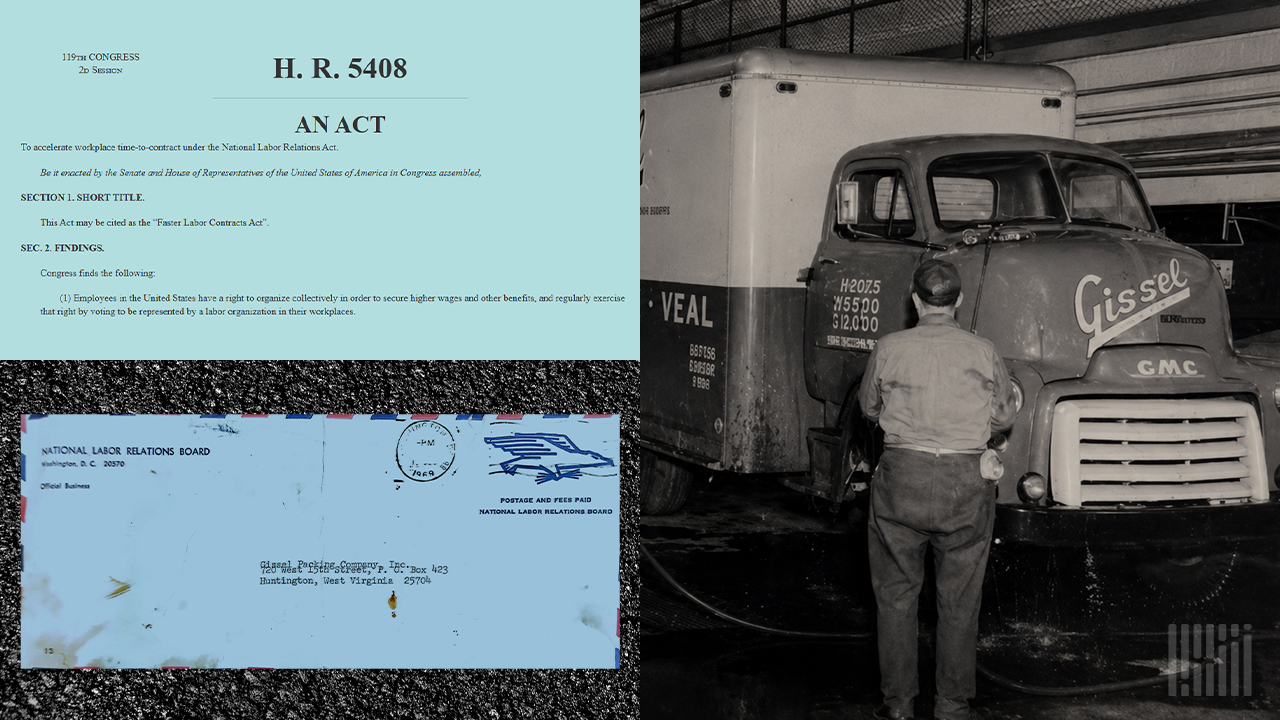
The U.S. House of Representatives passed the Faster Labor Contracts Act (H.R. 5408) on June 9, 2026, by a vote of 230 to 193, according to FreightWaves. The legislation amends the National Labor Relations Act to impose a federally mandated, compressed timeline for first contract negotiations between employers and newly certified unions, a move with significant implications for unionized and potentially unionized employers across the country.
The Legislative Timeline
The Faster Labor Contracts Act establishes a mechanical sequence for first contract bargaining, as reported by FreightWaves:
| Step | Deadline (from union certification) | Action |
|---|---|---|
| 1 | Day 10 | Employer must begin bargaining |
| 2 | Day 100 | If no agreement, federal mediation triggered via FMCS |
| 3 | Day 130 | If mediation fails, binding interest arbitration initiated |
| 4 | Day 144 | Arbitration panel seated, empowered to impose a complete first collective bargaining agreement |
This results in a maximum of 120 days of actual bargaining (90 days of negotiation plus 30 days of mediation) before a government-appointed arbitrator writes the contract covering wages, benefits, work rules, and all related terms, according to FreightWaves. The bill was introduced by Representative Donald Norcross of New Jersey and reached 218 signatures on a discharge petition on May 20, 2026, forcing it out of committee and onto the floor. The bill is a provision lifted directly from the Protecting the Right to Organize Act (PRO Act), which had failed to advance across multiple Congresses.
Political Calculus in the House
The vote saw 20 Republicans voting yes alongside all 210 Democrats. FreightWaves noted the political pattern: five from Ohio (Mike Carey, David Joyce, Max Miller, Michael Rulli, Michael Turner); five from New York (Andrew Garbarino, Nick LaLota, Nicholas Langworthy, Michael Lawler, Nicole Malliotakis); two from Pennsylvania (Robert Bresnahan, Brian Fitzpatrick); two from New Jersey (Christopher Smith, Jefferson Van Drew); two from Florida (Carlos Gimenez, Maria Elvira Salazar); and one each from Nebraska (Don Bacon), West Virginia (Riley Moore), Minnesota (Pete Stauber), and Wisconsin (Derrick Van Orden). FreightWaves described these as Republicans in union-heavy swing districts making a survival calculation based on district demographics.
Senate Prospects
The bill now moves to the Senate, where it needs 60 votes to advance past a filibuster. According to FreightWaves, Fisher Phillips, a major management-side labor law firm, noted that the White House could issue a Statement of Administration Policy in support, providing political cover for Republican senators in labor-heavy states. The bill needs only eight Republican votes assuming all Democrats vote yes, and FreightWaves called it "a lobbying campaign."
What This Means for Trucking
The Teamsters represent workers at UPS, ABF Freight, TForce Freight, and Yellow’s former operations, and have been expanding organizing into non-union carriers, last-mile delivery, and warehouse workforces. Under current law, first-contract negotiations can take a year or more, allowing both sides to understand operational realities. FreightWaves emphasized that H.R. 5408 forces a 144-day clock that "runs out before a carrier has completed a single budget cycle."
The arbitrator does not know your deadhead percentage. The arbitrator does not know what your insurance renewal looks like. The arbitrator does not know that your fuel surcharge is the difference between a profitable quarter and a loss. The arbitrator writes a contract based on comparable agreements in the industry, and, in this context, comparable means whatever the largest unionized carriers agreed to under entirely different economic conditions.
FreightWaves reported that the compressed timeline changes the calculus for organizers as well, as the difficulty of reaching a first contract under current law is a factor that tempers organizing campaigns.
Background: The Gissel Case
The article by FreightWaves author Rob Carpenter includes a personal connection: his grandfather, Roman Gissel, owned Gissel Packing in Huntington, West Virginia, and closed the company rather than bargain with the NLRB. The resulting Supreme Court case, NLRB v. Gissel Packing Co. (1969), remains fundamental labor law and is taught in every law school. Carpenter notes that H.R. 5408 is designed to render that choice irrelevant.
Next milestone: Senate consideration, where the bill requires 60 votes to overcome a filibuster. The political dynamics and potential White House support will be critical.
Sources: