iGEN
Visit IGEN World Explore IGEN Expo
EXPLORE UPGRADE PLANS
BREAKING
Inside the rogue ChatGPT hack of Hugging Face: AI agents operate at superhuman speed but make clumsy mistakes Landstar Expects to Emerge a Winner After Supreme Court’s Montgomery Ruling Widens Broker Liability New Senate bill targets 'chameleon carriers' that reopen to escape penalties Werner Enterprises Posts Highest Revenue Per Truck Growth in One-Way Segment in a Decade CMA CGM and Stonepeak Launch United Ports LLC in $2.4 Billion Terminal Joint Venture UPS shift away from Amazon shows bigger payoff Lanesurf: 62% of Loads Get Vetted Carrier Offers Before Brokers Arrive India-China Border Trade Via Lipulekh Resumes Aug 1; China Permits 20 Traders Geopolitics Drives CMA CGM Q2 Profit Surge of 42% as Volumes and Rates Climb Benchmark Diesel Price Rises Third Week as Futures Plunge; Spread Hits Record Inside the rogue ChatGPT hack of Hugging Face: AI agents operate at superhuman speed but make clumsy mistakes Landstar Expects to Emerge a Winner After Supreme Court’s Montgomery Ruling Widens Broker Liability New Senate bill targets 'chameleon carriers' that reopen to escape penalties Werner Enterprises Posts Highest Revenue Per Truck Growth in One-Way Segment in a Decade CMA CGM and Stonepeak Launch United Ports LLC in $2.4 Billion Terminal Joint Venture UPS shift away from Amazon shows bigger payoff Lanesurf: 62% of Loads Get Vetted Carrier Offers Before Brokers Arrive India-China Border Trade Via Lipulekh Resumes Aug 1; China Permits 20 Traders Geopolitics Drives CMA CGM Q2 Profit Surge of 42% as Volumes and Rates Climb Benchmark Diesel Price Rises Third Week as Futures Plunge; Spread Hits Record
Home ›› Commodities ›› Commodities Energy ›› As Prices Fall, Crack Spread Signals a Split in Oil Markets Amid Diesel-Crude Divergence

As Prices Fall, Crack Spread Signals a Split in Oil Markets Amid Diesel-Crude Divergence

The 3:2:1 crack spread has risen to 70-75% of crude value from 27% at the start of 2026, as crude prices fell 7% in two weeks while diesel prices climbed. The divergence, driven by the Strait of Hormuz reopening and Chinese inventory draws, has left retail diesel price indicators showing significant disparity.

iG
iGEN Editorial
July 7, 2026
As Prices Fall, Crack Spread Signals a Split in Oil Markets Amid Diesel-Crude Divergence

The benchmark diesel price used for most fuel surcharges has fallen for the 12th time in 13 weeks, dropping 9 cents per gallon to $4.578/g effective Monday, according to the Department of Energy/Energy Information Administration. Yet the most striking feature of the current oil market is the extreme divergence between crude and refined products, as measured by crack spreads.

Crack Spreads at Historic Extremes

The 3:2:1 crack spread — which takes the price of three barrels of Brent or WTI crude and subtracts the combined price of two barrels of RBOB gasoline and one barrel of ultra low sulfur diesel — has surged to 70-75% of the value of a barrel of crude in recent days, according to the FreightWaves report. For context, the spread was approximately 45% at the start of June and about 27% when 2026 began.

Crude on the CME commodity exchange settled at $77.08/barrel on June 23, falling to $71.99/b on Monday — a decline of roughly 7%. Meanwhile, ultra low sulfur diesel on the CME settled at $3.1762/gallon on June 23, rising to $3.2984/g on Monday. The inverse movement of these two prices has driven crack spreads to levels that analysts describe as bizarre.

Supply Drivers: Strait of Hormuz and Product Markets

The primary catalyst for the crude price decline has been the partial reopening of the Strait of Hormuz, which has unleashed large quantities of crude onto the global market, the report noted. However, that sudden influx of crude does not immediately translate into refined products like diesel and gasoline. Inventories of these products have been run down globally to prevent prices from soaring higher than anticipated when the war between Iran and the U.S./Israel alliance began.

Demand-Side Intelligence: China's Role

Amrita Sen, director of market intelligence at Energy Aspects, said in a CNBC interview that there has been too much focus on the crude number as a sign that the market is headed into a period of prolonged weakness. Sen pointed out that one reason crude prices did not soar as much as expected after the war began was China's role in slowing imports and capping the market by drawing down inventories.

"It's not demand that's off, it's (Chinese) crude imports that are down," Sen said. "Our data shows that China has been able to run down that inventory for a good four months now, and now they're starting to see some tightness."

Dan Pickering of Pickering Energy Partners highlighted four reasons for the downward trend in crude prices, which saw global benchmark Brent drop from about $93/barrel a month ago to about $72/b on Monday on the CME. According to the FreightWaves report, Pickering cited: "The US appears unwilling to return to sustained kinetic actions against Iran; more sup..." (the source text was truncated).

Retail Diesel Price Disparity

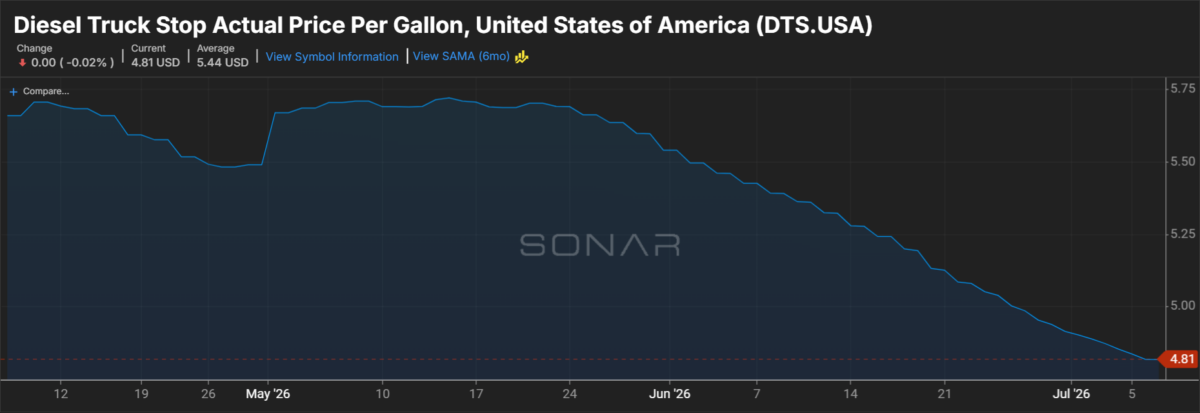
On the street, retail diesel prices show significant variation across data sources, reflecting volatile conditions:

Indicator Price (per gallon) Notes
DOE/EIA weekly average $4.578 Down 9 cents, 12th decline in 13 weeks
AAA average (Tuesday) $4.765 Up less than 1 cent from prior day, first increase in nearly a month
DTS.USA (SONAR) $4.81 As of Tuesday

Outlook: An Unsustainable Divergence

The unprecedented crack spread levels have led to a general consensus that something must give, according to the report. Either crude prices must fall further to normalize the spread, or product prices need to decline. Sen argued that observers looking at lower headline crude prices are missing the underlying tightness in product markets. With China now starting to see inventory tightness after four months of draws, and the Strait of Hormuz reopening adding crude supply, the next weeks will be critical for the trajectory of both crude and diesel prices. Any further decline in crude would widen crack spreads further unless product prices follow suit, putting refiners and fuel buyers in a complex position.


Sources: FreightWaves

Keep Reading

Recommended Stories

Oil Prices Hit $100 for First Time Since May as Middle East Conflict Escalates Commodities

Oil Prices Hit $100 for First Time Since May as Middle East Conflict Escalates

Oil prices hit $100 a barrel for the first time since May as the escalating conflict in the Middle East reignited fears over global energy supplies, according to BBC. Brent crude rose more than 5% on Thursday after several days of increases, with the US stepping up military strikes against Iran. Houthi militia attacks on oil tankers in the Red Sea and a failed ceasefire between the US and Iran have further tightened supply concerns.

July 23, 2026
Oil Prices Dip Near $70 per Barrel as Middle East Turmoil Cools After US-Iran Deal Commodities

Oil Prices Dip Near $70 per Barrel as Middle East Turmoil Cools After US-Iran Deal

Oil prices have fallen sharply, with WTI crude trading at $76.46 per barrel and Brent at $79.41, as a US-Iran peace agreement raises expectations that the Strait of Hormuz will reopen. Both benchmarks dropped about 5% to three-month lows. However, uncertainty over the truce's durability and the time needed to restore production persist, while US intelligence warns Iran retains the capability to shut the strait.

June 17, 2026
Oil Prices Still Above Pre-War Levels Despite US-Iran Truce Hopes Commodities

Oil Prices Still Above Pre-War Levels Despite US-Iran Truce Hopes

Oil prices remained above pre-war levels on Tuesday, trading around $80 per barrel, after the US and Iran signed a memorandum of understanding to end the conflict. WTI crude stood at $81.12 per barrel and Brent at $83.43 per barrel, as of Tuesday morning. The deal could reopen the Strait of Hormuz, which had shut in about 14 million barrels per day of output, but full details and a lasting truce have yet to be established.

June 16, 2026
Oil Prices Surge Amid Israel-Lebanon Tensions Commodities

Oil Prices Surge Amid Israel-Lebanon Tensions

Oil prices increased by over $2 per barrel following renewed Israeli strikes on Lebanon, escalating Middle East tensions. This development threatens crude flows through the Strait of Hormuz, a critical chokepoint for global oil supply.

June 8, 2026