The U.S. diesel market is moving in two directions at once: the benchmark retail price rose for a fourth consecutive week even as ultra low sulfur diesel (ULSD) futures on CME plummeted on reports that a deal to reopen the Strait of Hormuz is imminent, according to FreightWaves.
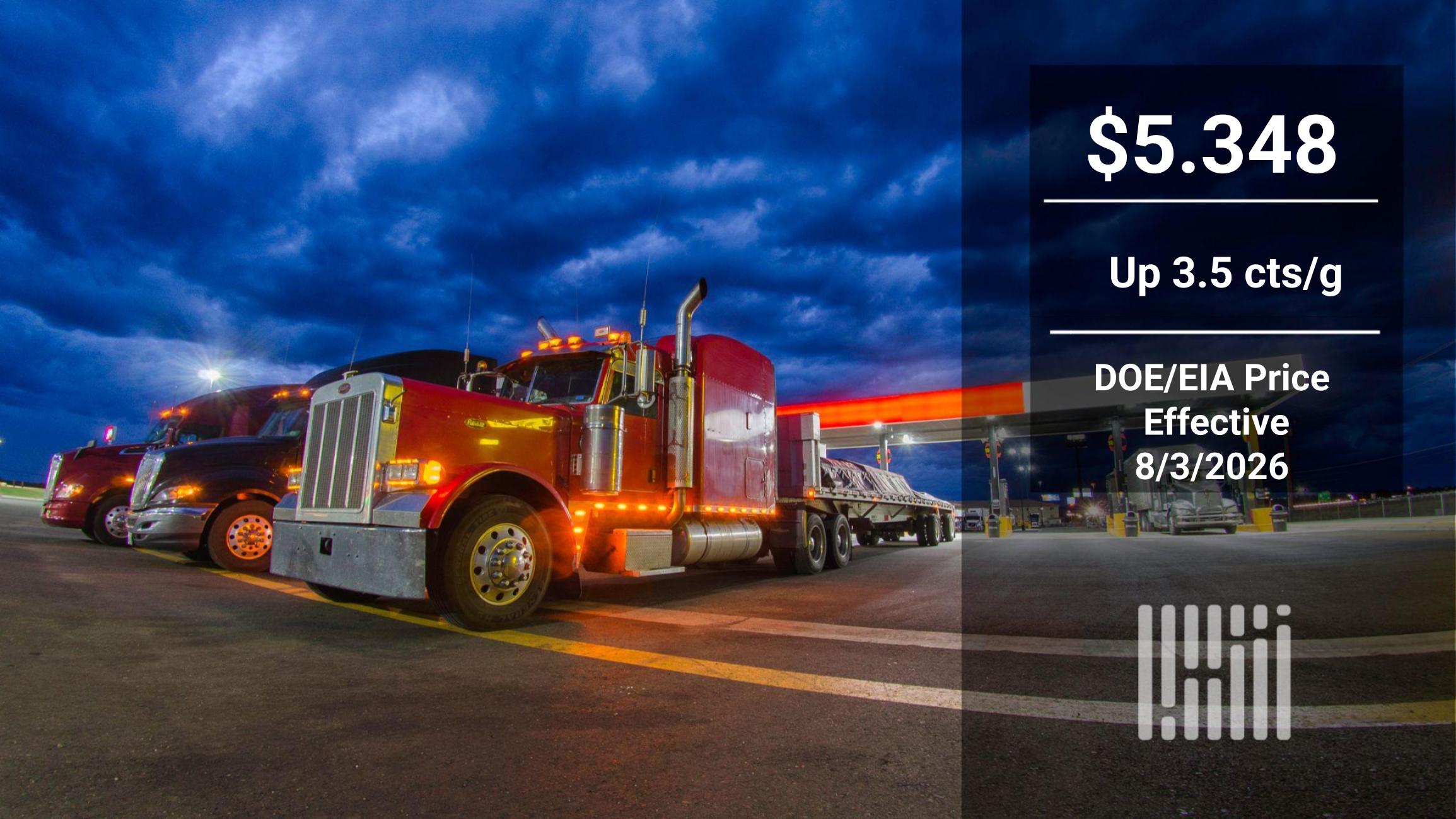
Retail benchmark climbs to $5.348/g
The weekly Department of Energy/Energy Information Administration average retail diesel price — the basis for most fuel surcharges — was published Tuesday at $5.348/gallon, up 3.5 cents/g, FreightWaves reported. It is the fourth consecutive weekly increase, with the benchmark up 77 cents/g during that time.
ULSD futures slide on Hormuz hopes
Futures have been rapidly falling on the latest news that a deal to reopen the Strait of Hormuz is imminent, FreightWaves reported. The decline followed a sharp slide in the prior three trading days on the same hope, as the market quickly embraces any prospect of an end to the closure of the strait. Price movement in the ULSD contract on CME has been some of the most volatile since the U.S. and Israel launched attacks on Iran at the beginning of March.
With the market latching on to any talk of a settlement that would reopen the Strait of Hormuz, ULSD on CME fell in the three trading days ending Monday:
- Session 1: -3.68%
- Session 2: -2.09%
- Session 3: -5.93%
The day before that streak, the price was up 5.28%. The Monday settlement of $3.8772/g was the lowest since July 13, a significant drop from the $4.3416/g settlement on July 23. At approximately 9:40 a.m. Tuesday, ULSD was down 4.34%, or 16.81 cents/g, to $3.7091/g; if it settled there, it would be the lowest since July 10.
| Benchmark / Contract | Price / Change | Period |
|---|---|---|
| DOE/EIA retail diesel | $5.348/g, +3.5 cts/g | Fourth consecutive weekly gain; +77 cts/g over four weeks |
| ULSD CME settlement July 23 | $4.3416/g | Before the slide |
| ULSD CME settlement Monday | $3.8772/g | Lowest since July 13 |
| ULSD CME intraday Tuesday ~9:40 a.m. | $3.7091/g (-16.81 cts/g, -4.34%) | Would be lowest since July 10 |
Trump's call for lower retail prices
The retail market now also faces uncertainty over how, if at all, companies will respond to President Trump's call on oil companies to lower their retail prices, spurred by a not-surprising string of second-quarter earnings reports showing profitability soared, according to FreightWaves.
The problem, FreightWaves noted, is the definition of an oil company. ExxonMobil and Chevron are fully integrated, producing crude and other hydrocarbons and refining them into finished products like gasoline and diesel. They sell wholesale products through a distribution system known as "the rack" and set prices daily based on market fluctuation, often multiple times a day when markets are volatile. They do not, however, set prices at the pump, which are controlled by station owners who might own one station or 100.
Independent refiners such as Valero and Marathon are not integrated, FreightWaves reported. They buy 100% of their inputs, mostly crude, off the open market or through contracts and turn them into products. That activity is at present highly profitable as refining spreads have blown out during the Iran war. They also sell through rack systems.
No single entity controls costs
There is no one entity that can reduce the price of crude at will, nor can any single company control the cost of blendstocks such as ethanol, reformate, or raffinate.
The conundrum for a company under White House pressure is that, while it can try to limit increases or accelerate decreases in its wholesale prices, those actions are independent of input prices, which it does not control, according to FreightWaves. Supplying a wholesale system does not take place just with output from a refinery; a company like Valero at all times is selling gasoline and diesel into the spot and wholesale market, but the supply could be coming from open market purchases of finished products, not just its refineries' production. The systems are constantly selling and buying inputs and outputs to balance.
Sources: