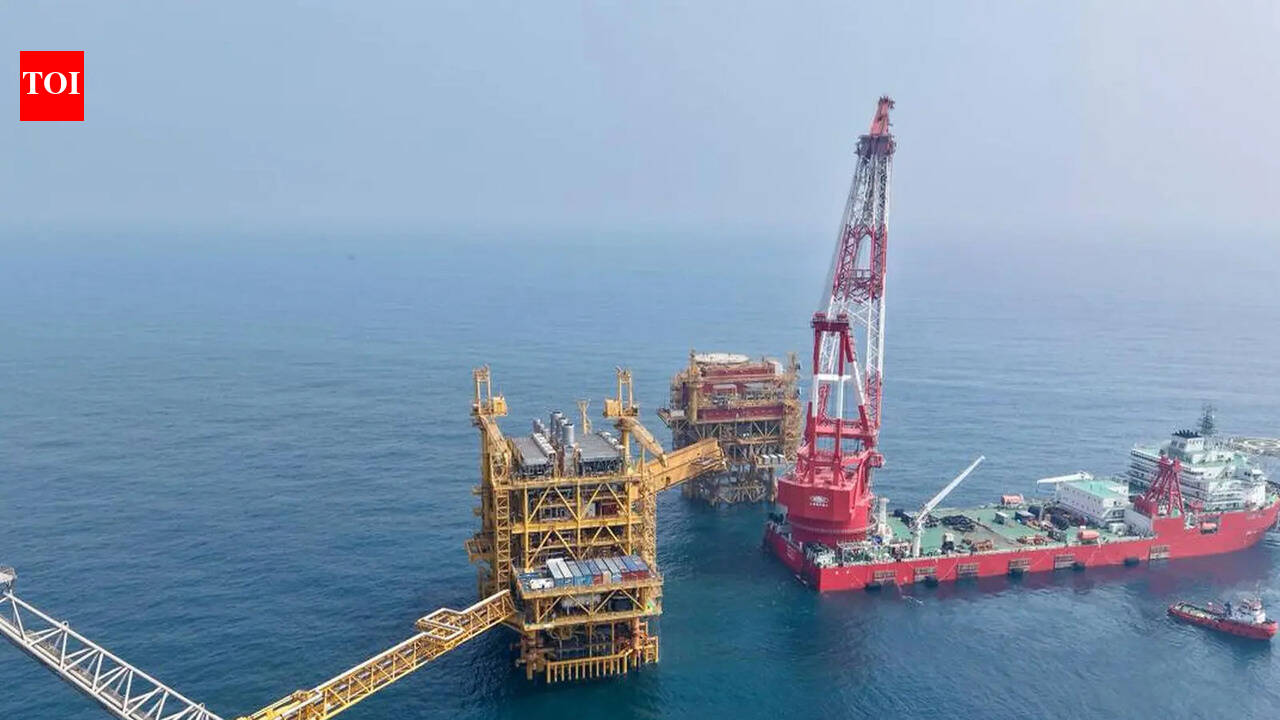
India's Union Cabinet has approved the ₹84,084-crore Samudra Manthan National Offshore Exploration Scheme, under which the government will fund half the cost of drilling a deep-sea and ultra-deepwater exploration well, or ₹650 crore, whichever is lower, for 60 wells over the next five years, according to PTI. The programme is designed to curb the country's growing dependence on imported crude oil and gas.
First-of-its-kind state-funded exploration risk
Officials quoted by PTI described the programme as unprecedented. "This perhaps is the first time that any government in the world is funding risk exploration from the budget," an official said, adding that 60 deepwater and ultra-deepwater exploration wells will be funded from the budget over the next five years.
The government will also part-fund common infrastructure, including subsea pipelines and onshore oil and gas receipt and processing facilities, allowing multiple operators to commercialise hydrocarbon discoveries using shared assets. A central piece of the scheme is its Common Hub Infrastructure (CHI) component.
Companies holding blocks awarded under previous Open Acreage Licensing Programme (OALP) rounds, as well as those securing acreage in the ongoing bid round, will be eligible to claim government support of up to ₹650 crore for each deepwater or ultra-deepwater exploratory well they drill, an official said. The scheme is designed to draw global energy majors into India's offshore basins.
Officials said private companies have largely shied away from risk exploration because the investment has to be written off if no commercially viable hydrocarbon discovery is made. "They were spending money only on development drilling — producing already established discoveries. Hardly any money went into risk exploration, which is key to finding new resources," an official said. "Samudra Manthan is, in that sense, a game-changing scheme," another official added.
Where the money goes
The scheme's ₹84,084-crore outlay is weighted heavily toward the riskiest part of the exploration chain. More than half — ₹43,200 crore — will be deployed over five years through 2031 specifically to support deep-sea drilling, working out to roughly ₹650 crore for each of the 60 wells planned.
| Component | Allocation (₹ crore) | Purpose |
|---|---|---|
| Deep-sea drilling support | 43,200 | Funding for 60 deepwater/ultra-deepwater wells through 2031 |
| Common infrastructure | 10,000 | Subsea pipelines, processing facilities and shared assets |
| Offshore data acquisition | 28,534 | Seismic and geological surveying to identify promising basins |
| Oil and gas manufacturing and services zones | 2,000 | Industrial ecosystem for the offshore sector |
The government has set aside ₹10,000 crore to fund the common infrastructure needed to move any discovered reserves into production, while ₹28,534 crore is allocated for offshore data acquisition and ₹2,000 crore for developing oil and gas manufacturing and services zones.
Industry reaction and import impact
Prashant Vashisht, Senior Vice President at ICRA Ltd, said the scheme provides funds for offshore seismic data acquisition especially in erstwhile No-Go zones, a key issue hampering commercial exploitation of oil and gas reserves due to lack of good prospectivity data.
"Additionally, the scheme provides support for drilling deepwater/ultra-deepwater wells where the domestic Upstream sector has limited experience and technical expertise and exploitation of the same remains highly capital intensive and risky. The scheme aims to add incremental annual production of 10-15 million tonne of oil equivalent which would reduce the dependence on imports of oil and gas but only to the extent of 3-5 per cent," Vashisht said.
For commodity traders tracking Indian crude and gas demand, the 60 exploration wells and the accompanying seismic programme represent a multi-year state-backed effort to unlock domestic offshore reserves. While the targeted import reduction is modest at 3-5 per cent, the scheme's fiscal commitment to exploration risk — funded directly from the national budget — is the clearest signal yet of India's intent to lean on its own basins before global markets.
Sources: