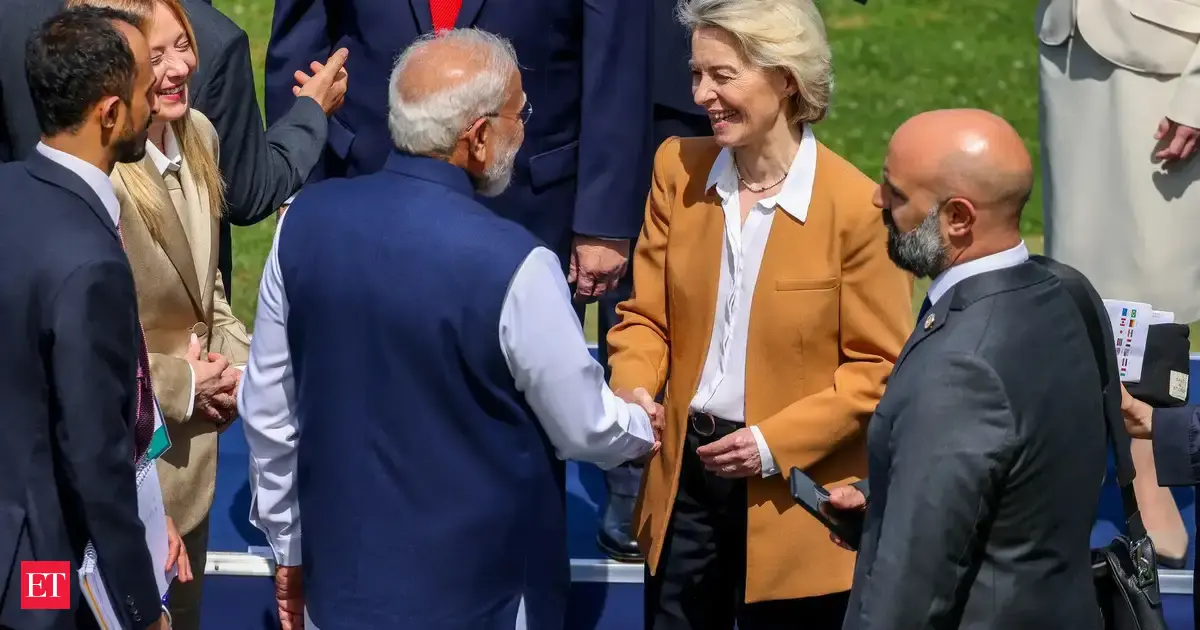
In a significant development for bilateral trade, European Commission President Ursula von der Leyen announced that the India-European Union Free Trade Agreement (FTA) will be signed by the end of the year. The announcement was made during a meeting on the sidelines of the G7 summit in Evian-les-Bains, France, also attended by European Council President Antonio Costa. Von der Leyen stated on social media that the two sides would also accelerate work on an investment agreement.
Announcement at G7 Summit
The meeting between Indian Prime Minister Narendra Modi and EU leaders took place at the G7 summit, a gathering of major economies. According to Ursula von der Leyen, President of the EU Commission, "Since we have concluded the mother of all trade deals, we have been moving fast to deliver on our commitments. We will sign the Free Trade Agreement by the end of the year. And accelerate work on an investment agreement." The comment, posted on social media, underscores the urgency both sides place on finalizing the pact. The G7 summit in Evian-les-Bains provided a high-level platform for the discussions.
Key Figures and Stakeholders
- Ursula von der Leyen: President of the European Commission, who made the public announcement.
- Antonio Costa: European Council President, who joined the meeting.
- Narendra Modi: Prime Minister of India, who also held separate bilateral meetings on the summit's sidelines, including with German Chancellor Merz on trade and defence.
The involvement of both the European Commission and European Council highlights the unified EU stance on the agreement. The FTA is expected to be one of the most comprehensive trade deals for India, given the EU's status as a major trading partner.
Next Steps: Free Trade and Investment Agreements
Von der Leyen explicitly linked the FTA signing to the end of the year, with parallel efforts to advance an investment agreement. The timeline reflects a renewed momentum after years of negotiations. Additionally, the leaders discussed the India-Middle East-Europe Corridor, a connectivity initiative that could further integrate supply chains across regions. While the exact scope of the tariff reductions remains unspecified, the "mother of all trade deals" characterization suggests substantial market access commitments.
Implications for Importers and Exporters
For trade professionals, the conclusion of the India-EU FTA before year-end will have direct operational impacts. Importers and exporters on both sides can expect:
- Reduced tariffs on a wide range of goods, lowering the cost of traded products.
- Simplified customs procedures and harmonized standards, reducing delays and compliance costs.
- Improved market access for services and investment, opening new opportunities for businesses.
The accelerated investment agreement further signals a favorable environment for capital flows. Companies should begin preparing for the new regulatory landscape by reviewing supply chains and exploring potential tariff savings. The India-Middle East-Europe Corridor, if realized, could also create alternative trade routes and reduce logistics costs.
The announcement was made alongside the G7 summit, indicating strong political backing from both sides. The involvement of top EU and Indian leadership ensures that the agreement will be a priority for implementation.
With the end-of-year deadline, stakeholders should monitor official announcements from the Indian Ministry of Commerce and the European Commission for precise tariff schedules and rules of origin. The deal represents a major milestone in India-EU economic relations and will reshape bilateral trade dynamics.
Sources: