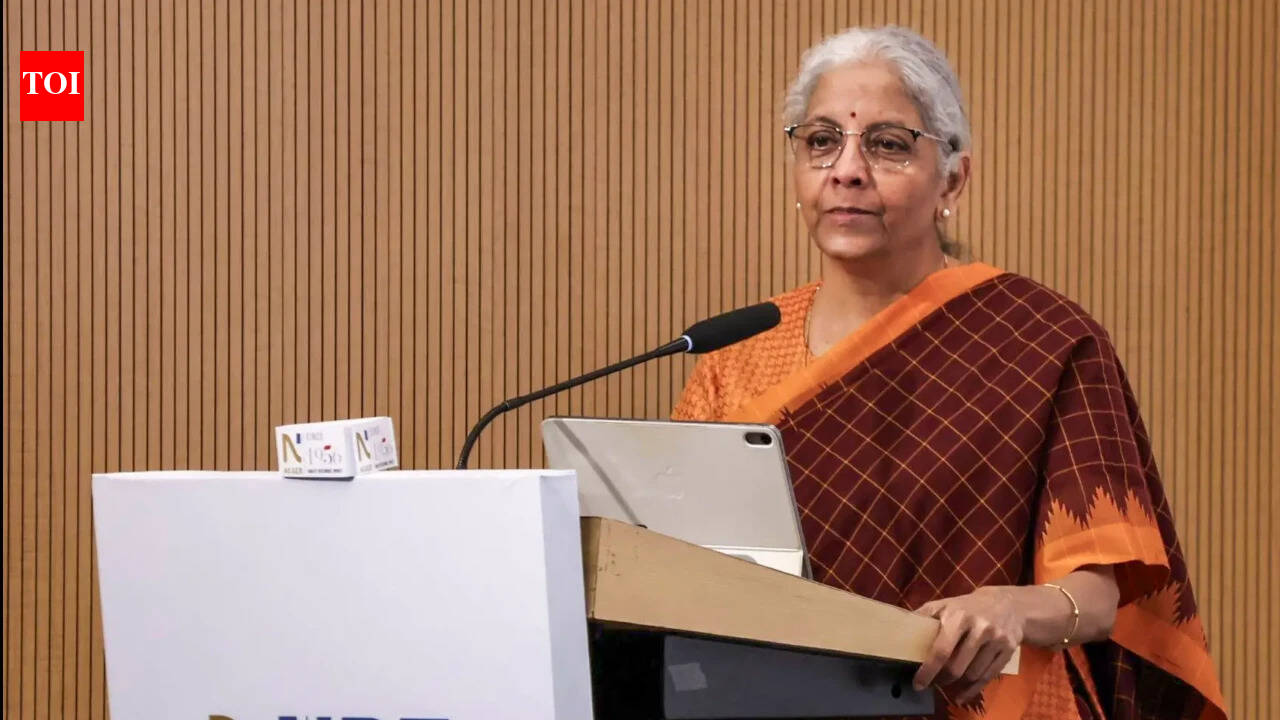
Finance Minister Nirmala Sitharaman said on Thursday that lowering customs tariffs will be a focus in the next budget, according to Business Today. Speaking after delivering the CD Deshmukh Memorial Lecture organised by NCAER in New Delhi, she said progress was being made on reducing duty rates and set a target: by the budget of 2027-28, barring a few items, duties will come down to single digits.
Customs duty roadmap
Sitharaman said, according to Business Today: “Yes, there is progress being made, may be by budget of 2027-28, I would be able to say that barring a few items, it will come down to single digits. Even now, barring 13 items we had rationalised it.”
The statement follows up on a promise she had made after rationalising GST last year, the report said. In the last few budgets, customs duty simplification has been a focus area, with fewer slabs and correction of the inverted duty structure — where tariff on a product is lower than an input in the value chain — according to Business Today.
Key elements of the customs approach:
- Lower customs tariffs are a stated focus for the next budget.
- By budget 2027-28, duties are targeted to come down to single digits, barring a few items.
- Barring 13 items, the minister said duties have already been rationalised.
- Recent budgets have focused on fewer slabs and correction of the inverted duty structure.
| Customs duty position | Status |
|---|---|
| Rationalisation completed so far | Barring 13 items, as stated by the FM |
| Target for budget 2027-28 | Single-digit duties, barring a few items |
| Recent budget focus | Fewer tariff slabs; correction of inverted duty structure |
For importers, exporters and customs brokers, the minister’s statement continues a rationalisation drive already documented in recent budgets, according to Business Today. The report noted that simplification of customs duties has been a focus area in recent budgets; the minister specifically cited the budget of 2027-28 as the point when duties would fall to single digits, barring a few items.
Capital expenditure and private investment
Sitharaman also said the Centre’s capital expenditure push since Covid has boosted the private sector’s confidence in the economy, encouraging firms to take risks and invest, according to the report.
State debt and borrowing discipline
On state finances, Sitharaman said there should be a conscious effort to ensure that states borrow only as much money for asset creation as they can service, and do not leave the debt for the next generation to repay. She said states are working to put their “house in order”.
According to Business Today, she added: “There are several states today who are conscious of what their debts are... I have had conversations ... saying that borrowings have been made some time ago, can we sustain them or not? (A few states) had conversations with the team in the ministry (who) helped them restructure their debts. I am glad to do this, as long as states realise that debt, otherwise, is not a thing that you engage in and forget about it. You cannot leave it unattended.”
Responding to a query on public debt, Sitharaman said acquiring debt is necessary because no country can run on its own resources, but added that a decision is needed on the magnitude and purpose of borrowing, according to Business Today.
Sources: