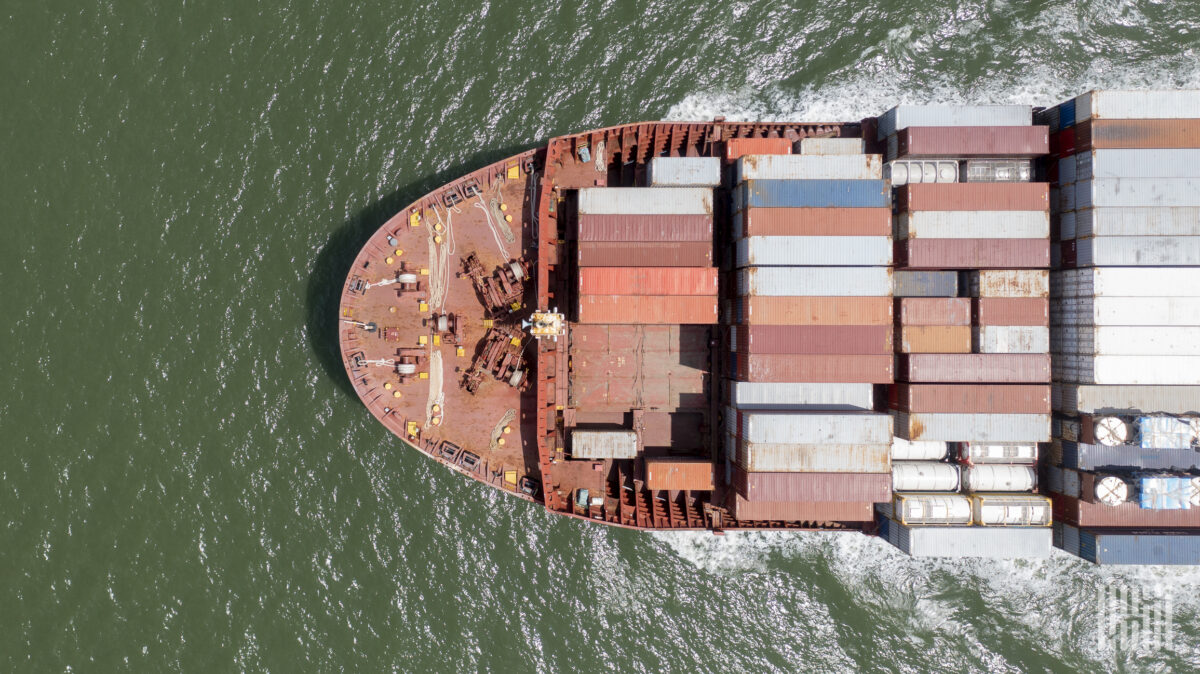
Ocean spot rates have climbed more than 300% in five months, and GEODIS President and CEO Laura Ritchie told FreightWaves Today that blank sailings, port congestion, and ongoing threats in the Red Sea and Strait of Hormuz have combined to create a backlog straining manufacturing supply chains.
Ritchie said the pressure has been building for months. Cargo booked in March was still rolling into July, and shippers are paying far more for space.
We have product that we've been trying to book since March that's still rolling in July. And for people in the manufacturing space where they need these things on their assembly line, they're not too happy. — Laura Ritchie, President and CEO, GEODIS
She added: "We aren't seeing quite the COVID levels, but a container is a lot more expensive than it was just a few months ago."
What's Driving the 300% Rate Surge
According to Ritchie, three forces are converging: blank sailings, port congestion, and ongoing threats in the Red Sea and Strait of Hormuz. Together, they have left shippers competing for limited ocean vessel space and absorbing sharply higher costs.
Air freight capacity exists as an alternative, Ritchie said, but comes at a cost shippers must be willing to absorb. She also noted that big tech customers are navigating chip shortages and semiconductor import constraints simultaneously, compounding pressure on both ocean and air modes. GEODIS, which employs 20,000 workers across 230 U.S. sites, is staying close to customer forecasts to help manage the uncertainty, she said.
Where the Squeeze Hits Hardest
The pain is concentrated in manufacturing supply chains, where delays translate directly into idle assembly lines. Ritchie said demand is uneven across sectors: some GEODIS customers are posting sales growth of 30% to 40%, while others are flat. Apparel is a bright spot, with unit volumes rising even on an inflation-adjusted basis; housing improvements and new housing starts remain soft. The bifurcation, she said, largely depends on each customer's end-market exposure.
A snapshot of the current market, based on Ritchie's comments to FreightWaves Today:
| Metric | Value |
|---|---|
| Ocean spot rate increase | More than 300% over five months |
| Cargo booked | Booked in March, still rolling into July |
| Container pricing | "A lot more expensive than it was just a few months ago" |
| Customer sales growth | 30% to 40% for some; flat for others |
| GEODIS footprint | 20,000 workers across 230 U.S. sites |
How GEODIS Is Adapting
GEODIS is deploying AI to manage shipment data and trucker oversight, and using the tools to train and upskill warehouse associates who collectively speak more than 30 languages, Ritchie said. The company is also piloting drones for inventory management inside warehouses, citing accuracy and worker safety benefits over traditional cycle counting.
Ritchie said supply chain orchestration — using predictive data to autonomously respond to disruptions — will define the next two to three years for third-party logistics providers.
She also restructured the company's client experience earlier in 2024, consolidating continuous improvement, data and analytics, and account management into a single organization that reports directly to her. Ritchie said she modeled the structure partly on changes made at American Airlines, which reorganized its customer journey after identifying internal silos that prioritized operational convenience over the passenger experience.
What Shippers Should Do Now
Ritchie said shippers are shifting how they think about outsourcing. "People are back to actually thinking about supply chain as partnerships instead of transactional," she said, with shippers more deliberately defining which core functions — product, marketing, manufacturing — they control and which they entrust to a 3PL.
GEODIS is owned by SNCF, the French national railroad. Ritchie said that ownership provides financial stability and compliance infrastructure that has become increasingly valuable following the Supreme Court's Bisected Freight ruling and tightened broker liability scrutiny.
Watch List
The factors that could change the rate picture, according to Ritchie and the FreightWaves report:
- Ongoing threats in the Red Sea and Strait of Hormuz affecting ocean routing and capacity.
- Chip shortages and semiconductor import constraints affecting big tech shippers.
- Emerging challenges from data center infrastructure demand.
- Pace of 3PL adoption of AI-driven supply chain orchestration over the next two to three years.
- Whether shippers convert transactional freight buying into long-term 3PL partnerships.
Sources: