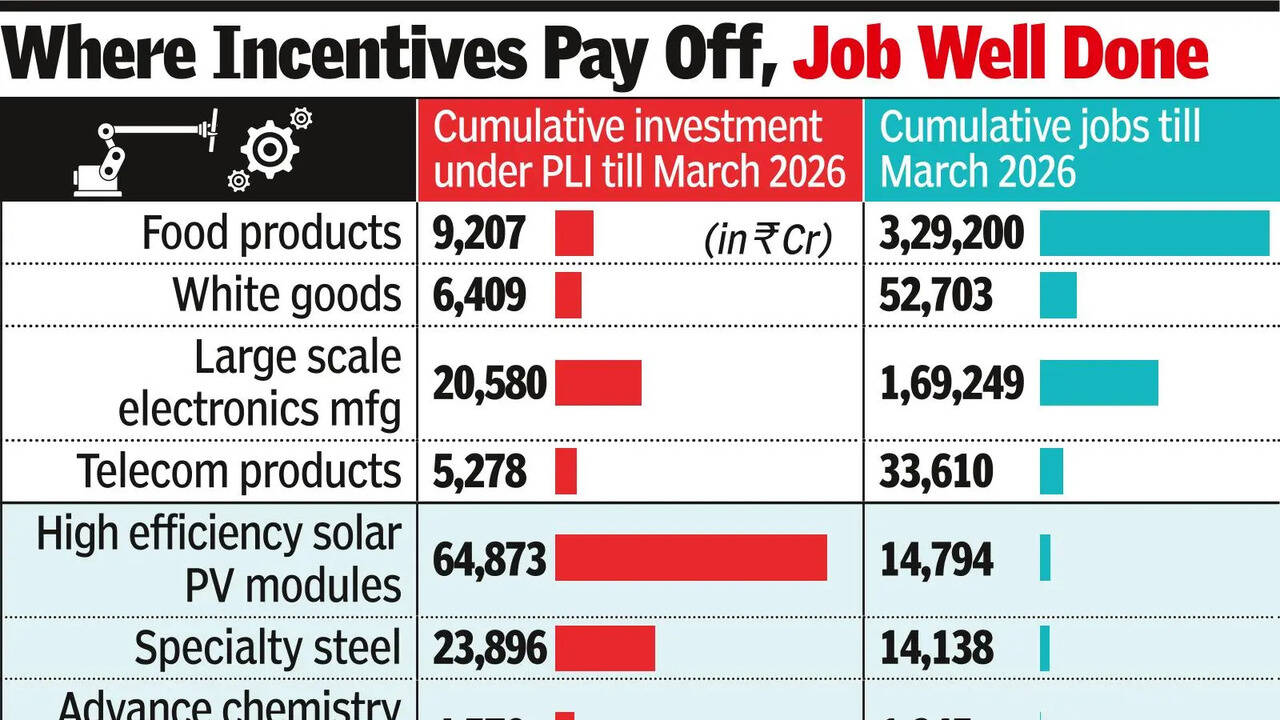
The production linked incentive (PLI) scheme has generated the most direct employment in food products, even though electronics manufacturing received the highest policy attention, according to government data presented to Parliament on Tuesday. Food products added nearly 3.3 lakh direct jobs with an investment of Rs 9,200 crore, the lowest investment-to-job ratio among major sectors.
Sector-wise Job Creation and Investment Under PLI
A detailed breakdown of the PLI scheme's performance reveals stark contrasts across sectors. The large-scale electronics manufacturing segment, focused on smartphones, created 1.7 lakh jobs while attracting investments of Rs 20,580 crore. The pharmaceutical sector added over 1.1 lakh jobs with Rs 45,158 crore in investment. White goods, covering air conditioners and LED lights, invested Rs 6,400 crore till March 2026 and generated 52,700 direct jobs.
| Sector | Direct Jobs Created (lakh) | Investment (Rs crore) | Job per Rs crore investment (approx) | |--------|---------------------------|----------------------|-------------------------------|----| | Food products | 3.3 | 9,200 | 35.9 | | Large-scale electronics | 1.7 | 20,580 | 8.3 | | Pharmaceuticals | 1.1 | 45,158 | 2.4 | | White goods | 0.527 | 6,400 | 8.2 | | High-efficiency solar PV modules | 0.148 | 64,800 | 0.23 | | Specialty steel | ~0.148 | 23,800 | 0.62 |
Investment Intensity and Employment Efficiency
The data, sourced from government records, indicates that sectors requiring highly skilled workforces have fared poorly in job creation relative to capital deployed. High-efficiency solar PV module manufacturing received the highest investment among listed sectors at Rs 64,800 crore but generated only 14,800 jobs. Specialty steel created a similar number of jobs at an investment of Rs 23,800 crore. In contrast, food products delivered 35.9 jobs per crore of investment, compared to 8.3 for electronics and just 2.4 for pharmaceuticals.
Implications for Manufacturing Strategy
For manufacturing executives and procurement professionals, the PLI data underscores the importance of sector selection when planning capacity expansions. While electronics remains a strategic priority for the government's Make in India push, food processing offers a faster return on investment in terms of employment. However, the higher skill requirements in solar and pharmaceutical manufacturing mean that capital-intensive automation may be necessary to compete globally. The data also highlights that white goods, with an investment of Rs 6,400 crore and 52,700 jobs, strike a balance between moderate capital outlay and meaningful employment.
Production Timeline
The data reflects investments and job creation up to March 2026. Future PLI disbursements and additional capacity additions will depend on scheme extensions and company compliance with production targets.
Sources: