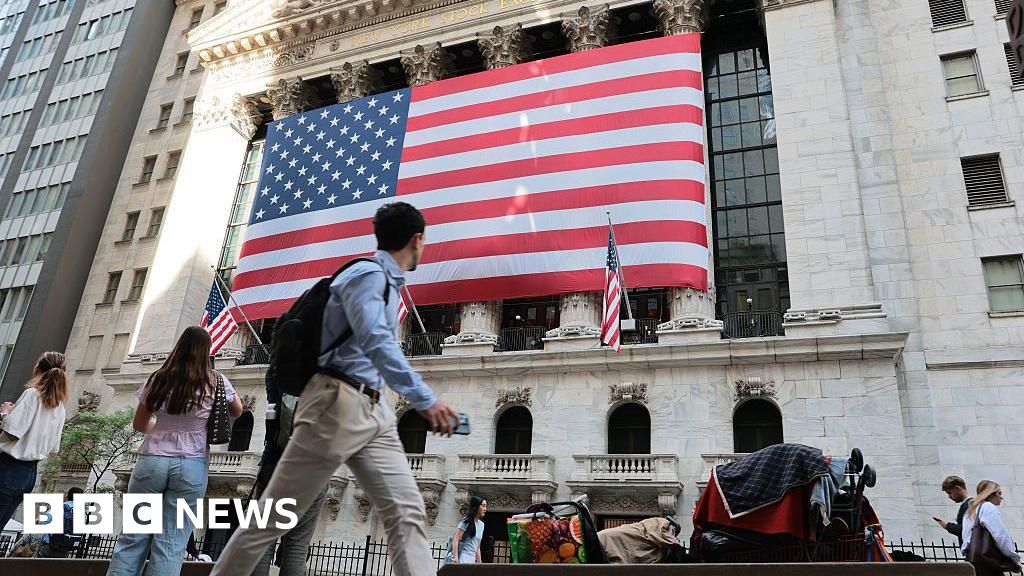
The US economy has repeatedly defied expectations, continuing to expand at an annualised rate of around 2% despite facing the same global shocks that have weighed on other developed nations. The contrast between Volkswagen's closure of its "Transparent Factory" in Dresden, Germany, and BMW's expansion of its largest plant in Spartanburg, South Carolina, illustrates a broader divergence that has puzzled economists. According to BBC Business reporter Michelle Fleury, the resilience stems from a combination of robust corporate investment, rising productivity, energy independence, and a cultural appetite for risk.
Corporate investment defies trade headwinds
Despite President Trump's sweeping tariffs that disrupted global trade, US corporations did not accept lower margins. Instead, they invested harder. Joe Brusuelas, chief economist at RSM, told the BBC that capital expenditure (CapEx) currently stands at 13.9% of US GDP. "That should be slowing, given the mix of supply and demand shocks the economy is absorbing, and it's not," he said. Brusuelas argued that the trade war itself became the strongest proof of American resilience: "The own goals that the Trump administration has imposed on the US with respect to trade and immigration are probably the single best example of the underlying dynamism of the American economy."
Productivity and energy as buffers
The pressure from tariffs and immigration changes has been offset by a notable rise in productivity. At the same time, energy markets provide another explanation. Historically, conflict in the Middle East that pushes oil prices higher would have posed a major threat to US growth. But the shale revolution fundamentally altered America's exposure. Over the past two decades, the US has become one of the world's largest oil and gas producers, while businesses have steadily reduced their reliance on petroleum. Brusuelas noted: "The development since the early 2000s of fracking in the United States, alongside the evolution of alternative fuels, has created the conditions where oil's contribution to GDP per unit has fallen by half over the past 50 years."
This contrasts sharply with Europe. While the US focused on flexibility—embracing fracking and letting prices respond to the market—Europe relied on long-term contracts and interconnected supply networks. That approach left many European countries exposed when Russian gas supplies were cut after the Ukraine invasion, and vulnerability remains given current Middle Eastern tensions.
Cultural attitudes and structural differences
For Rebecca Christie, senior fellow at the Brussels think tank Bruegel, the divergence is not just about policy choices but about cultural attitudes toward risk. "Americans are very solutions-oriented and much more comfortable with taking a short-term risk in service of a long-term advantage. Europe as a culture is risk-averse," she said. She recounted an event where the EU's own commissioner for financial services remarked that in Europe people don't talk enough about the risk of not taking risk.
The difference extends to how businesses and retirement systems are structured. In much of Europe, companies rely heavily on bank loans for financing, and workers' pensions are often structured differently—though specific details were not elaborated in the source.
Implications for executives and investors
For C-suite executives and investors, the US economy's resilience suggests that corporate strategy should account for continued domestic demand and investment opportunities. The high CapEx rate indicates that US-based companies are betting on long-term growth, while energy independence provides a buffer against global supply shocks. Conversely, the European emphasis on risk aversion and reliance on external energy supplies may warrant strategic reassessment for firms operating across the Atlantic.
| Factor | US | Europe |
|---|---|---|
| CapEx as % of GDP | 13.9% (high, not slowing) | Not specified in source |
| Energy strategy | Fracking, market-driven prices | Long-term contracts, interconnected grids |
| Risk culture | Solutions-oriented, comfortable with short-term risk | Risk-averse, less comfortable with risk-taking |
| Impact of Middle East conflict | Reduced vulnerability due to shale and alternative fuels | Remains vulnerable due to past reliance on Russian gas |
Sources: