
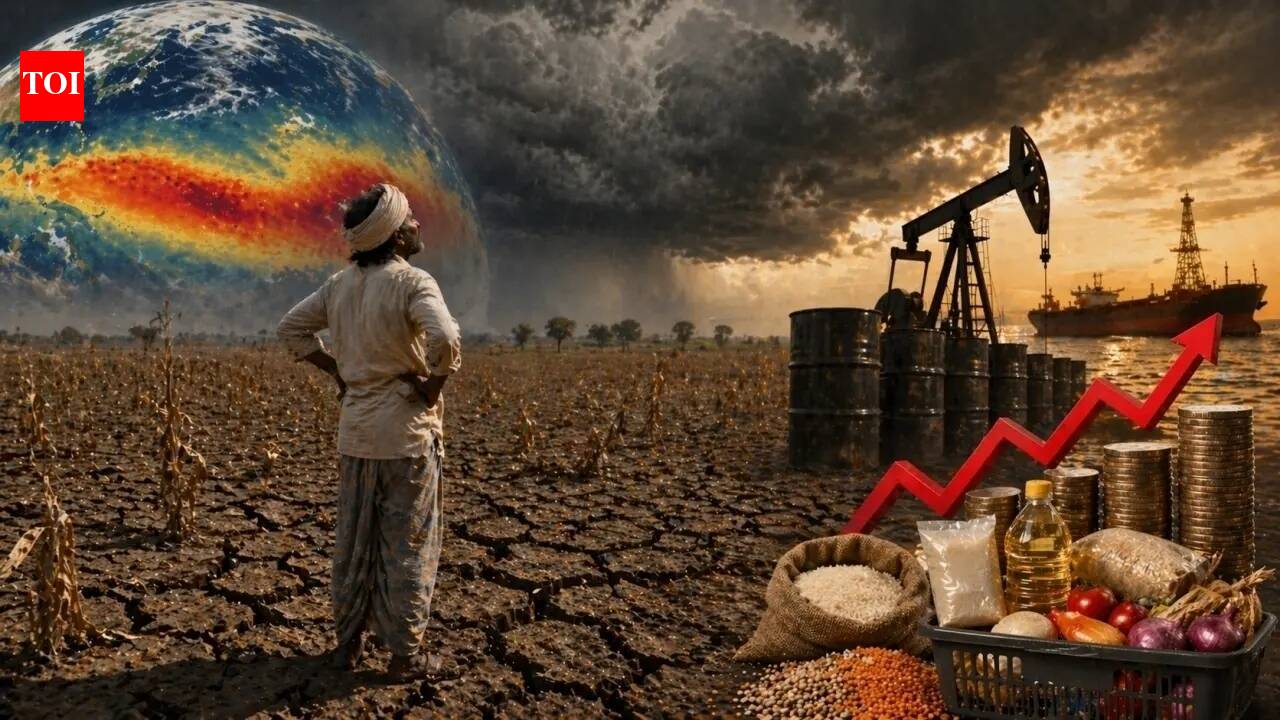
The Indian economy faces a potentially greater threat from a weak monsoon driven by El Nino conditions than from the recent US-Iran conflict, according to a Business Today report. While the impact of the US-Iran war may prove transient if peace talks hold and the Strait of Hormuz opens, the monsoon shortfall could more deeply affect domestic demand and inflation. With cumulative rainfall running 42% below the long-period average as of June 21, 2026, concerns are mounting over agricultural output, food prices, and rural livelihoods.
Monsoon Progress and Rainfall Deficit
The southwest monsoon arrived late this year, reaching Kerala on June 4, 2026 — three days after the normal onset date of June 1 and more than a week after the India Meteorological Department's (IMD) initial projection of May 26. As of June 21, cumulative rainfall across the country was 42% below the long-period average, substantially larger than the IMD's forecast of an 8% deficit for the month. The report notes that the season got off to a weak start amid El Nino conditions, and so far June 2026 ranks among the weakest in recent years.
Reservoir Levels and Water Storage
The sluggish monsoon has led to a sharp decline in reservoir levels. As of June 18, 2026, water storage stood at 27.7% of total reservoir capacity, down from 34.3% at the end of May 2026 and below the 31.8% recorded during the corresponding period last year. The article highlights that 2026 has witnessed the steepest reduction in reservoir levels between the end of May and the third week of June in the past six years. This deterioration threatens irrigation for the kharif crop season.
Economic Implications: Inflation and Rural Demand
A below-normal monsoon impacts crop sowing and harvest, leading to rising prices of vegetables and staple foods. Since food forms an important part of the consumer price index (CPI) calculation, this directly raises inflation. The Reserve Bank of India's (RBI) target for CPI inflation is 4%. If inflation moves much above that, it could trigger a rate hike, the article warns. Additionally, lower rural incomes due to damaged crops reduce a major demand driver for the economy, compounding the negative impact on growth.
Historical Context and Outlook
Comparisons with past years show that early deficits do not necessarily predict seasonal outcomes. In 2019, rainfall was 43% below normal as of June 21, yet the season ended with a surplus of 10% after strong rains in August and September. In 2023, a 42% deficit as of June 17 was reduced to a monthly shortfall of 10%, and the overall monsoon season ended with a 6% deficiency. Both years were influenced by El Nino, but 2019's El Nino faded by peak monsoon.
| Year | Rainfall Deficit as of Mid-June | Final Seasonal Outcome |
|---|---|---|
| 2019 | 43% below normal | +10% surplus |
| 2023 | 42% below normal | -6% deficiency |
| 2026 | 42% below normal (as of June 21) | TBD |
"The contrasting experiences of 2019 and 2023 underscore the fact that early rainfall deficits in the season may not necessarily be reliable predictors of seasonal outcomes," said QuantEco Research in its latest report. The report added that over the southwest monsoon season, India will most likely witness a moderate to strong El Nino, with IMD's 10% rainfall deficiency forecast appearing reasonable but risks tilted to the downside. With 10 days remaining in June, the final monthly outcome remains uncertain, and all eyes will be on the evolution of rainfall through the core monsoon months of July and August.
Sources:


