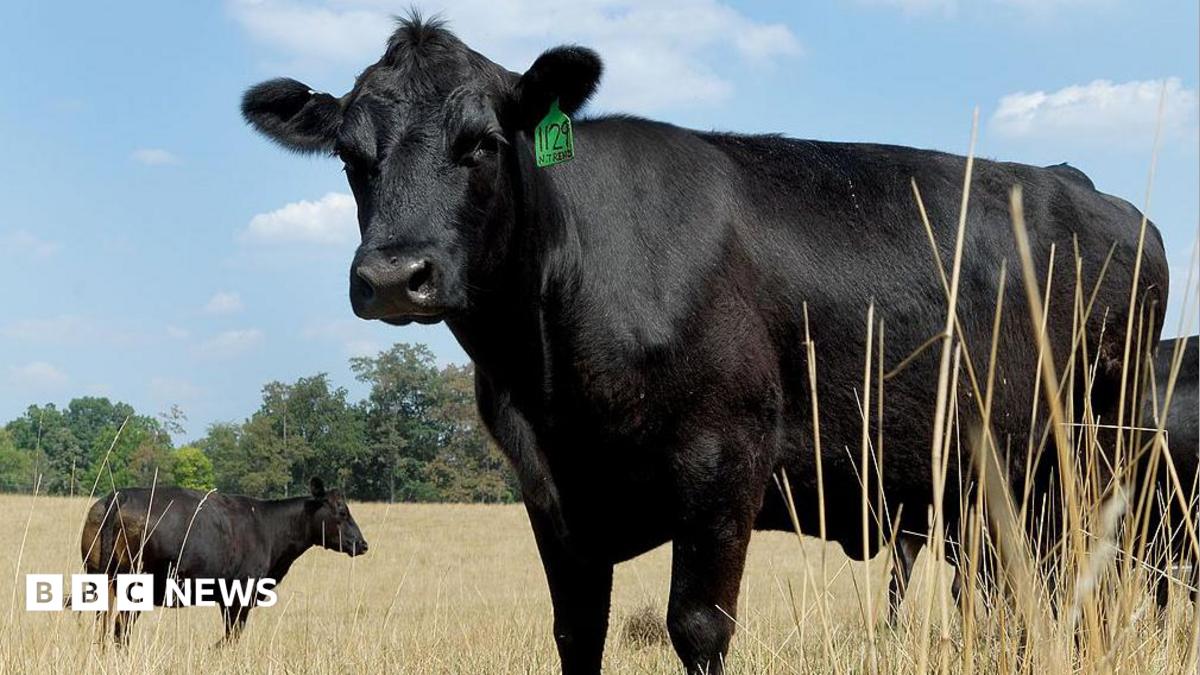
The US Department of Agriculture (USDA) confirmed this week the return of New World screwworm to the United States after a 60-year absence, detecting the flesh-eating parasitic fly in a calf in southern Texas. The pest, which poses a major threat to livestock, was eliminated from the US in 1966 and pushed south to Panama by 2006, but modeling had predicted a reintroduction as soon as summer 2025, according to the USDA.
To head off a wider outbreak, officials are deploying the sterile insect technique, a biological control method pioneered by USDA researchers in the 1950s. The approach involves releasing large numbers of radiation-sterilized male flies. Since female New World screwworm flies mate only once in their lifetime, mating with sterile males produces unviable eggs, causing the population to crash. “The sterile insect technique is probably the most eloquent example of a completely successful biologic control mechanism,” said Sally DeNotta, associate professor of veterinary medicine at the University of Florida. “The life cycle stops. There's no progeny produced. It’s been very successful.”
Current Response and Production Capacity
The USDA has established a roughly 12-mile zone around the infected calf in southern Texas and is carrying out targeted release of sterile screwworm flies from trucks. This supplements the 4 million sterile flies per week already being air-dropped in the area. Anticipating the screwworm’s northward movement, the agency shifted efforts in February to 100 million sterile flies per week focused along the US-Mexico border.
USDA Secretary Brooke Rollins stated during a House Agriculture Committee meeting on Thursday that approximately 400 million flies per week are needed to beat back the screwworm. Currently, the US can only produce about 100 million flies per week at a facility in Panama.
| Facility | Current/Planned Output | Status |
|---|---|---|
| Panama (existing) | 100 million/week | Operational |
| Metapa, Mexico (retrofit) | 60–100 million/week | Expected operational summer 2026 |
| Moore Air Base, Edinburg, Texas (new) | TBD (up to 400M total target) | Operational November 2027 |
To close the gap, the USDA is investing $21 million to renovate and convert an existing fruit fly facility in Metapa, Mexico to produce an additional 60 to 100 million sterile flies per week, with operations expected this summer. The agency is also fast-tracking a $750 million sterile fly facility at Moore Air Base in Edinburg, Texas, near the Mexican border, though it will not be operational until November 2027.
Threat to Livestock and Humans
Screwworm infections occur when female flies lay eggs in open wounds or body parts of warm-blooded animals. The hatching maggots feed on living tissue before maturing into flies. Historically, New World screwworm killed hundreds of thousands of cattle annually in the American South and Southwest. While screwworms do not infest meat, fruits, or vegetables, they can infect humans. Since 2023, there have been at least 2,070 human cases of screwworm in Mexico and Central America, according to the source.
The pest's northward progression was previously blocked by the Darién Gap, a dense rainforest between Panama and Colombia where sterile flies were released. However, insects began breaking through that barrier in 2022.
Implications for Livestock Markets
For commodity traders and agribusiness, the reemergence of screwworm in the US signals potential supply disruption for cattle and other livestock in the affected region. The USDA’s containment zone in southern Texas, coupled with the need for massive sterile fly production, underscores the severity of the threat. While the immediate price impact is not yet quantified, the outbreak memory of historical cattle losses could pressure feeder cattle futures (CME) in coming weeks. Traders will watch USDA updates on case numbers, the expansion of sterile fly releases, and the timeline for new production facilities to gauge the risk to US beef production.
Key Entities and Next Steps
The USDA, Brooke Rollins, Sally DeNotta, and facilities in Panama, Metapa (Mexico), and Edinburg, Texas are central to the response. The House Agriculture Committee has been briefed. Upcoming milestones include the Mexico facility’s startup this summer and the Texas facility’s completion in late 2027. Continued surveillance and fly releases will determine whether the outbreak remains contained.
Sources: