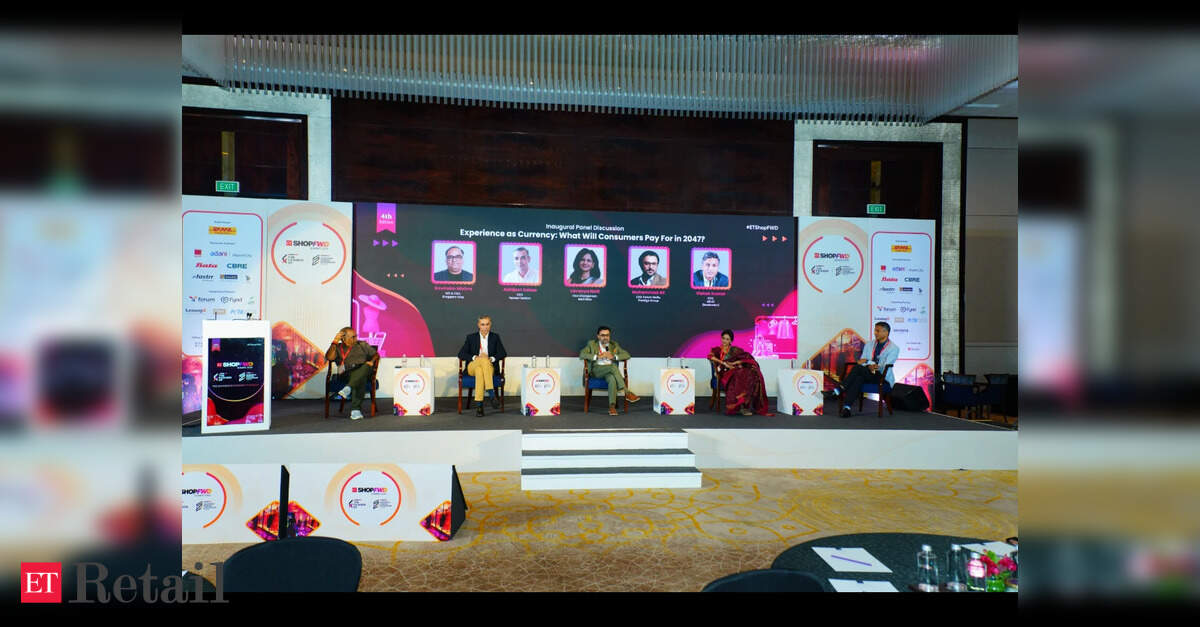
At the 4th ETRetail ShopFWD Summit 2026, held August 26-27 at the Conrad in Bengaluru, retail leaders said time, trust and personalisation will become retail's new currencies by 2047. The inaugural panel discussion, "Experience as Currency: What Will Consumers Pay For in 2047?", anchored the summit's theme, "The Experience Economy Playbook", and featured executives from Shoppers Stop, Nykaa Fashion, Nalli Silks, Forum Malls and ABLBL, according to ETRetail.
The panel's central argument
The panelists — Kavindra Mishra, MD & CEO of Shoppers Stop; Abhijeet Dabas, CEO of Nykaa Fashion; Lavanya Nalli, Vice Chairperson of Nalli Silks; and Muhammad Ali, CEO of Forum Malls, Prestige Group, moderated by Vishak Kumar, CEO of ABLBL — argued that the next phase of retail will be shaped by consumers' willingness to spend on meaningful experiences, convenience, privacy, relevance and quality time rather than products alone, according to ETRetail. The panellists said that while technologies, channels and formats will continue to change, the fundamental motivation behind discretionary consumption is likely to remain remarkably consistent: people buy fashion, visit malls and engage with brands not simply to fulfil a functional requirement, but to express themselves, seek recognition, create memories and enjoy their time, the report said.
Personalisation as a measurable driver
Mishra traced fashion retail's evolution back to a consumer need that has remained constant despite changes in formats and technology. Fashion, he said, has historically operated higher up the consumer's hierarchy of needs, addressing self-esteem and self-expression rather than basic necessity. At Shoppers Stop, personalisation is already demonstrating commercial potential. Mishra said personal shoppers account for about 3 per cent of the company's employees but contribute 26 per cent of its business. He suggested the opportunity is to make more employees capable of playing that role — understanding individual needs rather than simply facilitating transactions. Looking towards 2030, Mishra envisaged stores operating with much smaller teams, supported by technology, while the employees who remain become more deeply involved in personalised customer engagement.
| Metric | Share |
|---|---|
| Personal shoppers as share of employees | 3% |
| Personal shoppers' contribution to business | 26% |
From convenience to discounting to experience
Dabas said e-commerce began by selling convenience: the ability to buy something without travelling to a store. It subsequently moved into an era dominated by discounting as platforms spent heavily to acquire customers. Neither advantage is sufficient anymore, he said.
Convenience used to be the USP. It is table stakes now.
Dabas said that, adding that businesses built principally around offering value through discounts are unlikely to create a durable proposition. The next battleground is experience, including how effectively an online platform can make discovery, selection and engagement richer without compromising the convenience consumers already expect, according to Dabas. He also said the earlier assumption that direct-to-consumer brands should remain almost exclusively online has weakened considerably. Brands today recognise that the consumer does not belong to a channel. The same shopper operates online and offline, making presence across relevant touchpoints increasingly important.
| Era | Value proposition |
|---|---|
| Early e-commerce | Convenience of buying without travel |
| Discounting era | Heavy platform spending to acquire customers |
| Next battleground | Experience without compromising convenience |
Malls and the value of time
The panel also addressed physical retail's shifting role. According to ETRetail, the discussion covered how malls are moving from selling convenience to selling time, an idea that reinforces the summit's overarching theme that time and trust are becoming key currencies in retail.
Relevance for marketplace operators
For e-commerce marketplace operators and cross-border sellers, the panel's statements directly concern platform strategy. Dabas said the next battleground is experience, including how effectively an online platform can make discovery, selection and engagement richer without compromising convenience. He also said brands must be present across relevant touchpoints because the consumer does not belong to a channel. Mishra's data at Shoppers Stop provides a concrete example of personalisation's financial impact: a small share of specialised employees drove a disproportionately large share of business, according to his remarks.
Sources: