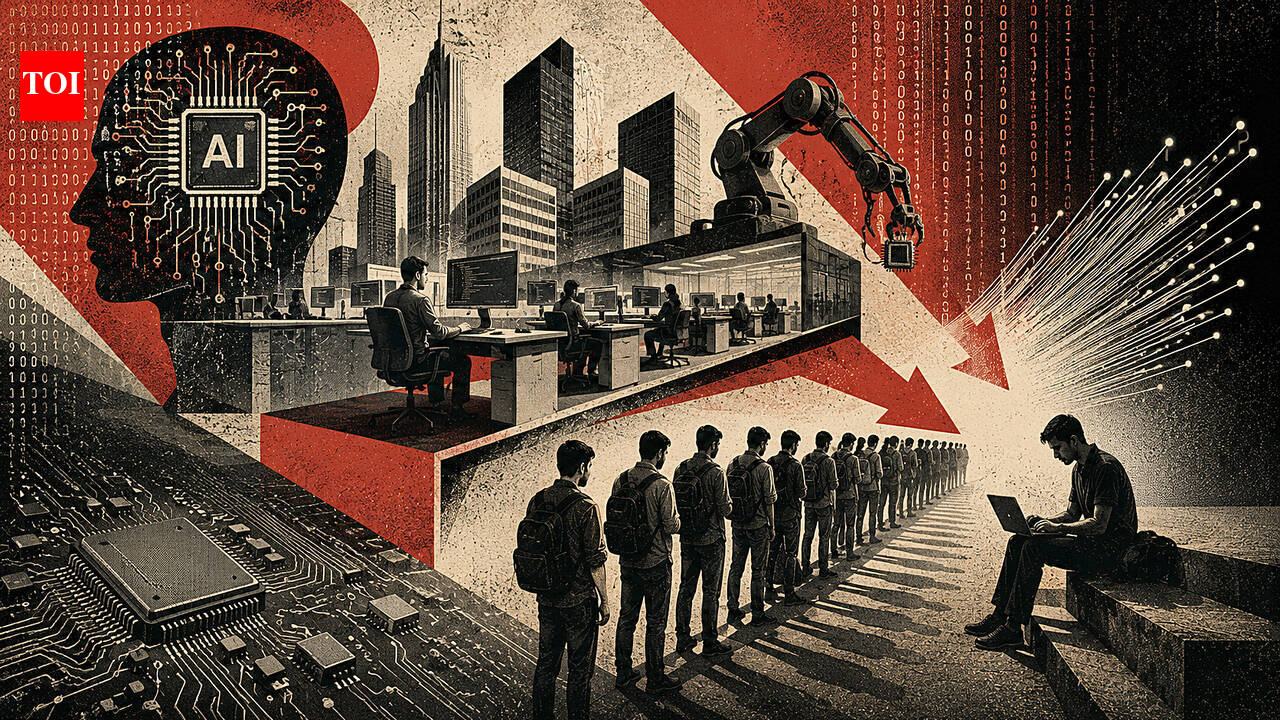
Tata Consultancy Services (TCS) chairman N Chandrasekaran said the IT industry will no longer hire at the scale seen over the past two decades as artificial intelligence takes over parts of traditional work, signalling a structural shift for India’s $315-billion technology sector.
“The company will not be hiring the kind of numbers it used to hire,” Chandrasekaran said at TCS’s 31st annual general meeting held virtually on Tuesday, according to a report by Times of India. He stated that AI agents would increasingly work alongside employees and could eventually match the size of the human workforce. “The company will have an equal number of AI workers—which we call AI agents—as there are employees. If the company has half a million employees, the day is not far when the company will have half a million AI agents,” he said.
Shift in Hiring and Workforce Composition
The remarks come as India’s IT services industry grapples with the implications of generative AI automating parts of software development, including testing and application maintenance—functions that have historically fuelled large-scale hiring by Indian IT firms. Chandrasekaran rejected the premise that AI would diminish the industry’s long-term prospects. “That does not mean there are no future opportunities. Once the transition happens, the AI world will produce many more opportunities. There will be new talent that will be required,” he said. He added that some work currently done by humans will shift to AI agents, describing it as “the nature of the transition that we have to go through not only as a company, but as an industry and as a country.”
Investor Concerns and Industry Performance
Investors have questioned the future of IT services in an AI-driven world, weighing heavily on technology stocks. According to Chandrasekaran, “India’s Nifty IT index fell more than a third. Globally, shares in technology services and platform companies plummeted.” Yet the industry’s operating performance tells a different story. “Margins have held. Revenues are up. The deal pipeline is stronger than ever. The business fundamentals have held,” he noted. He argued that investors are misreading the relationship between AI and IT services, calling AI “an infrastructure of intelligence” and “far from being a mortal threat, the most significant opportunity yet for enterprise IT.”
Five Growth Areas for IT Services
Chandrasekaran identified five major growth areas for IT services firms, which directly align with the needs of enterprise technology buyers in supply chain and logistics:
| Growth Area | Description |
|---|---|
| Modernizing legacy technology systems | Updating outdated IT infrastructure to support AI |
| Redesigning business processes around AI | Embedding AI into core operations |
| Governing AI agents | Ensuring safe and ethical deployment of AI workers |
| Building sovereign AI infrastructure | Creating national-level AI capabilities |
| Deploying AI in physical environments | Applying AI in factories, warehouses, and supply chains |
This last area is particularly relevant for logistics technology leaders, as it involves using AI for automation in physical operations such as warehousing, inventory management, and supply chain optimization.
Contrast: Paytm's Dual Strategy
In a separate development reported by Bloomberg, digital payments firm Paytm plans to hire about 4,000 employees over the next nine months as it expands its merchant network and accelerates investments in artificial intelligence. The recruitment drive, running through March next year, will focus on product, technology, AI, and leadership roles. The company has already added more than 800 employees over the past two months. At the same time, Paytm will trim about 1% of its workforce after the current appraisal cycle, affecting roughly 400 employees based on its current headcount of around 40,000. This dual approach of hiring in AI-focused roles while reducing headcount in other areas mirrors the broader industry shift toward AI augmentation.
Implications for Enterprise Technology Buyers
For CTOs and supply chain technology managers, Chandrasekaran's statements underscore the need to prepare for a workforce where AI agents operate alongside humans, especially in physical environments like warehouses and supply chains. The five growth areas provide a roadmap for technology procurement: investing in legacy modernisation, process redesign, AI governance frameworks, sovereign cloud infrastructure, and AI-powered automation in logistics. As TCS and other IT services firms pivot toward AI-driven services, enterprise buyers should expect new offerings that combine human expertise with AI agents, potentially reducing costs and improving efficiency in trade and logistics operations.
Sources: