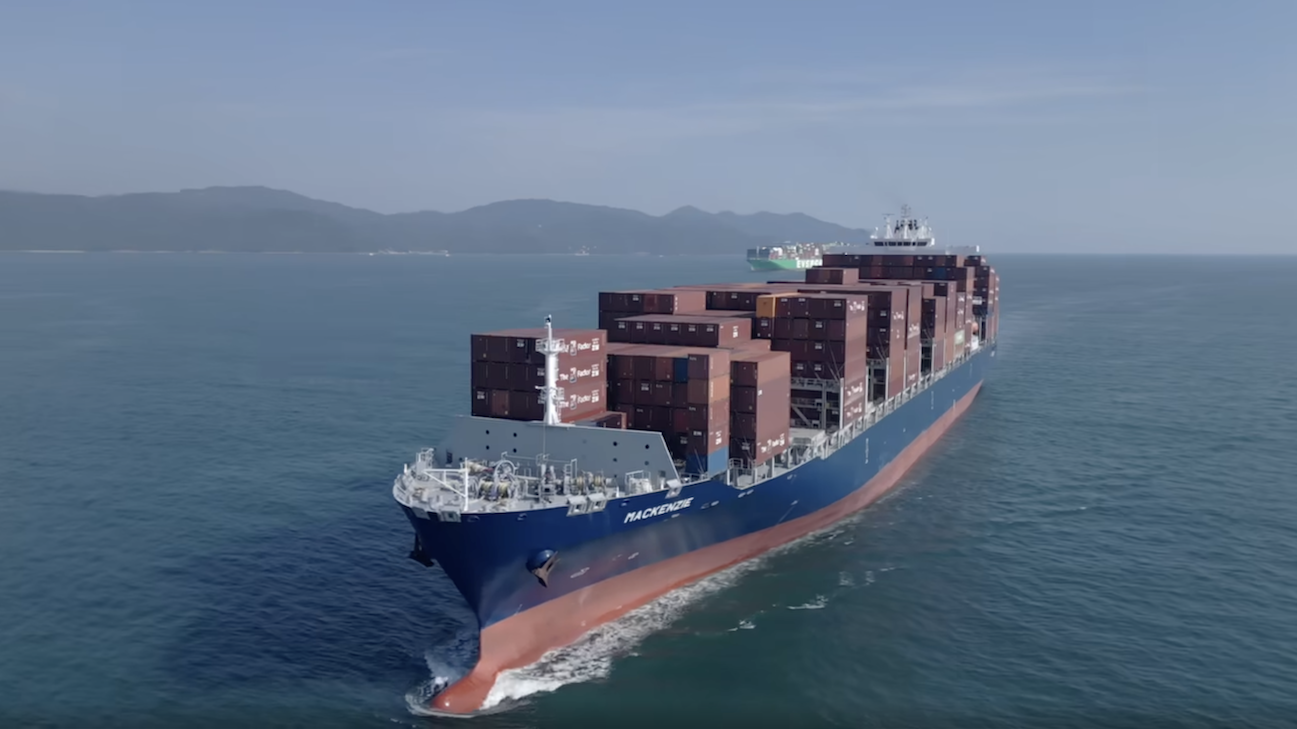
The global containership orderbook has reached roughly 38.7% of operating fleet capacity, a supply pipeline that is set to outpace container demand growth and could pressure ocean freight rates on mainline trade lanes, according to FreightWaves.
FreightWaves reported that the orderbook stands at approximately 13.1 million twenty-foot equivalent units (TEUs) against an operating fleet of about 33.8 million TEUs. Fleet growth this year is projected at about 4.2%, while container trade growth for 2026 is estimated at roughly 3% to 4%, meaning vessel supply is likely to grow faster than cargo demand once the orderbook delivers.
Orderbook-to-fleet ratio near 39%
Global Ship Lease of Athens, using Maritime Strategies International data as of June 30, estimated the orderbook-to-fleet ratio at 39.1% of the overall operating fleet, with more than half — 55.2% — for ships of 10,000 TEUs and larger, and 24.7% for smaller vessels. That puts the industry's greatest exposure in the large ships used on Asia-Europe, trans-Pacific and other arterial trades, according to FreightWaves.
Contracts in the second quarter alone for 164 vessels totaled approximately 866,000 TEUs, FreightWaves reported. The orderbook is heavily skewed toward large mainline vessels rather than feeders and smaller regional ships.
| Metric | Value | Detail |
|---|---|---|
| Global orderbook | ~13.1 million TEU | Against operating fleet of ~33.8 million TEU |
| Orderbook-to-fleet ratio | 38.7% / 39.1% | FreightWaves estimate / Global Ship Lease estimate |
| Ships 10,000+ TEU | 55.2% of orderbook | Largest exposure on Asia-Europe and trans-Pacific |
| Smaller vessels | 24.7% of orderbook | Feeders and intermediate segments |
| Q2 2026 newbuild contracts | 164 vessels / ~866,000 TEU | Contracts signed in second quarter alone |
| Q2 orders in 1,000–2,000 TEU range | 31.5% of vessels ordered | Active feeder segment |
Supply growth vs. demand
FreightWaves reported that current estimates suggest container trade growth of approximately 3%–4% in 2026, against full-year fleet growth of roughly 4.2%, with potentially stronger supply growth in 2027–2029 as deliveries accelerate. While those numbers may prompt fears of weaker rates, capacity is affected by slow steaming, port congestion, vessel idling, blank sailings, network changes and geopolitical diversions.
The continuing avoidance of the Red Sea, for example, has absorbed more than 2 million TEUs per year since 2023 by adding miles and voyage days, according to FreightWaves. The MPC report estimates that a return to the Suez route could release an effective-capacity increase equivalent to roughly 12% more TEU-miles. FreightWaves noted that a number of carriers this year have redeployed scheduled rotations to the route despite renewed violence against merchant shipping by Houthi rebels based in Yemen.
Newbuild geography and fuel choice
China continues to dominate containership newbuilding activity, with Chinese yards securing most of the new contracts in Q2 2026, while South Korean yards obtained only 10 orders, according to MPC. On the fuel side, one recent industry estimate places alternative-fuel ships at approximately 65% of the existing containership orderbook by TEU capacity. However, Clarksons data cited by MPC indicates that most of the new orders placed during Q2 itself were conventionally fueled, with relatively few vessels propelled by liquefied natural gas.
The broad trend, FreightWaves reported, is that the existing orderbook contains a substantial number of LNG-, methanol- or otherwise alternative-fuel-capable vessels, but ordering momentum in 2026 has become more cautious as owners weigh fuel availability, regulation and technology uncertainty.
Who is ordering the ships
The orderbook is being driven mainly by the liner companies and their affiliated or associated tonnage providers, with large carriers ordering vessels to defend or expand market share, according to FreightWaves.
Segment-level outlook: big ships exposed, feeders firm
While the large-ship pipeline creates fleet-growth risk, the feeder and intermediate sectors have a more favorable supply picture. Q2 ordering was active in the 1,000–2,000 TEU range, but that still does not create the same fleet-growth risk as the large-ship pipeline because the existing small- and medium-sized fleet is older and has experienced relatively little replacement, according to FreightWaves.
Global Ship Lease estimates that the median age of the oldest 25% of vessels in several sub-10,000-TEU segments is between 21 and 28 years, and that if vessels older than 25 years were scrapped, the implied net growth of the sub-10,000-TEU fleet through 2030 would be only about 0.7%. Charter markets for modern feeders and intermediate vessels remain relatively firm; MPC similarly describes modern feeder tonnage as scarce, with ordering concentrated in larger vessel classes and the existing fleet aging.
Implications for shippers and operators
For freight forwarders, 3PL operators and ocean carriers, the orderbook skew toward large mainline ships puts downward pressure on rates in Asia-Europe, trans-Pacific and other arterial trades as deliveries arrive, according to the data assembled by FreightWaves. The relatively small sub-10,000-TEU fleet growth, by contrast, points to continued tightness in feeder and intermediate charter markets, which could keep regional repositioning costs elevated. The concentration of newbuilding in Chinese yards and the cautious 2026 ordering pace also signal that the fuel transition remains unresolved, with owners holding back on LNG, methanol and other alternative-fuel commitments until regulation and fuel availability become clearer.
Watch list
FreightWaves highlighted several factors that could change the supply-demand balance: the pace of deliveries in 2027–2029, the trajectory of the Red Sea situation — a return to Suez could release an effective-capacity increase equivalent to roughly 12% more TEU-miles — and whether scrapping of vessels older than 25 years tightens the sub-10,000-TEU fleet, which would limit net growth in that segment to about 0.7% through 2030.
Sources: