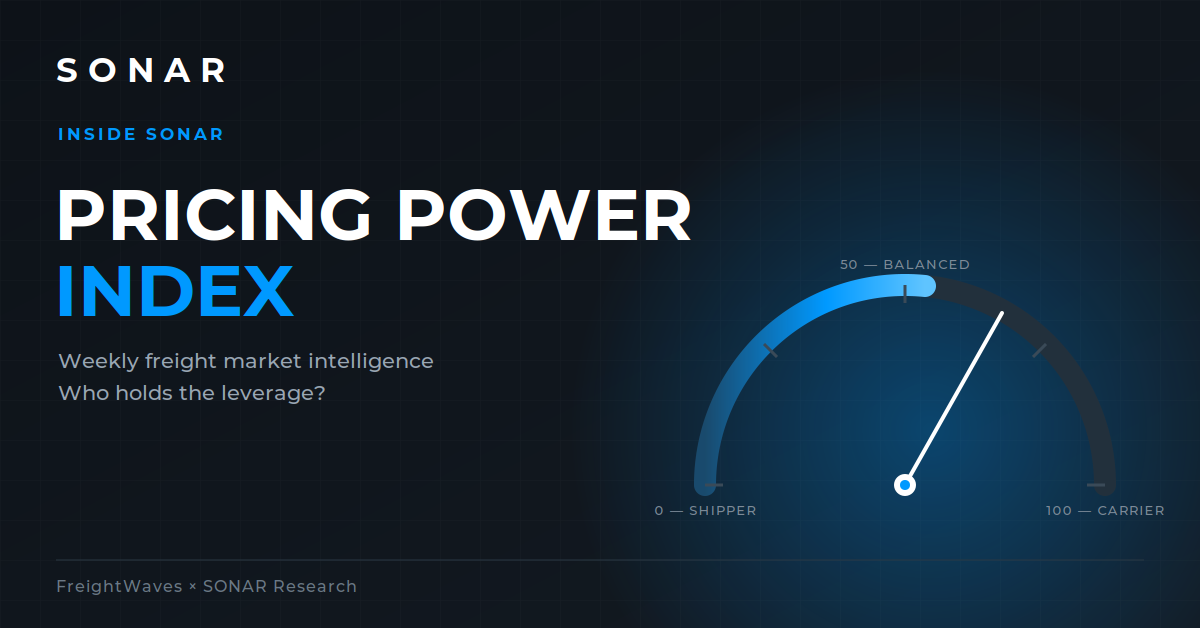
According to FreightWaves, carrier pricing power is losing ground: SONAR's Pricing Power Index (PPI) has slid for five consecutive weeks since peaking in mid-July, as capacity eases and demand signals that had been running hot cool off. For shippers, freight forwarders and 3PLs, that shift points to improving negotiating leverage; for carriers and ocean lines, it raises the stakes on peak-season timing and bid strategy.
The PPI, produced weekly by SONAR's Research team, condenses the entire freight market into a single 0–100 score that answers one question: is pricing power sitting with carriers or shippers right now? According to FreightWaves, the index is a direct-weighted, data-driven composite of eight SONAR metrics — tender rejections, accepted volume, rail volume, ocean TEU bookings, spot rates, van contract rates, the spot/contract spread, and intermodal contract rates. Each is ranked against five years of its own weekly history, then combined into one number. A reading of 50 marks a historically balanced market; above that, leverage tilts toward carriers, and below it, toward shippers.
What This Week's PPI Reading Shows
The PPI has been on a five-week slide since peaking in mid-July, FreightWaves reported. Capacity has eased, and two demand signals that had been running hot — rail volume and ocean import bookings — have cooled off. The spot-to-contract spread, which hit a record high just one month ago, has narrowed sharply in recent weeks. The companion three-month outlook, which applies the same methodology to a 90-day-forward projection, has also pulled back and now converges much closer to the current reading than it was diverging a few weeks ago.
| Signal | Recent trend (per FreightWaves) |
|---|---|
| Pricing Power Index | Five-week slide since mid-July peak |
| Rail volume | Cooled off after a hot stretch |
| Ocean import bookings | Cooled off after a hot stretch |
| Spot-to-contract spread | Narrowed sharply after a record high a month ago |
| Three-month PPI forecast | Pulled back, converging toward current reading |
What It Means for Shippers and Carriers
For shippers, forwarders and 3PLs, the slide suggests that the leverage carriers held in the mid-July market is softening. One month ago, carriers negotiated from a spot-to-contract spread at a record high; that negotiating cushion has now narrowed. For carriers, the question is whether this is a genuine rebalancing ahead of peak season or a seasonal pause before conditions retighten. FreightWaves noted that resolving that question is exactly the kind of analysis the PPI is built to support, and it is covered in full in this week's release.
Operationally, the cooling of ocean import bookings and rail volume reinforces that the demand signal spans both domestic trucking and international container movements. Shippers should consider current spot-market conditions before locking in long-term contract rates, while carriers may want to hold capacity commitments flexible until the three-month forecast direction becomes clearer.
Where to Find the Weekly PPI
The Weekly Pricing Power Index publishes every week through two channels, according to FreightWaves:
- FreightWaves Market Monitor (getfreightdata.com) — full access to the PPI release for $199 per month.
- SONAR platform Research library — enterprise SONAR customers can pull up every PPI release, plus the full research archive, from the clock icon in the platform's upper-right menu under Research (https://sonar.surf/research-library).
FreightWaves also promoted three upcoming industry events in Chattanooga, TN, around the F3 Future of Freight Festival: a Brokerage Compliance Symposium covering fraud exposure, carrier liability, FMCSA rules, cargo theft and insurance gaps; the F3 Awards Dinner honoring FreightTech100 companies and revealing FreightTech 25 and Shipper of Choice winners; and the F3 Future of Freight Festival itself, with keynotes, technology demos and networking.
Watch List
- Peak-season direction: Whether the five-week slide continues or reverses as peak season approaches.
- Ocean TEU bookings and rail volume: If these demand signals re-accelerate, carrier leverage could rebuild.
- Spot-to-contract spread: After its record high a month ago, further narrowing would reinforce a shipper-friendly market.
- Three-month forecast: A forecast that stays converged with the current reading signals balance; renewed divergence could point to a shift.
Sources: