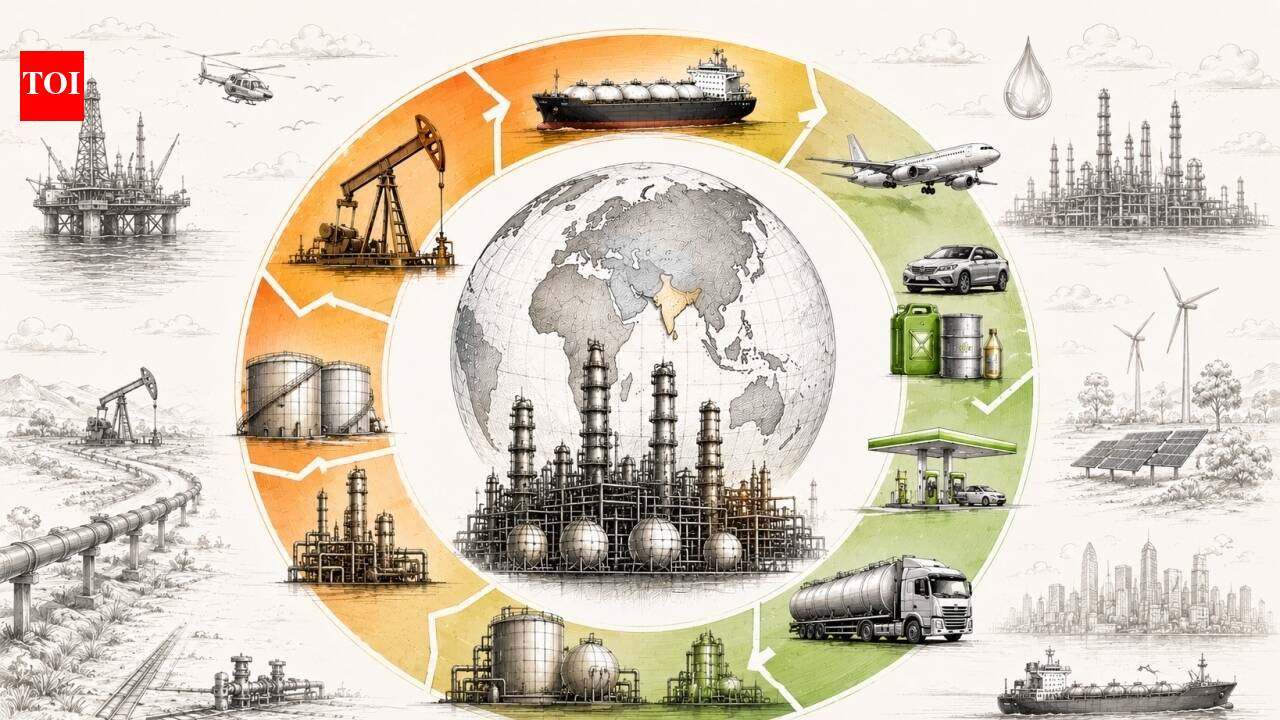
India is fast emerging as a new ‘swing supplier’ of refined oil products, with its export map expanding rapidly while the Middle East crisis disrupts global fuel flows, according to Business-Today. Singapore became India’s largest refined-product export destination at $4.3 billion, followed by Tanzania at $2.2 billion and the Netherlands at $2 billion. The growth is powered by refinery outages in Russia, logistical disruptions in the Middle East and lower fuel exports from China.
Export map reshaped by supply disruptions
The ongoing Middle East crisis has reshaped India’s oil-product export markets, with Italy and Spain among the fastest-growing destinations, and Singapore and Tanzania overtaking several traditional buyers, Business-Today reported. Tanzania and South Africa have entered the top 10. Among countries importing nearly $1 billion or more from India, Tanzania, Jordan and Sri Lanka saw strong growth, driven largely by higher oil-product shipments amid supply disruptions, although higher prices also boosted export values.
| Destination | Refined-product export value |
|---|---|
| Singapore | $4.3 billion |
| Tanzania | $2.2 billion |
| Netherlands | $2.0 billion |
Oil products now account for a much larger share of India’s exports to several destinations, and Singapore has also become India’s third-largest goods export destination overall, the report noted.
Refining capacity gives India the edge
According to government data cited by Business-Today, India is the world’s third-largest crude oil importer, fourth-largest refiner, and fifth-largest exporter of petroleum products. The country has about 258.1 million tonnes of installed refining capacity across 23 refineries and is the fourth-largest refining centre globally, after the US, China and Russia.
Refining capacity is expected to rise from 258.1 million tonnes to about 309.5 million tonnes, with capacity set to increase by 800 thousand barrels per stream day by 2028. The start-up of the Barmer refinery and upcoming upgrades at state-owned refineries will strengthen India’s position as a major petroleum-product exporter, Business-Today reported.
According to Pankaj Srivastava, Senior Vice President, Commodity Markets-Oil at Rystad Energy, this contrasts with China’s strategy: while China is expanding petrochemical capacity to support its solar and EV industries and boost petrochemical exports, India remains focused on leveraging its refining infrastructure to expand fuel production and exports.
Discounted Russian crude and product cracks
Experts acknowledge that discounted Russian crude is giving Indian refiners a competitive edge, but that is not the sole driver of the record exports, Business-Today reported. Expanding capacity and strong product cracks encourage refiners to capitalise on favourable global markets, while domestic fuel-pricing constraints weigh on realisations for oil-marketing companies; product exports therefore provide a valuable hedge against losses.
"Reliance Industries' Jamnagar complex remains the one of the world's largest and most complex single-site refineries and accounts for roughly 70% of India's refined fuel exports. This gives India a level of export flexibility that few refining hubs can match," according to Praveen Rai, Director, Grant Thornton Bharat.
A structural shift — but can it last?
During 2023-24, India was the largest supplier of refined fuels to the European Union, overtaking Saudi Arabia, the report said. Recent refinery expansions, coupled with consistently high operating rates, have enabled India to capitalise on a global supply gap created by refinery outages in Russia, logistical disruptions in the Middle East, and lower fuel exports from China.
Business-Today poses the question directly: can India sustain its new position as a major swing player in global refined oil product markets? The structural factors it identifies — expanding refining capacity, the flexibility of the Jamnagar complex, cheap Russian crude and strong product cracks — remain firmly in place, although the report does not provide a definitive answer on how long the supply gaps will persist.
Sources: